About Processa edulis (Risso, 1816)
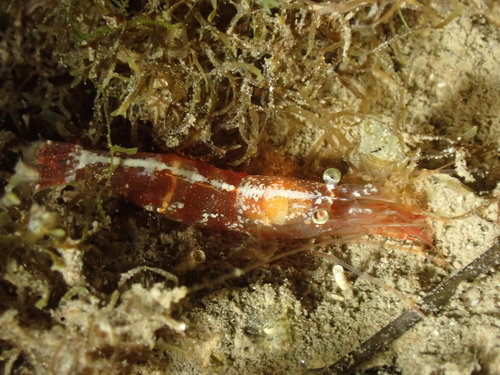
Processa edulis is a moderate-sized shrimp. Males of the species grow between 12 and 34 mm (0.47 to 1.34 in) in length, while females reach 25 to 52 mm (0.98 to 2.05 in). Its rostrum is short, does not extend past the eyes, and ends in a tooth and a point. The first two pairs of its legs are asymmetrical. The first leg has a claw on the left side and a clamp on the right. The second leg has a clamp on both sides, but the left leg is longer than the right. This shrimp is white during the day, and turns pink or red at night, scattered with tiny white spots that are its chromatophores. Astaxanthin and its derived esters are the main pigments that produce this red coloration.
Processa edulis is distributed in the eastern Atlantic Ocean between 55° and 33° North, as well as in the North Sea, the English Channel, the Mediterranean Sea and the Black Sea. It is a shallow water species found on soft bottoms in seagrass beds and among eelgrass. It is common in Posidonia beds in the English Channel, and is sometimes found among seaweeds that grow on sandy seabeds. By day, it hides among foliage or buries itself in sand, and emerges at night to feed.
Processa edulis eats small invertebrates including nematodes, polychaete worms, amphipods, isopods, ostracods, decapod larvae, foraminifera, molluscs and fish eggs. It occasionally consumes diatoms, fragments of seagrass and fragments of seaweed. An analysis of stomach contents from specimens collected near the Ebro Delta found a negligible amount of plant matter, which led to the hypothesis that Processa edulis is exclusively carnivorous, and that any plant material it consumes is ingested by accident. It tears apart prey using its asymmetric front legs. Although this shrimp is edible, it has been little studied. This may be because it is only caught when trawling occurs at night.
This shrimp is thought to be a protandric hermaphrodite, meaning it starts life as a male and becomes female as it grows larger. This idea is supported by the appearance of large numbers of moderate-sized females in mid-July, which occurs at the same time that the number of males drops sharply. At any time of year, small females are very rare. The few small females that are recorded may actually be undifferentiated juveniles, and large males do not exist at all. Breeding occurs between March and September, and multiple batches of eggs are laid during this period. The female attaches her eggs to her abdominal legs. The eggs are green when first laid, and turn grey before hatching three to four weeks later. The planktonic larvae develop over an additional three to four weeks before settling on the seabed to undergo metamorphosis into juvenile shrimps.

