About Procellaria westlandica Falla, 1946
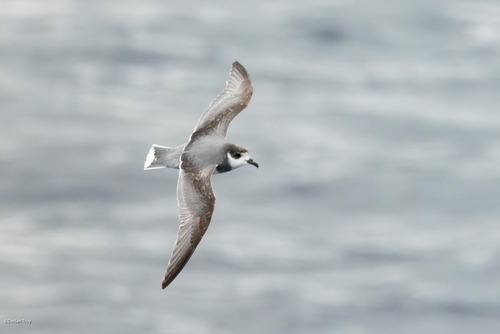
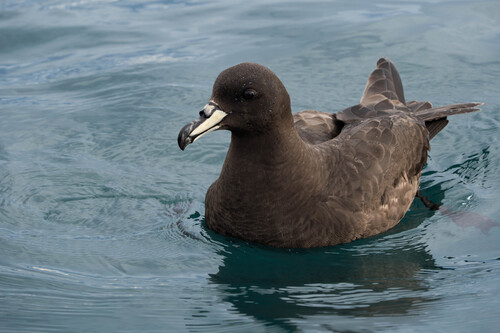
Procellaria westlandica Falla, 1946, commonly known as the Westland petrel, is a stocky seabird. Adult individuals weigh around 1,100 grams (39 oz), and are entirely dark blackish-brown with black legs and feet. A small number of individuals may have a few white feathers. Their bill is pale yellow with a dark tip. When Falla first described the species, he noted that males are slightly larger in measurement than females, although the female specimen he measured weighed slightly more than the male. It is one of the largest burrowing petrel species. Falla also described the species' eggs, which are white, smooth, non-glossy, and generally similar to the eggs of most other petrels. Egg shape ranges from elongate pyriform to ovate, and fresh eggs have an average weight of about 4 oz. Moulting takes place during the non-breeding season, between October and February, while the species migrates to South America. Immature birds moult earlier than older individuals. The Westland petrel is endemic to New Zealand. It spends most of its life at sea, only returning to land to breed, and breeds only in a small region of the South Island's West Coast. Its breeding range covers an 8 km (5.0 mi) wide strip between Barrytown and Punakaiki, stretching specifically from the Punakaiki River to Waiwhero (Lawson) Creek. Breeding colonies are located on forest-covered coastal foothills, within Paparoa National Park, other conservation lands, land owned by Forest and Bird, or private land. The combined total area of all breeding colonies is only about 16 hectares (40 acres). During the breeding season, adults can be found in waters around New Zealand from Cape Egmont to Fiordland in the west, through Cook Strait, and from East Cape to Banks Peninsula in the east. They also range across areas of the Pacific Ocean and Tasman Sea around the subtropical convergence. In the non-breeding season, they migrate east to waters off South America, and feed in the Humboldt Current, often occurring in waters west of the Chilean coast. Individuals typically stay solitary during this period, rejoining the colony when the next breeding cycle begins. The Westland petrel is one of the few remaining petrel species that nest on the mainland. Their large size and aggressive behaviour help them resist predators that would attack smaller petrel species. They nest in burrows dug 1 to 2 metres into steep hillside slopes. There are around 29 breeding colonies within the breeding territory, each holding between 50 and 1000 burrows. Colonies are located from 50 to 200 metres (160 to 660 ft) above sea level. Westland petrels are winter breeders. They arrive at breeding grounds annually in late March or early April to prepare their burrows for nesting. Colonies are very vocal for around three weeks before nesting, which is the period when courtship and mating take place. This species can form lifetime pair-bonds. The female lays a single egg between May and June, which hatches two months later between August and September. Both the male and female take turns incubating the egg. After hatching, parents care for the chick for roughly two weeks. After this period the chick is left alone, and is fed at night. If either parent dies before the chick is nearly ready to fledge, the chick will not survive. Fledging occurs 120 to 130 days after hatching. It starts in early November, peaks around 20 November, and finishes in mid-January. In total, chick rearing takes between 177 and 198 days, approximately 6 to 6.5 months. After leaving nesting sites, fledglings may not return for up to 10 years.