About Procellaria parkinsoni G.R.Gray, 1862
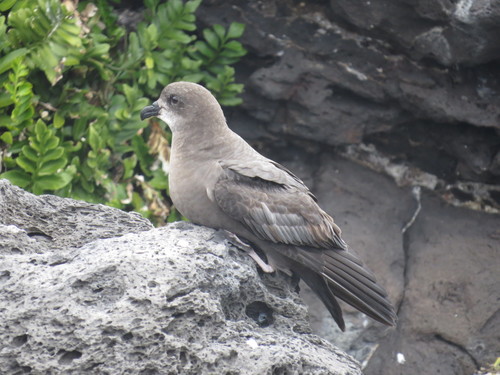
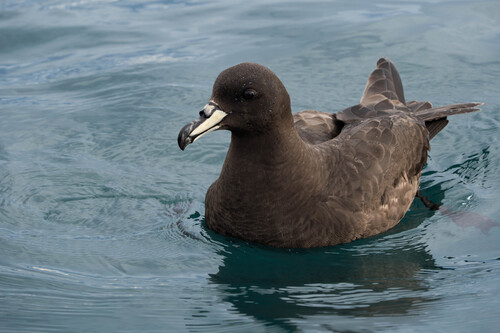
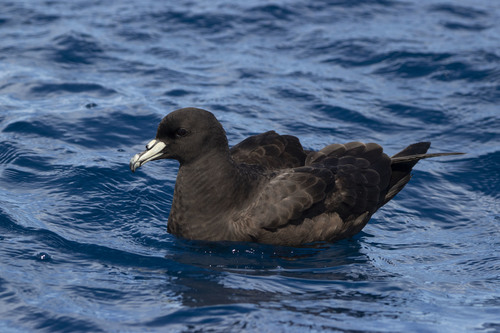
This species, commonly called the black petrel, has entirely black plumage, black legs, and a black bill that only has pale sections. It is a medium-sized petrel: males average roughly 720 g (25 oz), while females average around 680 g (24 oz). It has a total length of 46 cm (18 in), and its wingspan averages 115 cm (45 in). The black petrel is endemic to New Zealand. Historically, it ranged across the North Island and Northwest Nelson in the South Island, but introduced predators (feral cats and pigs) caused its extinction on the New Zealand mainland starting around the 1950s. It is frequently sighted in the outer Hauraki Gulf between October and May. Currently, breeding is limited to two colonies: a main colony on Great Barrier Island, which hosts around 5000 birds over summer (including approximately 1300 breeding pairs and 1000 pre-breeders searching for mates), and a small colony of about 250 birds on Little Barrier Island. Outside of the breeding colonies, an additional 6000 juvenile, pre-breeding, and non-breeding black petrels live at sea. When not breeding, black petrels can range from the east coast of Australia all the way to the coast of South America, spanning the area between Mexico, Peru, and the Galapagos Islands. Male and female black petrels forage in separate locations; the reason for this separation is unknown. While incubating eggs and raising chicks during summer and autumn, black petrels forage much closer to the Hauraki Gulf, mainly in the Tasman Sea and to the north-east of New Zealand.