About Procapra picticaudata Hodgson, 1846
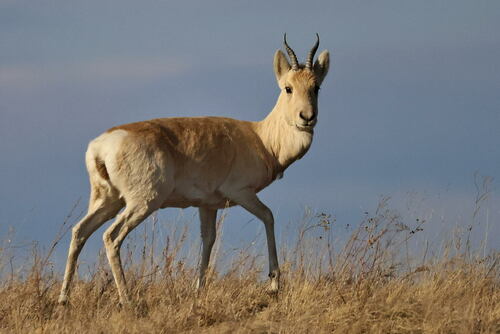
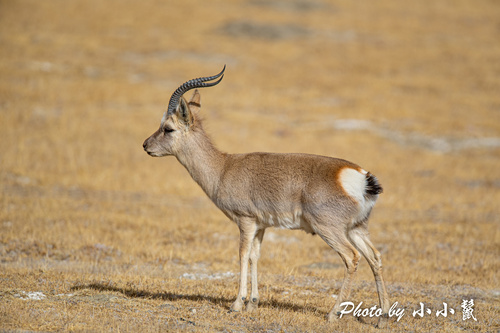
Procapra picticaudata, commonly called the goa, is a relatively small, slender, graceful antelope. Both sexes measure 54 to 65 centimetres (21 to 26 inches) tall at the shoulder, 91 to 105 cm (36 to 41 in) in head-body length, and weigh 13 to 16 kg (29 to 35 lb). Males have long, tapering, ridged horns 26 to 32 cm (10 to 13 in) long. The horns sit close together on the forehead, rising almost vertically before suddenly diverging toward the tips. Females do not have horns, and neither sex has distinct facial markings. Most of the goa's body is grayish brown; its summer coat is noticeably greyer than its winter coat. It has a short, black-tipped tail positioned in the center of its heart-shaped white rump patches. Its fur has no undercoat, and is made up only of long guard hairs; it is notably thicker during winter. The goa appears to have excellent senses, including sharp eyesight and hearing. Its long, thin legs improve its running ability, which it uses to escape predators. The goa is native to the Tibetan Plateau, where it is widespread. It inhabits terrain at elevations between 3,000 and 5,750 m (9,840 and 18,860 ft). It is almost entirely restricted to the Chinese provinces of Gansu, Xinjiang, Tibet, Qinghai, and Sichuan, with only tiny populations found in the Ladakh and Sikkim regions of India. No distinct subspecies of the goa have been reported. Its primary habitats are alpine meadow and high elevation steppe. It is scattered widely across its range, occurring as numerous small herds spread far apart. Estimated population density ranges from 2.8 individuals per square kilometer to less than 0.1, depending on the local environment. Unlike some other ungulates, goas do not form large herds, and are typically found in small family groups. Most goa groups include no more than 10 individuals, and many goas are solitary, though they occasionally gather into larger groups. They have been observed making short cries and calls to alert the herd when a predator or other perceived threat approaches. Goas feed on a variety of local vegetation, primarily forbs and legumes, with smaller amounts of grasses and sedges supplementing their diet. Their main native predators are the Himalayan wolf and the snow leopard. For most of the year, male and female goas stay separate, and females graze at higher elevations than males. Females descend from their high-altitude pastures around September, before the December mating season. During the rut, males are largely solitary. They scent mark their territories, and sometimes butt or wrestle with rival males using their horns. Gestation lasts around six months, and a single young is born between July and August. Infants stay hidden with their mother for the first two weeks of life before rejoining the herd. The age of sexual maturity for goas is unknown, but it is probably around 18 months. Goas have lived up to five years and seven months in captivity.