About Procambarus clarkii (Girard, 1852)
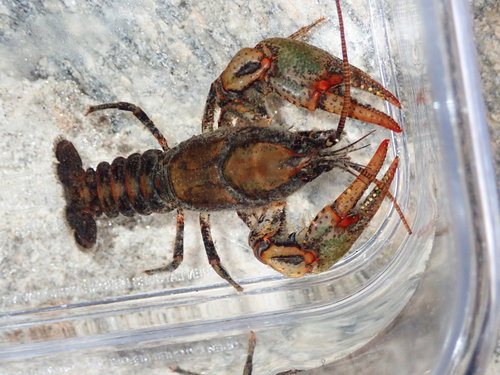
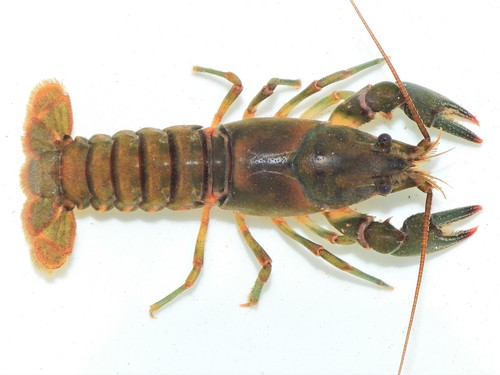
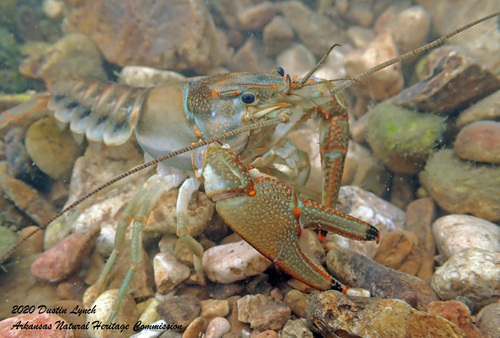
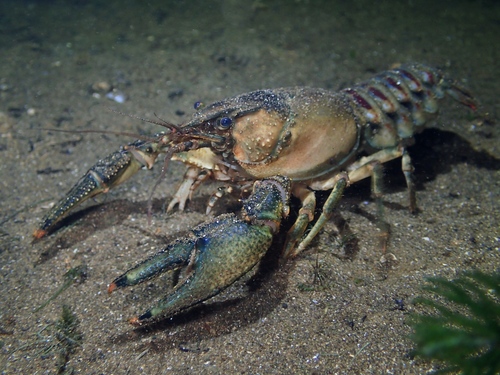
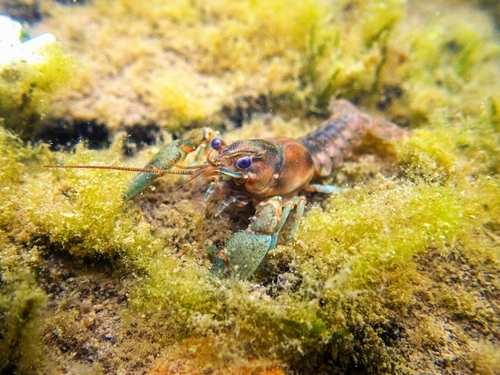
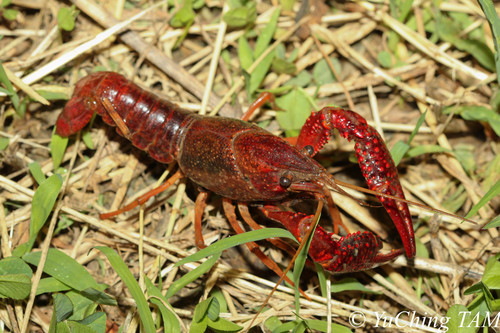
Procambarus clarkii, commonly called the red swamp crayfish, Louisiana crawfish, or mudbug, is a species of cambarid crayfish. It is native to freshwater habitats in northern Mexico, and southern and southeastern United States, but has been introduced to other regions across North America and other continents, where it frequently acts as an invasive pest.
The native range of P. clarkii extends from northern Mexico and far southeastern New Mexico, through the Gulf States to the Florida Panhandle, and inland north along the Mississippi Basin to southern Illinois. It has been introduced outside this natural range, sometimes intentionally, to countries in Asia, Africa, Europe, and other parts of the Americas. In northern Europe, its populations maintain themselves but do not expand, while in southern Europe, the species multiplies and actively colonizes new areas, displacing native crayfish species Astacus astacus and Austropotamobius spp. In some regions, it lives in sympatry with another invasive crayfish, Pacifastacus leniusculus. Individual P. clarkii can cross many miles of relatively dry ground, especially during wet seasons, though the aquarium trade and anglers have likely accelerated its spread in some areas – for example, anglers using P. clarkii as fishing bait are thought to have introduced the species to the U.S. state of Washington. Attempts to use P. clarkii as a biological control to reduce populations of snails that carry schistosomiasis have also led to the species being dispersed in places such as Kenya.
P. clarkii is most often found in warm freshwater bodies like slow-flowing rivers, marshes, reservoirs, irrigation systems, and rice paddies. It is considered the most ecologically plastic species in the order Decapoda, able to grow quickly even in water that is only present seasonally, and can tolerate dry periods of up to four months. P. clarkii grows quickly, and can reach weights over 50 g (1.8 oz) and total lengths of 5.5–12 cm (2.2–4.7 in). Unlike most crayfish, it can also tolerate slightly saline water, and can withstand relatively low concentrations of dissolved oxygen. The average lifespan of P. clarkii is five years, though some wild individuals have been recorded living over six years.
The burrowing behavior of P. clarkii can damage water courses and crops, especially rice, and its feeding habits can disrupt native ecosystems. It can outcompete native crayfish species, and acts as a vector for the crayfish plague fungus Aphanomyces astaci, the crayfish virus vibriosis, and a number of parasitic worms that infect vertebrates. Its burrowing may also threaten civil infrastructure such as storm ponds and levees.
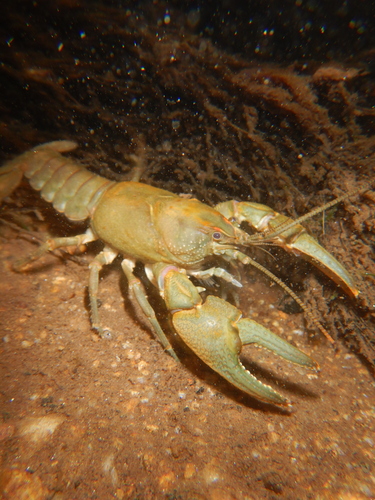
In 2007, troglomorphic (cave-adapted) specimens of P. clarkii were found in central Portugal, in karst springs of the Rio Anços in the Sicó massif and of the Alviela River in the Estremenho massif. In 2011, another cave-dwelling population was discovered in caves in the San Giuliano Terme municipality, Province of Pisa, Italy. Both locations have karst landscapes with extensive cave formations. The entire Portuguese population lacks pigmentation, though pigmented specimens live in nearby surface streams; the deepest recorded cave specimen was a male recovered from 240 metres (790 ft) deep. 53% of the Italian specimens have blue-white coloration. The higher share of pigmented individuals in Italy suggests either a more recent colonization of the caves, an external source of carotenoids, or movement between surface and underground waters. These populations are the first recorded cases of troglodytic (cave-dwelling) crayfish in Europe. As an invasive species, this crayfish threatens native stygobitic (subterranean) cave fauna, due to its generalist feeding habits and the extremely limited ranges of native cave species.
Procambarus clarkii normally reproduces sexually, but research indicates it may also reproduce via parthenogenesis.
P. clarkii is used as food in China, Cambodia, Thailand, Europe, Africa, the United States, Canada, Australia, New Zealand, and the Caribbean. In the United States, it is especially popular in Louisiana, where common culinary names include "crawfish", "crayfish", "crawdaddy", or "mudbug", and crawfish boils are popular social gatherings centered on eating this crustacean. Louisiana crawfish are typically boiled in a large pot with heavy seasoning (salt, cayenne pepper, lemon, garlic, bay leaf, and others) alongside other foods such as potatoes and corn on the cob. Many different seasoning methods exist, and there are many competing opinions on which method is correct. In 1990, Louisiana produced 90% of the world's P. clarkii harvest and consumed 70% of that production locally. By 2003, however, Asian fish farms and fisheries produced more P. clarkii than any other region, and have continued to lead global production. By 2018, P. clarkii production in the Americas made up only 4% of the total global supply of the species. Louisiana P. clarkii remains in demand for local production and consumption, and in 2018, 93% of all crayfish farms in the United States were located in Louisiana.