About Probosciger aterrimus (Gmelin, 1788)
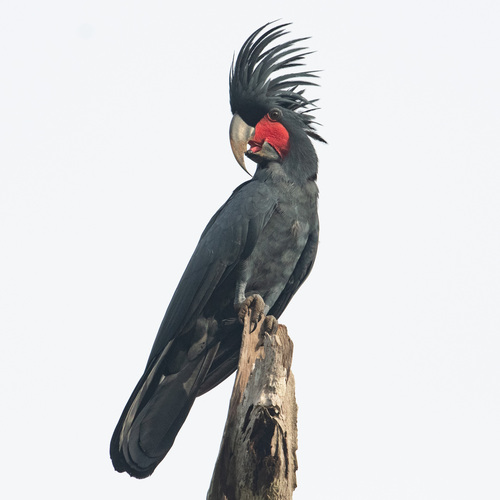
The palm cockatoo, scientifically named Probosciger aterrimus, is 55 to 60 cm (22 to 24 in) long and weighs 910–1,200 g (2.01–2.65 lb). It may be the largest cockatoo species and largest parrot in Australia, though large races of yellow-tailed black cockatoos and sulphur-crested cockatoos broadly overlap in its size range. It is a distinctive bird with a large crest and one of the largest bills of any parrot; only the hyacinth macaw has a larger bill. This powerful bill allows palm cockatoos to eat very hard nuts and seeds, and also lets males break off thick sticks, approximately 2.5 cm (1 inch) thick, from live trees to use for drumming displays. Males have larger beaks than females. The beak is unusual: for much of its length, the lower and upper mandibles do not meet, which lets the tongue hold a nut against the top mandible while the lower mandible cracks it open. The palm cockatoo also has a distinctive red cheek patch that changes colour when the bird is alarmed or excited. The subspecies P. a. goliath and P. a. stenolophus are larger than the nominate subspecies, and P. a. stenolophus also has narrower crest feathers. Palm cockatoos live in rainforests and woodlands of New Guinea and Cape York Peninsula, Queensland, Australia. They can still be found near Sorong, West Papua, Indonesia, where they are sometimes seen in trees along roads. Palm cockatoos have a unique territorial display: typically the male drums with a large stick or seed pod (up to 2.5 cm in diameter and 15 cm long) against a dead bough or tree, producing a loud noise that can be heard up to 100 m away. After drumming, the male occasionally strips the drumming tool into small pieces to line the nest. Although this drumming behaviour was discovered over three decades ago, in 1984 by G.A. Wood, the reason palm cockatoos drum is still not understood. One hypothesis is that females can assess the durability of the nesting hollow from the resonance of the drumming. Another possibility is that males drum to mark their territory against other males. The palm cockatoo is an unusual ancient species, and one of the few bird species known to use tools. Palm cockatoos usually feed during the early hours of the day. Their diet consists mostly of wild pandanus palm fruits and kanari tree nuts. They have also been observed eating fruits of Darwin stringy bark and the nonda tree, as well as seeds from the cocky apple tree, beach almond, and black bean tree.