About Proboscidea louisianica (Mill.) Thell.
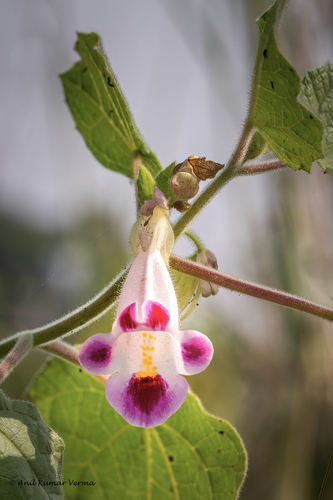
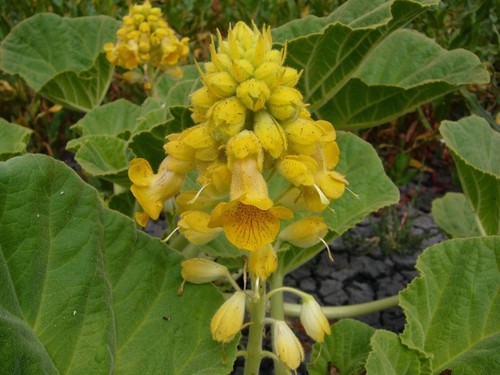
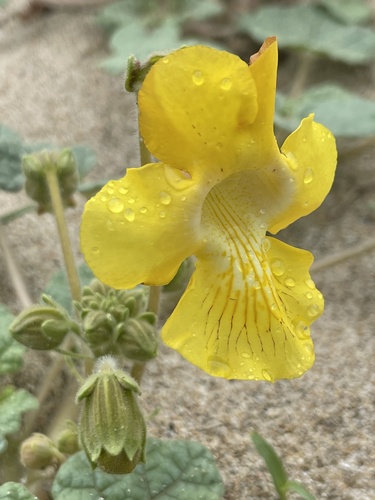
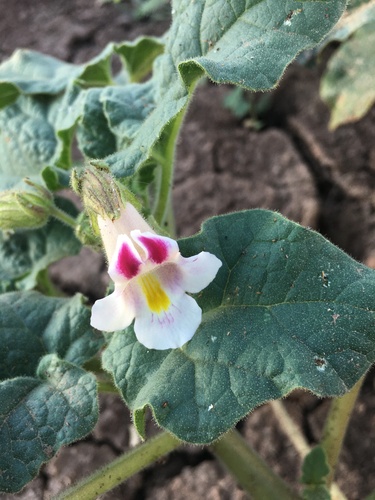
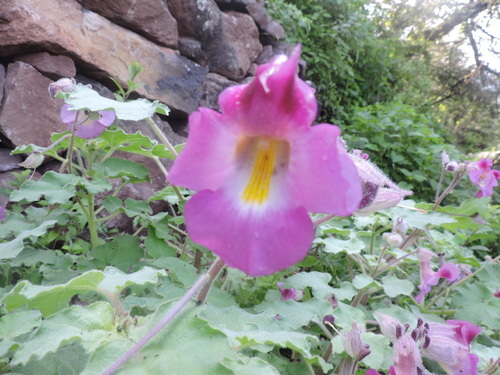
Proboscidea louisianica (Mill.) Thell. is an annual herb with spreading stems that can reach up to around 900 centimeters in length. Its ovate leaves are arranged oppositely, and their blades can grow up to 30 centimeters wide. All above-ground plant parts are covered in glandular hairs that hold tiny oil droplets, which give the plant an oily texture and a strong scent. The essential oil evaporates into the air, leaving a distinct acrid odor across the landscape where the plant grows. The lobed flower corolla can come in a range of colors: lavender, purple-cream, yellowish with purple spots, or dull white to somewhat pinkish purple. All variations have yellowish nectar guides, and may or may not have purple blotches. A single plant can produce up to 80 fruits. The fruit is a dehiscent capsule that reaches up to 10 centimeters long, ending in a long, narrow, curving beak. As the fruit dries and its flesh falls away, the hard beak splits into two horns that can grow up to 30 centimeters long. Seeds can be black or white; white-seeded plants are more common in cultivation. The seeds contain over 43% oil by content. In terms of ecology, this plant rarely self-pollinates. It is pollinated by bees, and recorded bee species found on the plant include Melissodes communis, Svastra obliqua, Anthophora occidentalis, Augochlorella striata, Bombus fervidus, Bombus pensylvanicus, and Lasioglossum species. For uses, the young green fruits are edible and can be pickled. Native Americans used the seeds of this plant as food. Like other Proboscidea species, the dry fruits were very useful for Native American basketry: the dry horns could be added to baskets to create patterns, or used as sewing implements. The dry fruits also produce a black dye, especially when mixed with ash. Recorded use of this species in basketry exists for the Hopi, Apache, Havasupai, and Kawaiisu peoples. The Tohono O'odham domesticated this species and used its dark dry fruit to create black-colored patterning in basketry designs. Many other groups likely cultivated and used this plant, but historical records of use rarely distinguish between different Proboscidea species used. Today, this plant is grown as an ornamental, a garden novelty, and used in floral arrangements. It is cultivated using methods similar to those used for okra.