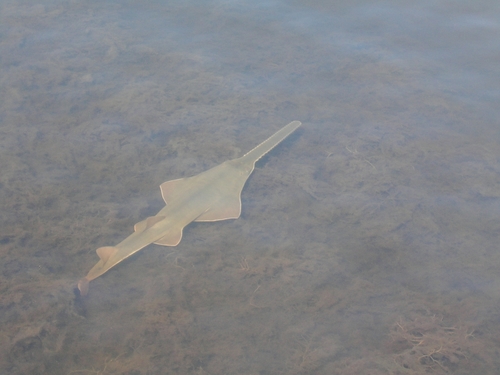
About Pristis pectinata Latham, 1794
The smalltooth sawfish, scientifically named Pristis pectinata, is a sawfish species that belongs to the family Pristidae. It occurs in shallow tropical and subtropical coastal and estuarine waters of the Atlantic. Any reports of this species being found outside this range are now considered to be misidentifications of other sawfish species. It is classified as a critically endangered species, and it has disappeared from most of its original historical range. The smalltooth sawfish is distributed across tropical and subtropical regions of the Atlantic, including the Caribbean and the Gulf of Mexico. Among all sawfish species, its historical range was the smallest in size, covering approximately 2,100,000 km2 (810,000 mi2). Historically, its western range extended from the United States to Uruguay, and its eastern range extended from Senegal to Angola. Today, the species has disappeared from much of this historical range. There are older records of smalltooth sawfish in the Mediterranean Sea, but these individuals were very likely vagrants, and the Food and Agriculture Organization of the United Nations considers the species to be locally extinct in the Mediterranean. Smalltooth sawfish are most commonly found in coastal marine waters and estuarine brackish waters. It generally prefers water less than 8 m (26 ft) deep, though adult individuals are occasionally spotted offshore at depths reaching up to 122 m (400 ft). When salinity levels rise, juvenile smalltooth sawfish have been observed far upriver. This species is most often found in habitats with soft bottoms such as mud or sand, but it can also occur over hard rocky bottoms or at coral reefs. They are frequently found in areas that support mangroves or seagrass. The lower temperature limit of the water they can tolerate is 16–18 °C (61–64 °F).

