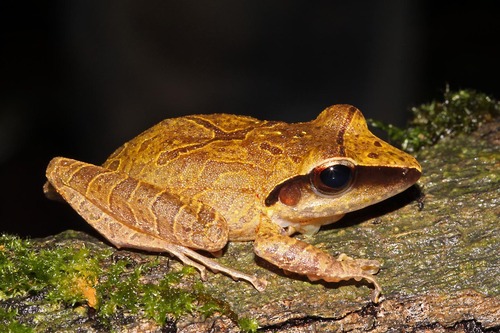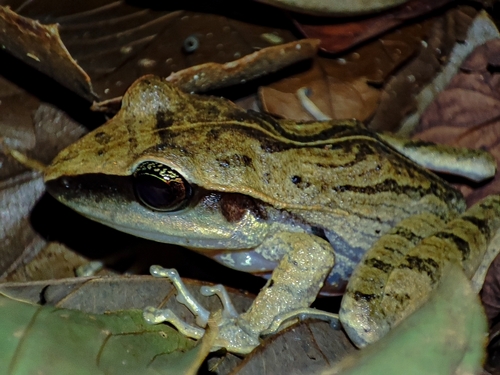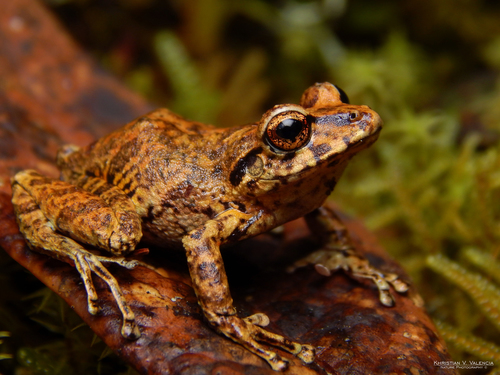
About Pristimantis permixtus (Lynch, Ruiz-Carranza & Ardila-Robayo, 1994)
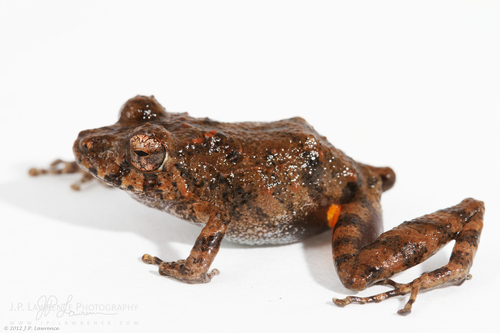
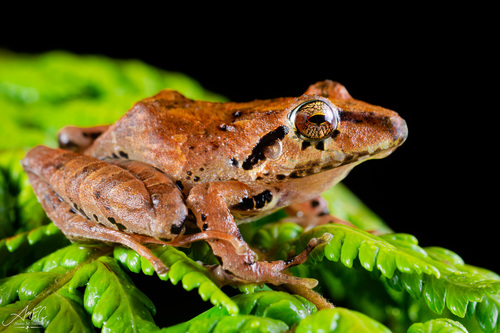
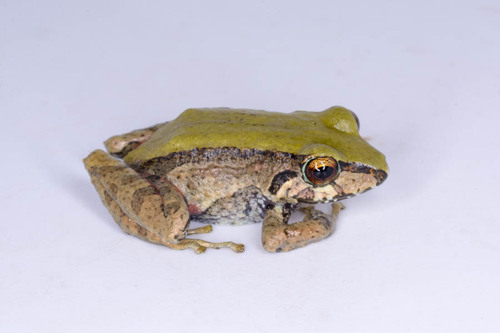
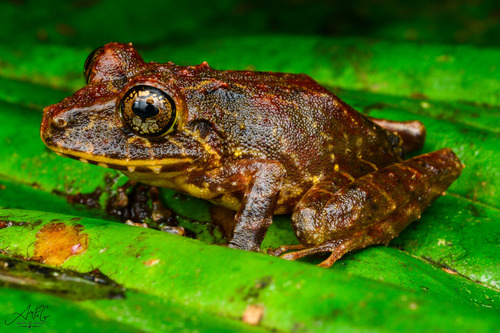
Pristimantis permixtus is a moderately sized frog, first described by Lynch, Ruiz-Carranza & Ardila-Robayo in 1994. Key characteristics of this species include: dark reticulation that encloses pale spots on the groin and the concealed surfaces of the thighs; distinct labial stripes and a distinct superficial tympanum; nonconical or subconical tubercles on the eyelid and heel; absence of vocal slits in males; and a polymorphic dorsal pattern. Size varies among populations, with southern populations being smaller overall. Males have a snout–vent length of 22–31 mm (0.87–1.22 in), while females have a snout–vent length of 32–45 mm (1.3–1.8 in). For a southern population located at the lower altitudinal limit of the species' range, average snout–vent length is 24 mm (0.94 in) for males and only 27 mm (1.1 in) for females. This species is most similar to Pristimantis supernatis, and the two have been confused with one another. Its natural habitats are cloud forests and sub-páramo shrubland, and it can also be found in secondary forests and disturbed areas. It is a nocturnal species that lives on low vegetation, up to 2 metres above the ground. Pristimantis permixtus is an abundant, widespread, and adaptable species, with no major threats to its survival.