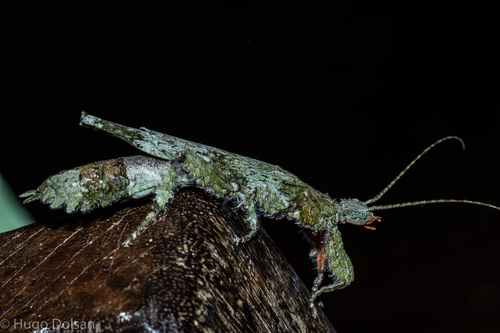
About Prisopus sacratus (Olivier, 1792)
Prisopus sacratus (Olivier, 1792), sometimes called the dragon of Amboina, is a stick insect of the genus Prisopus in the family Prisopodidae. It is one of approximately 14 recognized species in the genus Prisopus. This species is primarily found in the southern portion of the Atlantic Forest (Mata Atlântica in Portuguese), located in the Brazilian states of São Paulo, Paraná, and Santa Catarina. It has an elongated body with spiny, hairy projections that improve its ability to mimic plant stems and branches. The genus Prisopus was first described by Amédée Louis Michel le Peletier, comte de Saint-Fargeau and Jean Guillaume Audinet-Serville in 1828, and its type species is Prisopus sacratus (Olivier, 1792), which originates from South America. Genus Prisopus species range from southern Mexico, through Central America, to northern South America, found in countries including Costa Rica, Panama, Ecuador, Peru, and Brazil. All Prisopus species live in tropical forests, and their cryptic body shape works as an effective defense against predators. These insects exhibit sexual dimorphism: females are typically larger, and they lay eggs in clusters that are adhered to vegetation, a behavior that is common across the entire genus. Taxonomic studies have divided the subfamily Prisopodinae into tribes, and place Prisopus in the tribe Prisopodini based on the structure of its tarsal attachment pads. This placement highlights the species' evolutionary adaptations that allow them to adhere to plant surfaces.

