About Prionurus microlepidotus Lacepède, 1804
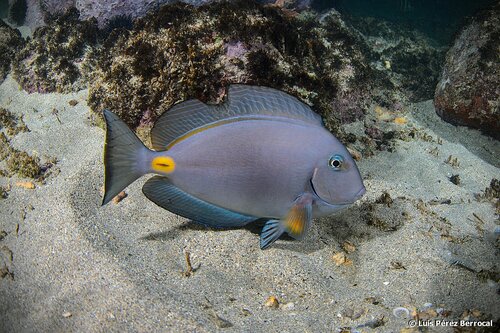
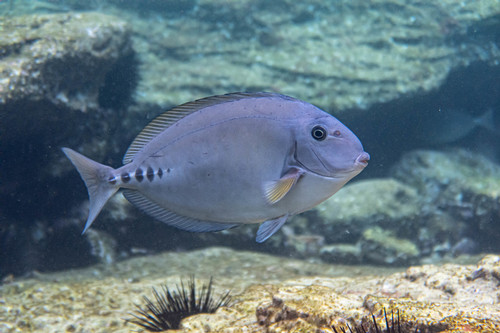
Prionurus microlepidotus has a dorsal fin supported by 8 spiny rays and 21 to 22 soft rays. Its anal fin is supported by 3 spiny rays and 20 or 21 soft rays, and its pectoral fin has 16 rays. Body depth, measured relative to standard length, ranges from half of standard length in subadults to just over one-third of standard length in larger adult individuals. Larger adults grow a small protuberance on the snout, located just above the mouth. This species has six keeled bony plates along each side of the rear of its body and its caudal peduncle, and its caudal fin is emarginate. Its body is uniformly grey, with a slender lateral line. The bony plates on the rear of the body sit within dusky blotches. This species can display a white band at the base of the caudal fin, and when it visits cleaning stations, it can change its body color to solid white. The maximum published total length recorded for this species is 70 cm (28 in). Prionurus microlepidotus is endemic to the southwestern Pacific Ocean, and has only been recorded in Australian waters, where it ranges from New South Wales in the south to Townsville, Queensland in the north, and is also found around Lord Howe Island. The species occurs along rocky shorelines and on coral reefs, while juvenile individuals prefer sheltered habitats including bays and estuaries. It gathers in schools and grazes on benthic algae.