About Prionotus evolans (Linnaeus, 1766)
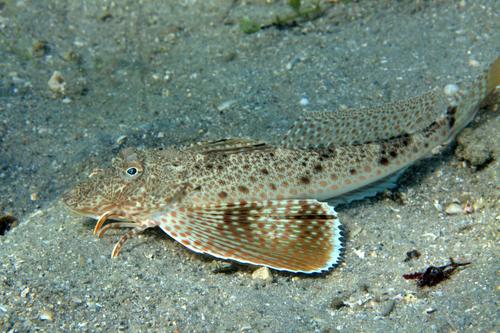
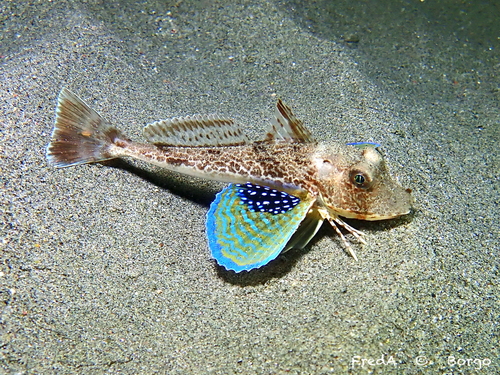
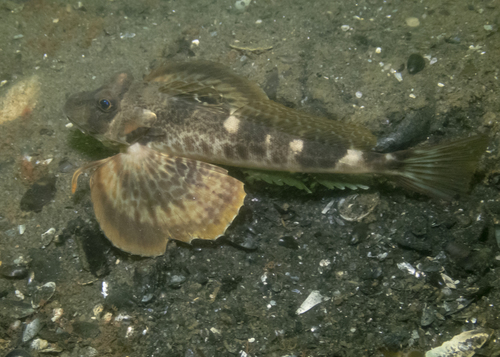
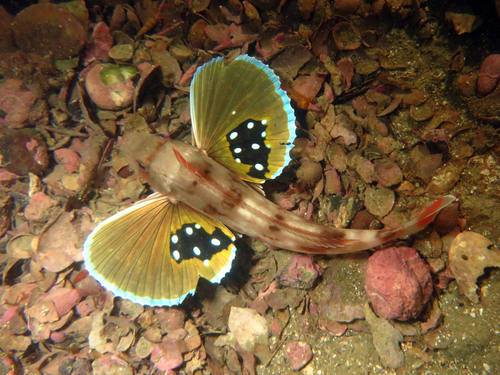
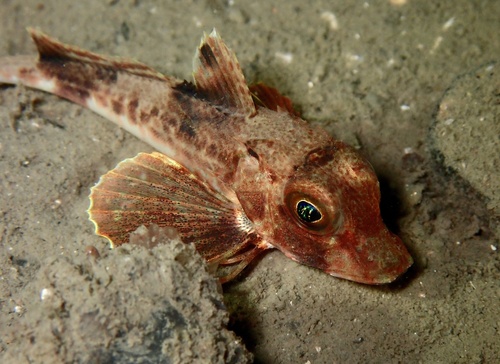
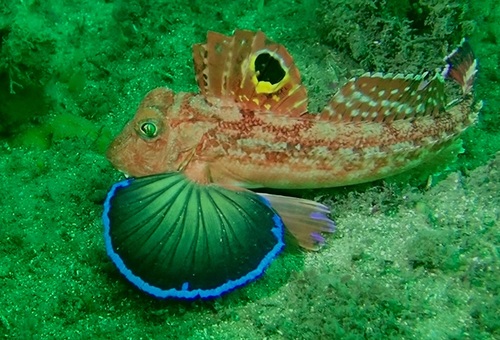
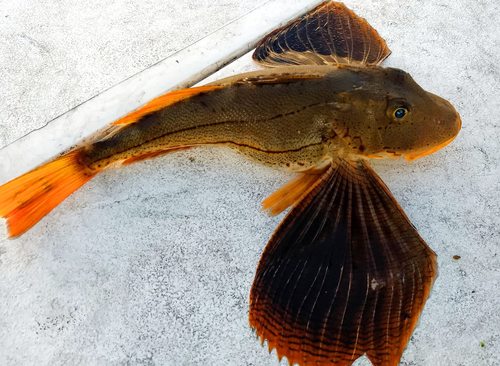
The striped searobin, Prionotus evolans, has a maximum published total length of 45 cm (18 in), with 30 cm (12 in) being a more typical size, and a maximum published weight of 1.6 kg (3.5 lb). Its overall body color ranges from reddish to olive brown, with a thin dark stripe along the lateral line, and a second thin dark stripe that runs parallel to the first on the lower body. The entire pectoral fin is marked with closely spaced, sinuous dark vertical lines, and the inner section of the fin forms a dark patch. A dark blotch is present on the first dorsal fin between the fourth and fifth spines. This species has a large, deep head, with no cirrhi at the nostrils or above the eyes, and no spines located near the nostrils. The mouth is large, reaching as far back as the anterior margin of the eye. It is slightly inferior, meaning the lower jaw does not protrude. The spine on the preoperculum does not extend past the operculum. Prionotus evolans has two separate dorsal fins: the first dorsal fin has 10 spines, while the second has 12 soft rays. The anal fin contains 10 soft rays. The pectoral fin has a rounded posterior margin, with 13 to 14 rays contained within its membrane, and the fin extends almost to the rear of the anal fin base. Three enlarged, free rays that are not connected to the fin membrane are located at the bottom of the pectoral fin. The body is covered in scales. Prionotus evolans occurs in the Western Atlantic Ocean. Its range extends from Nova Scotia in the north southward along the Atlantic coast of the United States to southeastern Florida, and it is also found around Bermuda. This species is rare north of Cape Cod, Massachusetts. It inhabits depths between 9 and 180 m (30 and 591 ft), most commonly between 20 and 70 m (66 and 230 ft). It lives on sandy substrates, ranging from estuaries to offshore depths, and is only infrequently found associated with reefs. The striped searobin has minor commercial uses, and it is also classed as a game fish. It is reported to be good to eat, and is occasionally used as bait.