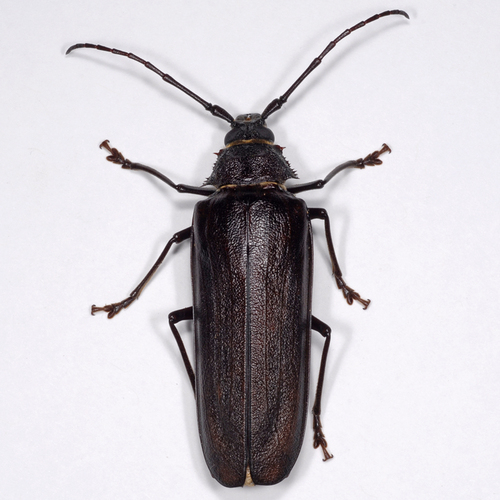
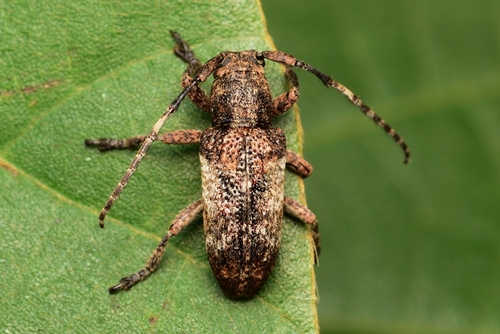
About Prionoplus reticularis White, 1843
The huhu beetle, with the scientific name Prionoplus reticularis, is a large longhorn beetle species endemic only to New Zealand. Adults can reach up to 5 cm in length. This species is widespread across New Zealand, occurring at altitudes up to 1500 m. Adult huhu beetles do not feed. Their larvae feed and burrow in dead tree wood, feeding almost entirely on gymnosperm trees such as rimu and monterey pine. Huhu beetle larvae are high in protein and fat, are edible, and have a long history of consumption by Māori people of New Zealand, who have specific terms for some of the species’ life stages. In the wild, the larval stage of the huhu beetle takes two to three years for the beetle to reach maturity; this development occurs more quickly under laboratory conditions. Huhu beetles are nocturnal, and are strongly attracted to artificial light from human settlements. At night, adults fly to search for mates, and females produce olfactory cues to attract males. Many predators, including native birds and introduced mammals, prey on huhu beetles. The fairy wasp Prionaphes depressus exclusively parasitizes the eggs of this beetle. The intestinal tract of huhu beetle larvae hosts a diverse community of microorganisms that may help the larvae digest wood. Because larvae burrow into logs, New Zealand requires that exported logs be treated to prevent the spread of this beetle to other countries. Huhu beetles are endemic to New Zealand, widespread across New Zealand’s main islands, and occur from sea level up to altitudes of 1400 m. There is only one recorded record of a huhu beetle captured on Raoul Island in the Kermadecs. Visiting researchers have searched rotting wood on Raoul Island for evidence of huhu beetle larvae, but have found none, indicating the species has not established a permanent population there. It is assumed the single recorded specimen came from untreated construction wood brought to the island. Before European settlement of New Zealand, huhu beetles were mainly associated with podocarp and kauri forests. They have since spread more widely across the country following the introduction of exotic conifers. Female huhu beetles lay clutches of 10–50 eggs, sometimes up to 100 eggs, in cracks and crevices located in or under bark. One other study reports that clutches may hold 250–300 eggs. Around 94–98% of wild-collected eggs successfully hatch. In laboratory conditions of approximately 20 °C (68 °F) and 75% humidity, eggs hatched after 23 ± 2 days. Before hatching, the larva is visible moving inside the egg, and breaks out by using its mandibles to pierce the egg’s chorion, then chews to enlarge the opening; the larva does not ingest the chorion. Setae on the first to sixth abdominal segments help support the larva as it exits the egg and excavates its initial gallery. The larval stage lasts two to three years in the wild. In laboratory conditions, this stage can be shortened to 250 days when an artificial diet is used and temperature is kept at 20 °C (68 °F). In its final developmental instar, the larva moves to within 7.5–10 cm of the wood surface before constructing a pupal chamber. It builds the chamber by enlarging the diameter of its existing gallery over one to three days. This process creates wood fragments similar to wood shavings, about 3 cm by 1 cm in size, which the larva packs into its existing gallery to form a plug. After completing the plug, the larva lines the walls of the pupal chamber with the last frass voided from its gut. The larva then enters a resting period of approximately ten to fifteen days, during which its abdominal segments contract and its body darkens slightly, before moulting into a pupa. The pupal stage lasts around 25 days. Eclosion, the emergence of the adult from the pupal cuticle, begins with a series of ruptures across the head and thorax. The head, legs and wings are freed through arching movements of the body through the ruptured cuticle. The newly emerged adult may stay inactive for three to five days before digging an exit tunnel out of the pupal cavity. Adult huhu beetles cannot feed, and live for roughly two weeks. The adult sex ratio of the species is approximately 1:1. Huhu beetle larvae, commonly called huhu grubs, are edible for humans, with a long history of consumption by Māori. Their flavor has been described as similar to peanut butter. Fully grown larvae, called tataka by Māori, are the most valued, as they no longer contain undigested wood pulp inside their bodies. Huhu grubs can be eaten raw, or traditionally cooked in a hāngī. It has been proposed that huhu larvae could be farmed for human consumption, but additional research is needed into challenges including maintaining genetic diversity and identifying optimal growing conditions to confirm commercial viability. Prionoplus reticularis contains substantial amounts of key nutrients. Large larvae and pupae are relatively high in fat, with fat making up to 45% and 58% of their dry weight respectively. Most fat in huhu larvae consists of oleic acid and palmitic acid. Protein is the second most abundant nutrient, making up 30% of dry weight in large larvae and approximately 28% of dry weight in pupae. Protein extracts from huhu larvae and pupae are high in essential amino acids including isoleucine, lysine, leucine, and valine. The total essential amino acid content of huhu larvae meets the World Health Organization’s essential amino acid requirements for human nutrition. The essential amino acid content of huhu is significantly higher than that of mealworms, and is comparable to the content in beef and chickpeas. When reconstituted in water, protein powders made from huhu larvae and pupae can form stable foams and emulsions. Ash content, which represents mineral content, is 1.8% of dry weight in large larvae, and 2.2% of dry weight in pupae. Present minerals include manganese, magnesium, phosphorus, iron, copper, and zinc. One study found that wild-caught huhu larvae have very low levels of heavy metals, making them safe for human consumption.