About Prionodura newtoniana De Vis, 1883
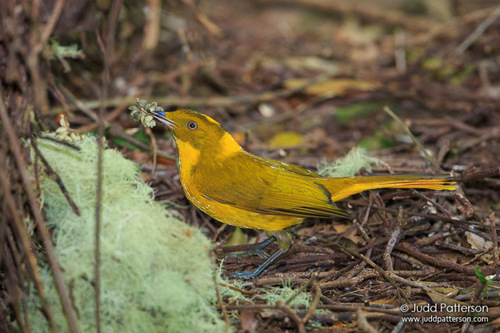
The male golden bowerbird (Prionodura newtoniana De Vis, 1883) has a brown head and brown wings, with bright yellow-gold coloration on its underparts, tail, crest, and nape. The female is olive brown with ash-gray underparts. Immature golden bowerbirds look similar to females, except they have brown eyes. This is the smallest species of bowerbird. The golden bowerbird has a patchy distribution in northeastern Queensland. It has a limited range, and its population is estimated to have declined by as much as 60% over three generations of the species. It lives in rainforests above 350 metres (1,100 ft) in elevation, including some habitat that has been disturbed by human activities such as logging. Its traditional habitats include mild slopes, ridges immediately surrounding hill crests, and areas below steeper slopes where the terrain levels off. Canopy coverage in these habitats is often greater than 70%, and the species is not found on hilltops or in fully disturbed forest. The golden bowerbird feeds mainly on fruits, and sometimes consumes insects and spiders. Its diet also includes fruits (especially those from vines), flowers, buds, and arthropods. Nestlings eat mostly fruits alongside a small number of insects, most commonly cicadas (Cicadidae), and the proportion of fruit in their diet increases as they grow. Fledglings eat both fruits and insects. In the Paluma Range, males cache fruits, particularly bunches of wild pepper (Piper), in crevices around bower sites to recover for later use. One nesting female has been observed retrieving a cached fruit. The golden bowerbird forages by sallying and seeking, and it rarely hawks cicadas. It usually feeds alone, but 3–4 individuals (often juveniles) may forage in the same fruiting canopy alongside other bird species, including other bowerbirds.