About Prionailurus bengalensis (Kerr, 1792)
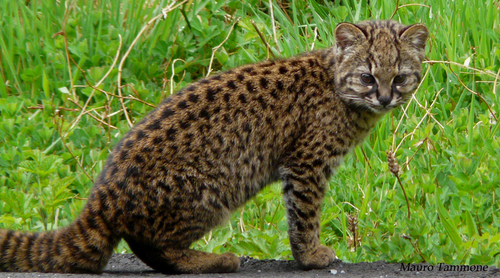
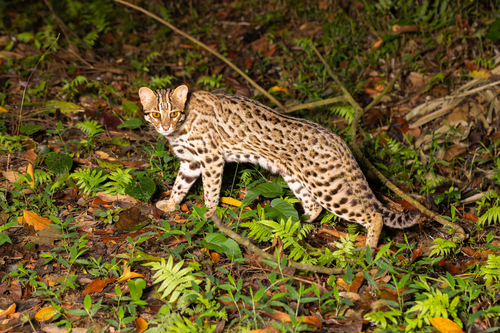
Prionailurus bengalensis, commonly called the leopard cat, is roughly the size of a domestic cat, but has a more slender build, longer legs, and distinct webbing between its toes. Its small head has two prominent dark stripes and a short, narrow white muzzle. Two dark stripes run from the eyes to the ears, and smaller white streaks run from the eyes to the nose. The backs of its moderately long, rounded ears are black with central white spots. Its body and limbs are marked with black spots of varying sizes and colours, and two to four rows of elongated spots run along its back. Its tail is about half the length of its head and body combined; it is spotted with a few faint rings near the black tip. The background colour of its spotted fur is tawny, while its chest and belly are white. Across its very large geographic range, leopard cats vary widely in fur colouration, spot size, body size, and weight, so they were initially thought to represent several separate species. Populations in the southern part of the range have yellowish brown fur, while northern populations have pale silver-grey fur. Black markings can be spotted, rosetted, or even form dotted streaks, depending on the subspecies. In the tropics, leopard cats weigh between 0.55–3.8 kg (1.2–8.4 lb), have head-body lengths of 38.8–66 cm (15.3–26.0 in), and tails between 17.2–31 cm (6.8–12.2 in) long. In northern China and Siberia, leopard cats can weigh up to 7.1 kg (16 lb), with head-body lengths reaching up to 75 cm (30 in); generally, individuals gain weight before winter and lose weight until spring. Average shoulder height is about 41 cm (16 in).
The leopard cat is the most widely distributed small wild cat in Asia. Its range stretches from eastern Afghanistan, northern Pakistan, and most of the Indian subcontinent and Southeast Asia to the Russian Far East. It inhabits tropical evergreen rainforests and plantations at sea level, as well as subtropical deciduous and coniferous forests in the Himalayan foothills at elevations over 1,000 m (3,300 ft). It can tolerate human-modified landscapes with existing vegetation cover to some degree, and lives in agricultural areas such as oil palm and sugar cane plantations. In Afghanistan, it was recorded in the 1970s from Jalalkot, Norgul in the Kunar Valley, and the Waygul forest of Dara-I-Pech District. It is rare in Pakistan's arid, treeless regions. In 2009, a camera trap recorded a leopard cat in Nepal's Makalu-Barun National Park at an elevation of 3,254 m (10,676 ft), where at least six individuals live in a survey area dominated by rhododendron, oak and maple associations. The highest recorded elevation for the species was documented in September 2012 at 4,474 m (14,678 ft) in the Kanchenjunga Conservation Area. Between 1999 and 2003, 20 leopard cats were radio-collared in Thailand's Phu Khiao Wildlife Sanctuary. Male home ranges measured between 2.2 km² (0.85 sq mi) and 28.9 km² (11.2 sq mi), while home ranges of the six collared females measured between 4.4 km² (1.7 sq mi) and 37.1 km² (14.3 sq mi). Between 2002 and 2008, the species was recorded in Changqing National Nature Reserve in the Qinling Mountains, Tangjiahe National Nature Reserve in the Min Mountains, Wolong Nature Reserve, and other protected areas in the Qionglai Mountains and Daliang Mountains in China. In far eastern Russia, it lives close to rivers, valleys, and ravine forests, and avoids areas with more than 10 cm (3.9 in) of snowfall. In the Japanese archipelago, the leopard cat is currently found only on the islands of Iriomote and Tsushima; Pleistocene fossils indicate it had a broader distribution in the past.
Leopard cats are solitary except during the breeding season. Some individuals are active during the day, but most hunt at night, preferring to stalk murids, tree shrews and hares. They are agile climbers and often spend time in trees. They rest in trees, and also hide in dense thorny undergrowth on the ground; in these agricultural undergrowth areas, they eat a larger proportion of rats than they do in forested areas. Leopard cats can swim, but rarely do so. They produce a similar range of vocalisations to domestic cats. Both sexes scent mark their territories by spraying urine, leaving faeces in exposed spots, head rubbing, and scratching.
Leopard cat breeding seasons vary based on local climate. In tropical habitats, kittens are born year-round. In colder habitats further north, females give birth in spring. Their gestation period lasts 60–70 days. Litter size ranges between two and three kittens. Captive-born kittens weigh 75 to 130 grams (2.6 to 4.6 oz) at birth and open their eyes by 15 days of age. Their weight doubles within two weeks, and reaches four times their birth weight by five weeks of age. At four weeks old, their permanent canines erupt, and they begin eating meat. Captive females reach sexual maturity as early as one year old, and have their first litter when they are 13 to 14 months old. Captive leopard cats have lived for up to thirteen years. The estrus period lasts five to nine days.