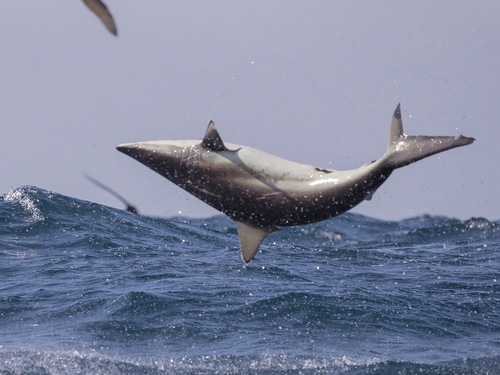
About Prionace glauca (Linnaeus, 1758)
Description: Blue sharks have a light, elongated, slender body build with long pectoral fins. Like many other sharks, blue sharks are countershaded: the top of the body is deep blue, the sides are lighter, and the underside is white. At maturity, males commonly grow to 1.82 to 2.82 m (6.0 to 9.3 ft) long, while larger females commonly reach 2.2 to 3.3 m (7.2 to 10.8 ft) long at maturity. Large specimens can grow to 3.8 m (12 ft) long. Occasional reports of outsized blue sharks exist, including one widely circulated claim of a 6.1 m (20 ft) long individual, but no shark even close to this size has been scientifically documented. Typically, mature males weigh 27 to 55 kg (60 to 121 lb), and large mature females weigh 93 to 182 kg (205 to 401 lb). Females over 3 metres (10 ft) long occasionally weigh more than 204 kg (450 lb). The heaviest scientifically reported weight for this species is 391 kg (862 lb). Unverified anecdotal claims exist that blue sharks can exceptionally reach weights of 800–900 kg (1,800–2,000 lb). The blue shark is ectothermic and has a unique sense of smell. Distribution and habitat: The blue shark is an oceanic epipelagic shark found worldwide in deep temperate and tropical waters, ranging from the surface down to around 350 m (1,150 ft). In temperate seas, it may approach shorelines where divers can observe it, while it lives at greater depths in tropical waters. Its range extends as far north as Norway and as far south as Chile, and it can be found off the coasts of every continent except Antarctica. The highest concentrations of blue sharks in the Pacific Ocean occur between 20° and 50° North, with strong seasonal population fluctuations. In the tropics, blue sharks are spread evenly between 20° N and 20° S. The species prefers water temperatures between 12 and 20 °C (54–68 °F), but has been recorded in water ranging from 3.9 to 31 °C (39.0–87.8 °F). Records from the Atlantic document that blue sharks undertake regular clockwise migrations following prevailing ocean currents.