About Priodontes maximus (Kerr, 1792)
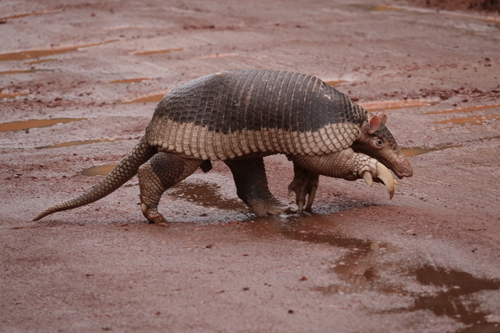
The giant armadillo, Priodontes maximus, is the largest living armadillo species. It has 11 to 13 hinged body armor bands, plus an additional three or four hinged bands on its neck. Its body is dark brown, with a lighter yellowish band along the sides and a pale yellow-white head. This species has between 80 and 100 teeth, more than any other terrestrial mammal. All its teeth are similar in appearance; they are reduced premolars and molars, grow continuously throughout life, and have no enamel. Giant armadillos have extremely long front claws, including a sickle-shaped third claw that can reach 22 cm (8.7 in) in length. These claws are proportionately the largest of any living mammal. Its tail is covered in small rounded scales, and does not have the heavy bony scutes that cover the upper body and top of the head. The animal is almost completely hairless, with only a small number of beige-colored hairs sticking out between its scutes. Fully grown giant armadillos typically weigh 18.7–32.5 kg (41–72 lb), but one wild specimen has been recorded weighing 54 kg (119 lb), and captive specimens have weighed up to 80 kg (180 lb). The typical body length of the species is 75–100 cm (30–39 in), with the tail adding an extra 50 cm (20 in). Giant armadillos live across most of northern South America east of the Andes, excluding eastern Brazil and Paraguay. To the south, their range extends into the northernmost provinces of Argentina, specifically Salta, Formosa, Chaco, and Santiago del Estero. No geographic subspecies are currently recognized for this species. They primarily live in open habitats: cerrado grasslands make up around 25% of their total range, but they can also be found in lowland forests.