About Prinia socialis Sykes, 1832
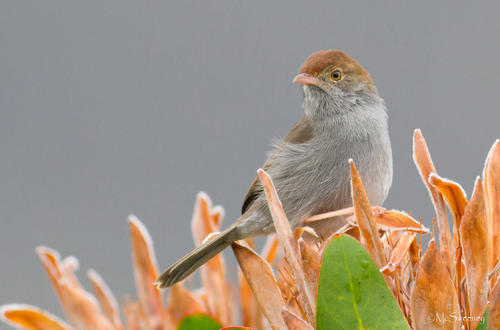
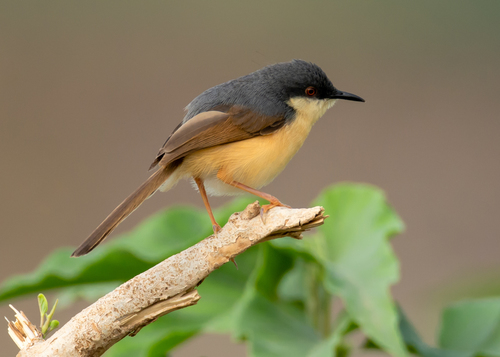
This species of warbler, Prinia socialis, measures 13 to 14 centimeters in length. It has short, rounded wings and a fairly long, graduated cream-colored tail tipped with black subterminal spots. It usually holds its tail upright, and its strong legs are used for clambering and hopping on the ground. It has a short black bill. In most plumages, the crown is grey and the underparts are rufous. When in breeding plumage, adults from the northern population are ash grey on their upperparts, with a black crown and cheek, and no supercilium, and their wings are coppery brown. In the non-breeding season, this northern population has a short, narrow white supercilium and a longer tail. P. s. stewartii, the northern subspecies described by Blyth in 1847, has warm brown upperparts and a longer tail in winter, and shows seasonal plumage variation. All other subspecies keep their summer plumage year-round. The subspecies inglisi, described by Whistler & Kinnear in 1933, occurs from West Bengal eastwards; it is slatier on the upperparts than the nominate peninsular race, has deeper rufous flanks, and a finer, shorter beak. P. s. brevicauda, the distinctive endemic subspecies of Sri Lanka described by Legge in 1879, has a shorter tail; juvenile individuals have yellowish underparts, and this subspecies also has a distinct call. Individuals are usually found alone or in pairs in shrubbery, and often forage on the ground. This passerine bird inhabits dry open grassland, open woodland, scrub, and home gardens in many cities. The northern range limit of the species runs along the Himalayan foothills, extending into the upper Indus river system. It is absent from the dry desert zone of western India, and its range extends east into Burma. The Sri Lankan population lives mainly in the lowlands, and can be found up into hills at around 1600 meters. Like most warblers, the ashy prinia is insectivorous. Its song is a repetitive tchup, tchup, tchup or zeet-zeet-zeet. It also has a nasal call that sounds like tee-tee-tee. During its fluttery flight, it makes a sound described as similar to "electric sparks"; this noise is most often thought to be produced by the wings, though one author has suggested it comes from the beak. The species is most easily recognized by the loud snapping noise it makes during flight. The source of this noise is not confirmed for certain. Reid thought the bird produced the sound by snapping its long tail, though the exact mechanism of this is unclear. Jesse believed the sound comes from the bird's mandibles. After observing the species for a long time, the original author of this description leans toward the idea that the noise is caused by the beating of the wings against the constantly wagged and jerked tail as the bird flits about. By comparison, when doves and pigeons fly, their wings often meet to produce a flapping sound, and the author suggests a similar process occurs when this bird, also called ashy wren-warbler, takes flight. The non-migratory genus Prinia undergoes a biannual moult, a trait that is rare among passerines. One moult takes place in spring, from April to May, and a second takes place in autumn, from October to November. It has been theorized that a biannual moult is advantageous when ectoparasite loads are very high, but no formal investigations have tested this idea. Prinia socialis replaces some flight feathers twice a year, so this is classified as a partially biannual moult; however, some authors describe the nominate subspecies P. socialis socialis as having two complete moults each year. While birds stay in pairs through the year, they roost singly on a branch of a small tree or shrub.