About Prinia hodgsonii Blyth, 1844
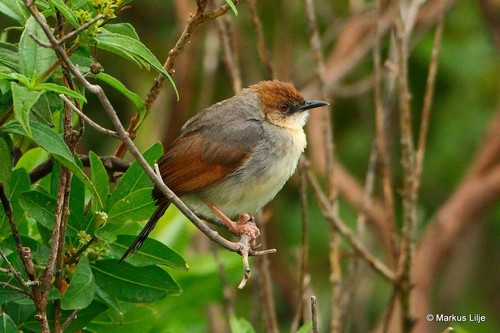
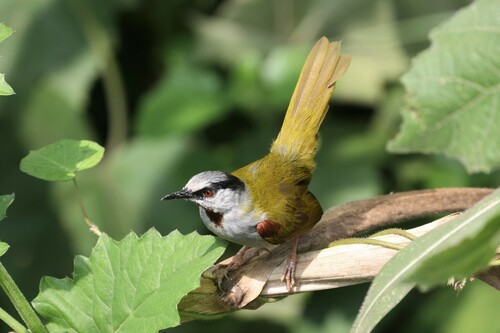
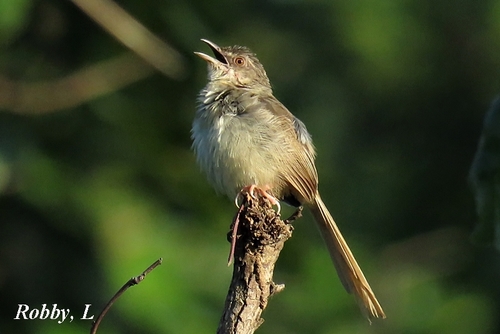
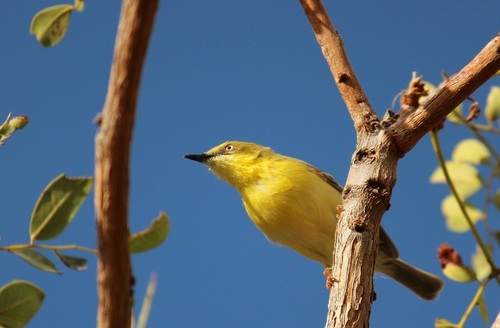
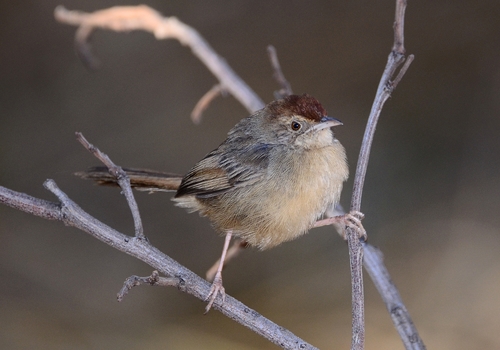
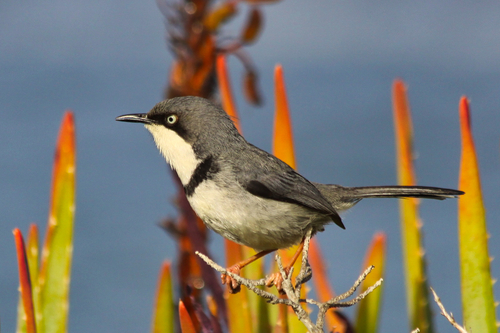
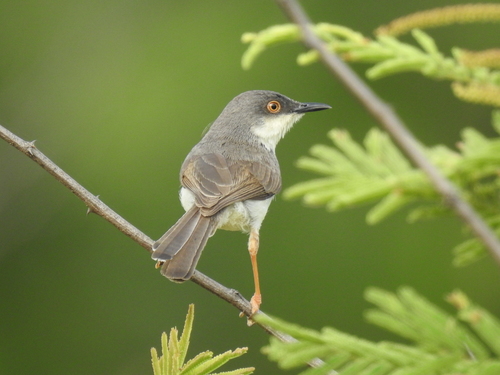
Prinia hodgsonii, commonly called the grey-breasted prinia, is a small warbler that measures 11 to 13 centimetres (4 to 5 inches) in length. This species has a moderately long grey tail with graduated feathers tipped in white, strong pinkish legs, a short black bill, and an orange eye ring. The sexes are similar in appearance across most populations, with the exception of the subspecies P. h. pectoralis from Sri Lanka, where females can be distinguished by an incomplete breast band. In breeding season, the underparts are buff white, and a grey breast band contrasts with the white throat. Grey-breasted prinias have a rufous wing panel: upperparts are smoky grey in the breeding season, and olive brown during the non-breeding period. Non-breeding individuals have a short, indistinct white supercilium, and often lack the breast band. Juvenile birds resemble non-breeding adults, but are more rufous on the upperparts. They also have a pale lower mandible. The distinctive, endemic, greyer Sri Lankan subspecies P. h. pectoralis retains breeding plumage year-round. Tail feathers are shorter in summer breeding plumage than in non-breeding winter plumage.
This skulking passerine is typically found in open woodland, scrub jungle, bushes, and hedgerows within cultivated areas. It also occurs in bamboo jungle, mangrove swamps, and reeds. The subspecies P. h. rufula has been observed in sugarcane patches near the Kathmandu valley. It is a common resident of the Indian peninsula, and makes short migratory movements further south during winter. Its distribution ranges from the Himalayan foothills to Southern India, and extends into the eastern Indian states of Arunachal Pradesh, Nagaland, Manipur, Meghalaya, and Assam. The species is also found in Pakistan, Burma, Vietnam, Sri Lanka, and Yunnan province in southern China. Its altitudinal range extends from plains up to 1000 meters (3280 ft) for the nominate subspecies P. h. hodgsonii, and up to 1800 meters (5900 ft) for P. h. rufula in Meghalaya.
Like most warblers, grey-breasted prinias are insectivorous. They feed mainly on insects such as ants, small beetles, and caterpillars, which they forage for among twigs and foliage of small trees. They also feed on nectar from the blossoms of trees including Erythrina and Bombax. During summer, their foreheads are sometimes dusted with pollen, which gives the head an orange or yellowish appearance that can lead to misidentification. They are usually found in pairs or small groups, and may sometimes form parties of five or more individuals, up to twenty. They jerk their tail as they flit between branches. The breeding season starts with the arrival of rains. Males sing from high perches, and also perform aerobatic rising and falling manoeuvres before diving while producing song. The song is a squeaky series of calls, transcribed as chiwee-chiwee-chiwi-chip-chip-chip or yousee-yousee-yousee-which-which-which-which. The nest is a grass cup placed between leaves sewn together with cobwebs; it resembles the nest of a common tailorbird, but is typically positioned closer to the ground. The typical clutch has three or four eggs. Eggs vary in colour, including glossy blue, pinkish white, greenish-blue, and pure white, and usually have reddish brown speckles at the broad end. Both parents incubate the eggs, which hatch after around ten to eleven days. More than one brood may be raised in a single breeding season.