About Prinia gracilis (Lichtenstein, 1823)
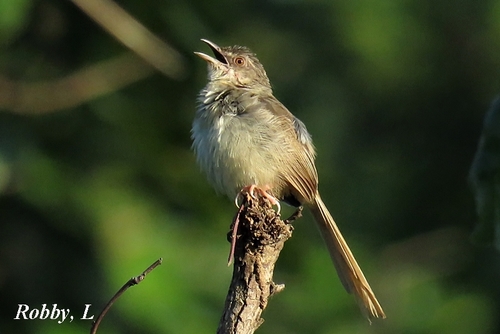
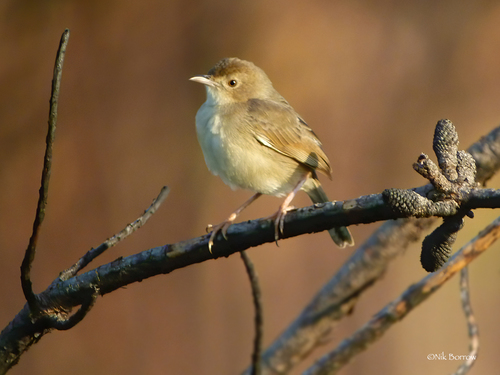
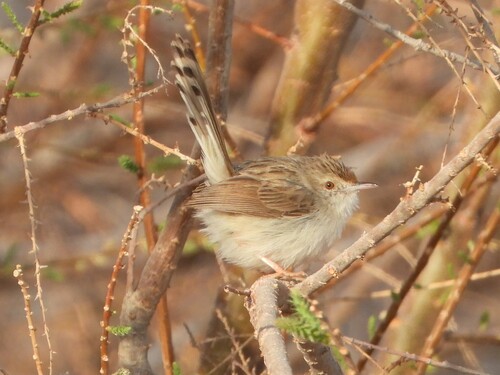
The graceful prinia, with the scientific name Prinia gracilis, is a small warbler; some older sources refer to it as the graceful warbler. This species is a resident breeder in northeastern Africa, particularly the Nile valley, and southern Asia, ranging from Egypt and Somalia east to Saudi Arabia, where it is sometimes called the streaked wren-warbler. This active passerine bird typically inhabits shrubs or tall grass in a range of habitats that feature thick undergrowth, tamarisks, or similar types of cover. The graceful prinia builds its nest in a bush or clump of grass, and lays between 3 and 5 eggs per clutch. These warblers measure 10 to 11 cm in length, with short rounded wings and a long tapering tail, where each individual feather is tipped with black and white. In breeding plumage, adult graceful prinias are grey-brown on their upperparts with dark streaking. Their underparts are whitish with buff-colored flanks, and they have a short, black bill. Males and females of this species have similar appearance. In winter plumage, adults are a brighter sandy brown on the upperparts with weaker streaking, have more buff coloration on their sides, and have a paler bill. There are 7 recognized subspecies of Prinia gracilis. This species often holds its long tail cocked upward, and its flight is weak. Like most warblers, the graceful prinia is insectivorous, meaning it feeds on insects. Its call is a rolling trilled breep, and its song is a hard rolling repetition of the phrase zerlip.