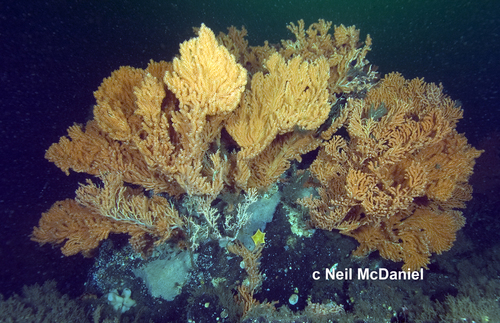
About Primnoa pacifica Kinoshita, 1907
Primnoa pacifica, commonly called red tree coral, is a species of soft coral in the family Primnoidae. It is a deep-water coral found in the North Pacific Ocean that plays an integral role in supporting benthic ecosystems. Red tree corals grow both axially and radially, producing calcite and gorgonian skeleton structures that form dense thickets. Like other coral species, red tree coral is composed of a soluble form of calcium carbonate that builds the reef structure. This structure provides food, shelter, and nutrients for surrounding organisms, many of which are commercially important fish and crustaceans. The marine habitats formed by these corals are listed as Habitat Areas of Particular Concern. However, human-caused impacts such as bottom trawling pose large-scale threats to these habitats. There are also concerns about the effects of ocean acidification on red tree coral, since it shares many traits with other corals currently affected by bleaching. Primnoa pacifica is a deep-water coral, and some individuals can survive at depths as great as 6 kilometers and temperatures as low as 30 °F. It is typically found along North Pacific outer continental shelves and inner continental slopes, at depths ranging from 150 meters (490 ft) to 900 meters (3,000 ft). The species is notably abundant off the coast of Alaska. In 2010, Primnoa pacifica was found in the unique habitat of Tracy Arm fjord, between 20 feet (6.1 m) and 100 feet (30 m) deep in Alaskan waters, including under glaciers. A large population lives in British Columbia's Knight Inlet, where the species occurs as shallow as 15 m deep on the crest of the sill between Hoeya Head and Prominent Point. Since 2010, the coral has also been discovered in other Pacific regions, including the waters surrounding Japan. Red tree corals prefer to attach to substrates that are mostly bedrock, and favor rougher seabeds over smooth seabeds. The growth rate of red tree coral has not been well established. Older studies found radial growth rates between 0.33 and 0.74 millimeters per year, and axial growth rates between 2.41 and 6.39 centimeters per year. More recent studies have recorded radial growth of 0.14 to 0.57 millimeters per year, and axial growth rates of 1.60 to 2.32 centimeters per year. Red tree coral radial size correlates with age, with large corals living over 100 years. Increasing age in red tree coral is also linked to slower growth rates. Unlike most corals which are hermaphroditic, red tree corals are a gonochoric species with separate sexes, which is similar to other Primnoidae. The reproductive processes of red tree corals have not been extensively studied, but the species uses both the asexual reproductive strategy of budding and the sexual reproductive strategy of broadcast spawning. Sexual reproduction has been observed to occur asynchronously, as colonies do not have mass spawning events. Brooding has also been observed in red tree coral colonies.

