About Priacanthus hamrur (Forsskål, 1775)
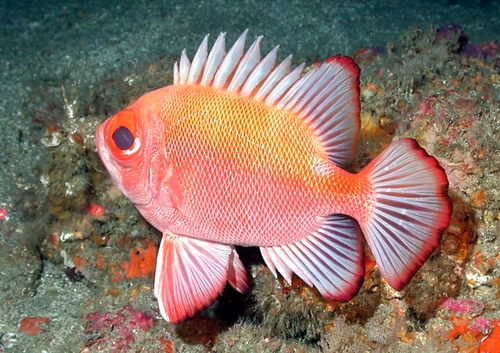
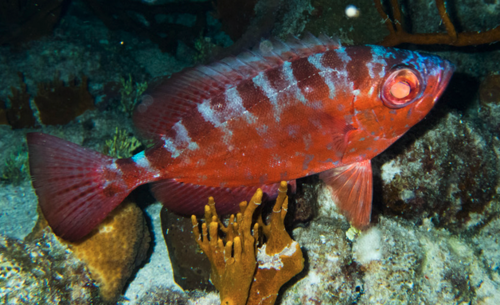
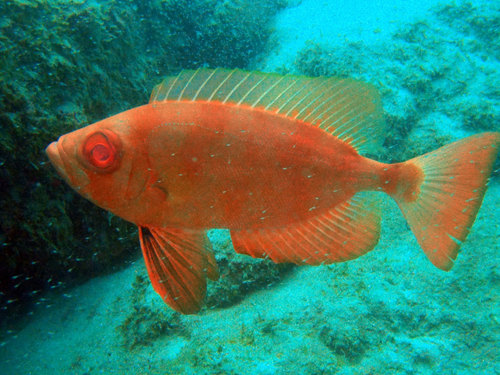
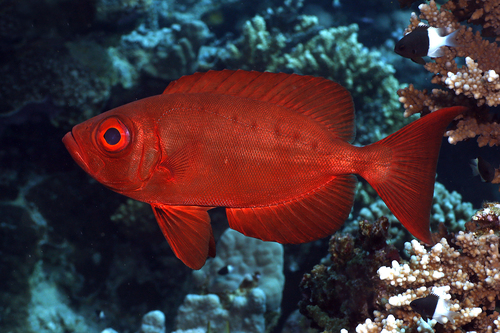
When Priacanthus hamrur reaches sexual maturity, males measure 18–19 cm (7.1–7.5 in) and females measure 19.1–20.0 cm (7.5–7.9 in); males of this species can reach a maximum total length of 45 cm. This species is commonly called the Crescent-tail Bigeye. Its body is relatively deep and strongly compressed laterally. Its eyes are very large and red, even when the fish has a silver body coloration. It has an oblique mouth, with a protruding lower jaw and small conical teeth. The tip of its lower lip sits above the median line of the body. Its dorsal fin has 13 to 15 soft rays. Its pelvic fins are very large. Its caudal fin has a concave, indented margin that can be crescent-shaped, which gives the species its common name. The body of the Crescent-tail Bigeye goes through multiple color phases, ranging from orange to fully red, fully silver, or silver marked with six broad red bands (the first of these red bands crosses the eye). This fish is also able to change its body color quickly. It may sometimes have a row of roughly fifteen small dark spots along its lateral line, or large dark spots on its upper body. Its fins range in color from red to light pink. This species looks quite similar and can be confused with Priacanthus blochii and Heteropriacanthus cruentatus, both of which only have slightly rounded caudal fins. Priacanthus hamrur is an uncommon but widespread species in the Indo-Pacific region, where it occurs from the Red Sea and southern Africa to French Polynesia, southern Japan, and Australia. It has also been recorded at Easter Island, and there are two confirmed records of the species in the Mediterranean Sea, off the coasts of Tunisia and Turkey respectively. Priacanthus hamrur is a reef-associated species that lives in tropical marine waters. It inhabits outer reef slopes, rocky areas, and lagoons, at depths between 8 and 250 meters, and is most commonly found between 30 and 50 meters deep.