About Priacanthus arenatus Cuvier, 1829
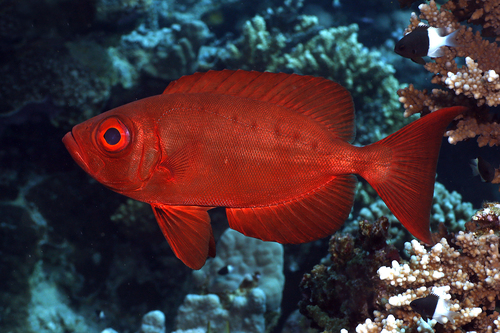
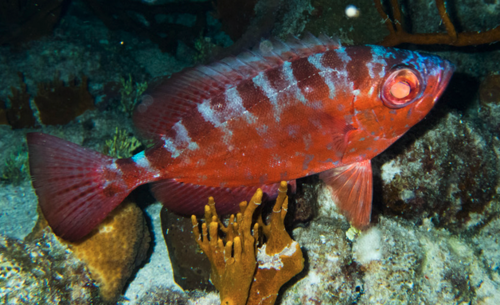
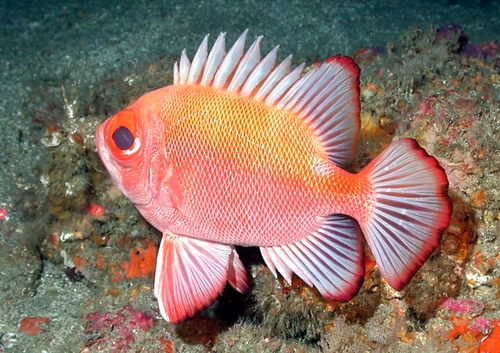
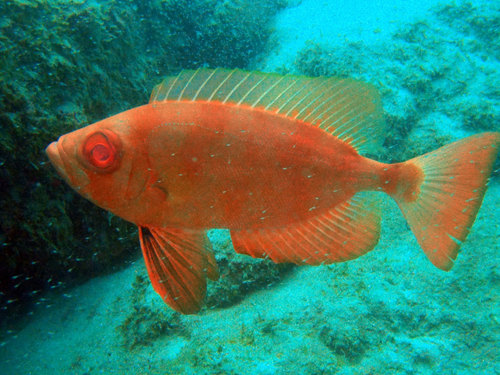
The Atlantic bigeye, Priacanthus arenatus Cuvier, 1829, is a small to medium-sized perciform fish. Almost all of its body, including its eyes, is entirely reddish-orange. Its dorsal fin has 10 spines and 14 rays, while its anal fin has 3 spines and 15 rays. Commonly found individuals reach around 14 inches in length. The IGFA world record for the species is 50 cm, or about 20 inches, caught in 2001. The Atlantic bigeye has notably large eyes, an adaptation to its primarily nocturnal feeding behavior. At night, this species forms small groups near the ocean bottom. The Atlantic bigeye is widely distributed across both the Northern and Southern Atlantic Ocean, across the ocean’s subtropical and tropical regions. In the Western Atlantic, its range extends from the Northeastern United States to Northern Argentina. Juveniles in the Western Atlantic occasionally stray as far north as Nova Scotia, Canada, carried by the Gulf Stream, but these individuals do not remain long because the species cannot survive cold water temperatures. In the Eastern Atlantic, the species occurs from West Morocco to Northern Angola. A single individual was reported in the Mediterranean Sea off Sardinia, Italy, in 1979. This fish can be found across multiple depths of the water column, ranging from 10 m to over 250 m, and it is most common between 30 m and 50 m depth. Juveniles are typically pelagic, occupying the upper levels of the water column. The Atlantic bigeye inhabits rocky ocean bottoms and coral reefs. Compared to many smaller reef fish, it prefers outer reef slopes, and it is also common around rocky outcrops on the continental shelf. It feeds primarily at night. Its diet includes small fish, bristle worms, and crustaceans, and most of its prey consists of the larvae of other reef animals. Atlantic bigeye are difficult for scientists to collect and observe, due to their nocturnal habits and skittish behavior. This species is a minor commercial fish, often caught as bycatch. Low numbers are captured via trawling, spearing, and hook-and-line fishing. Its flesh is marketed fresh and is considered to be of excellent quality. It is also occasionally targeted by recreational anglers who fish at night, though many anglers consider it a nuisance fish, since it is very common bycatch when fishing for much larger porgy, grouper, or snapper. When caught, it reportedly emits a foul odor similar to rotting garbage.