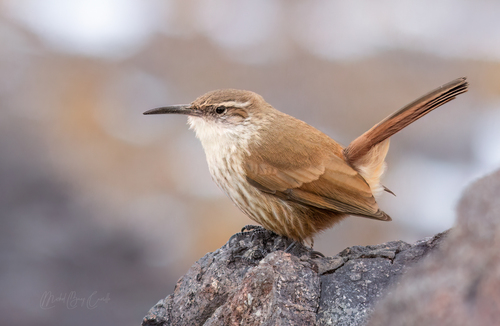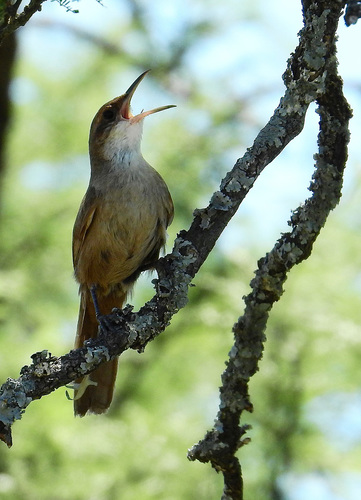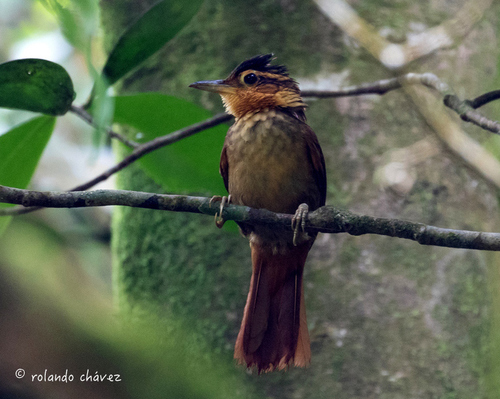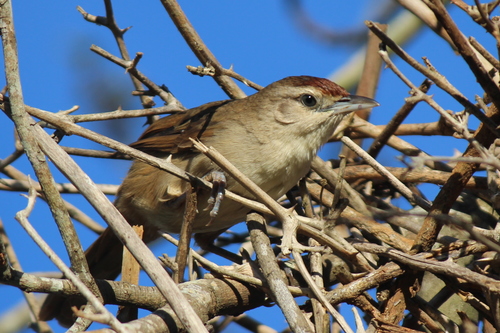
About Premnoplex brunnescens (P.L.Sclater, 1856)
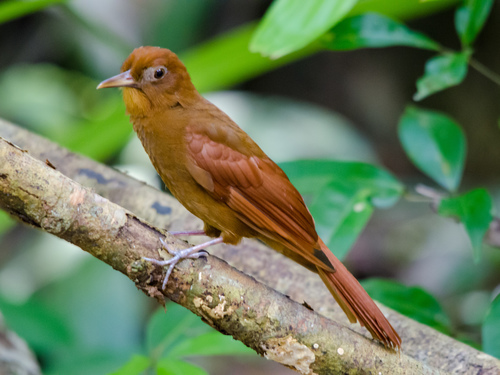
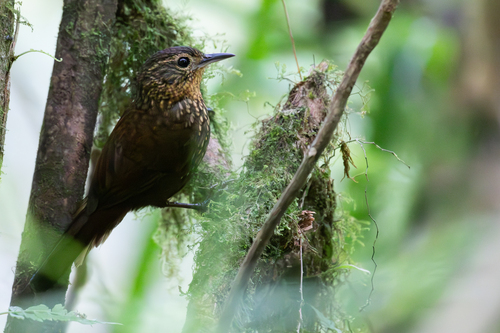
The spotted barbtail, Premnoplex brunnescens, ranges from 13 to 15 centimetres (5.1 to 5.9 in) in length and 14 to 19 grams in weight. This species does not have sexual dimorphism, so males and females have identical appearance. Within its family, the spotted barbtail is small and dark, with distinct rich patterning on its underside. Its forehead is dark greyish-brown, marked with tawny or ochraceous spots. It has a narrow supercilium formed by a series of closely spaced spots above and behind the eye, with similar lines of spots extending down the neck from the supercilium. Its crown is also greyish-brown, with dark-edged feathers that create a scalloped appearance, and the forehead spots fade smoothly into the crown. The back is dark brown with blackish-edged feathers, following the same scalloped pattern as the crown but less noticeably. The rump shares this scalloped appearance and has a slight chestnut hue. The uppertail coverts are chestnut-brown, and the wings are mostly dark brown. The primary coverts are darker than the rest of the wing, while other wing coverts have darker centers. The central tail feathers are somewhat stiffened, and all tail feathers lack barbs at their tips, which gives the tail a characteristic "spiny" look. The bird's throat is tawny, with brownish-edged feathers; individuals of the subspecies albescens have a paler whitish throat. The breast and belly are dull brown, marked with elongated tawny spots outlined in dark brown. The spots are largest on the breast, becoming smaller and less visible toward the vent, and fade into streaking on the flanks. The undertail coverts are also dull brown with faint spots. The upper mandible of the beak is black or dark brown, while the lower mandible ranges from greyish-pink to horn-colored, and occasionally has a darker tip. The iris is black. The spotted barbtail looks similar to the white-throated barbtail, but can be distinguished by its tawny spots instead of white, smaller and less dense breast spots, and a shallower beak.
The spotted barbtail inhabits evergreen montane forest, including the Talamancan montane forests and across the entire northern Andes. It prefers areas that have abundant moss and epiphytes. In Central America, it occurs at elevations between 1,200 to 2,300 metres (3,900 to 7,500 ft) above sea level. In the Andes, it is found from 900 to 2,600 m (3,000 to 8,500 ft), and occasionally extends as high as 3,000 m (9,800 ft), and as low as 650 m (2,130 ft) in the Western Andes. It is common across its entire range, and can be found in both fragmented and intact forest habitat. It is a sedentary species and is not considered globally threatened.
The spotted barbtail is thought to be a monogamous species. In the Central American portion of its range, it mostly breeds between March and June. In the Andes, eggs have been recorded in March and June, and nestlings have been recorded in April. The species lays two eggs per clutch; the eggs are entirely white, and measure approximately 22 mm (0.9 in) long by 17 mm (0.7 in) wide, making them disproportionately large for the bird's body size. Eggs are usually incubated for 27 days. Nestlings are cared for by parents for approximately three weeks, and both sexes take part in parental care. The nest is described as a massive ball constructed from lichen, liverworts, moss, and fine tiny roots, with a total diameter of around 30 cm (12 in). The nest ball has a tube-like entrance at its base, with a short tunnel leading to a central chamber 6 to 8 cm (2.4 to 3.1 in) across that is lined with soft fibres and moss. Nests are almost always placed in a shaded area near a stream, built in a crevice in a tree or rock, or hanging under a branch or fallen log, and are usually located within a couple of meters of the ground.