About Prays fraxinella (Bjerkander, 1784)
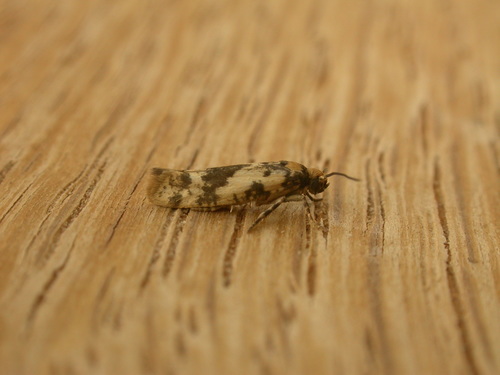
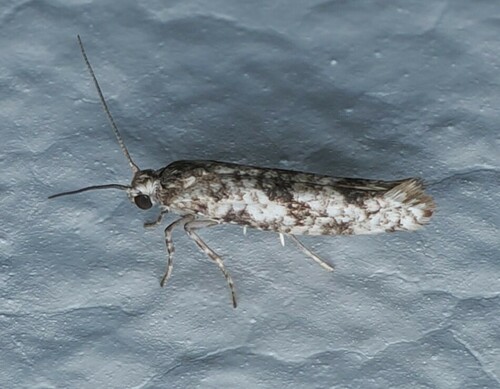
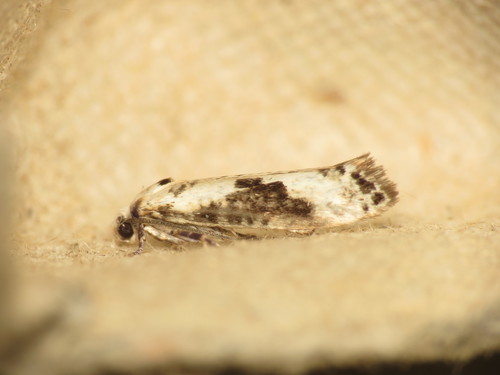
Prays fraxinella (Bjerkander, 1784) has a wingspan of 14–18 mm. Its head is white or greyish ochreous. The forewings are white or greyish-ochreous, with some blackish dorsal strigulae; a triangular blackish blotch, which is lighter or mixed with whitish on the costa, extends along the costa from near the base to two-thirds of the wing length; there are some irregular blackish marks towards the termen; sometimes the whole wing is unicolorous dark fuscous. The hindwings are rather dark grey. Fully developed larvae reach 12 mm in length, with a greenish body and a brown head marked with black spots. Young larvae that act as leaf miners have a yellowish body with a black head and black anal plate, while larvae that mine bark have a whitish body. Older larvae are greenish, marbled with red-brown on the upper side, have a deep green dorsal line, a pale brown head marked with dark spots, and two black spots on the second segment. Adults are on wing from May to June, and again in August, producing two generations per year depending on location. This species originally had two colour forms: the typical white and black colouration, and the melanic form f. rustica. Recently, f. rustica, which has an orange head, has been separated into an entirely new species, Prays ruficeps. Eggs are laid on the twigs of ash (Fraxinus excelsior) and manna ash (Fraxinus ornus) in June and July. Larvae pupate inside an open network cocoon, and pupae can be found in May or June.