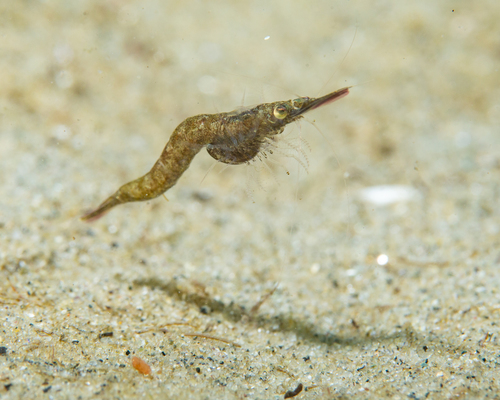
About Praunus flexuosus (O.F.Müller, 1776)
Praunus flexuosus (O.F.Müller, 1776), commonly called the chamaeleon shrimp, is a long, slender mysid shrimp with a distinct bend in its abdomen. It reaches sexual maturity at approximately 18 millimetres (0.71 in), and can grow up to 26 mm (1.0 in) in total length. Its coloration is highly variable, ranging from brown or red to green, which explains its common name. Praunus flexuosus is very similar to the closely related species Praunus neglectus, and the two can be distinguished by specific physical characteristics.
Praunus flexuosus is naturally distributed along the coasts of the North Atlantic Ocean between 40° north and 71° north, and also occurs in the Baltic Sea. There is only one doubtful record of this species from locations further south than Roscoff. It is the only documented non-native marine zooplankton species that has established a stable population on the East Coast of North America. It was first recorded in North America in 1960 on the north side of Cape Cod, and has since spread north as far as Nova Scotia. This colonization likely occurred after P. flexuosus was transported as a fouling organism on ships' hulls during the Second World War. The species was only first documented around the coast of Iceland in 1970, but has since become common along Iceland's south-west coast; this introduction may also have been enabled by wartime convoys during the Battle of the Atlantic.
Praunus flexuosus can tolerate salinities ranging from 2‰ to 33‰. It is frequently found living on algae, and is most closely associated with the brown seaweed Fucus vesiculosus. It inhabits shallow water, and is often found around artificial structures such as docks. It is an omnivore that feeds on organic debris and preys on small crustaceans, especially harpacticoid copepods. Compared to other common littoral mysids, such as Neomysis integer and Praunus inermis, P. flexuosus consumes a larger proportion of macrozooplankton. It is less gregarious than species like N. integer. When it detects a nearby predator using a combination of visual and chemical cues, P. flexuosus hides among vegetation.
Praunus flexuosus produces two generations each year. An overwintering generation produces a spring generation that emerges in May or June, after which the original overwintering generation dies off in the summer. Some individuals from the spring generation reach sexual maturity and reproduce in the autumn, producing the generation that will reproduce the following spring. Females deposit eggs into a brood pouch called a marsupium, where they are retained until hatching.

