About Prasophyllum brevilabre (Lindl.) Hook.f.
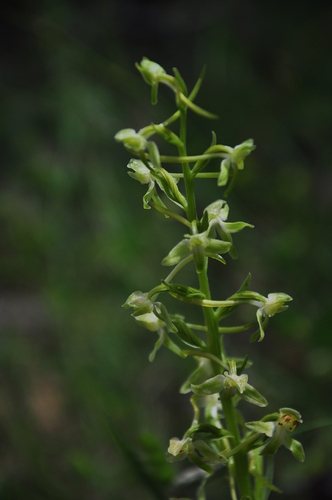
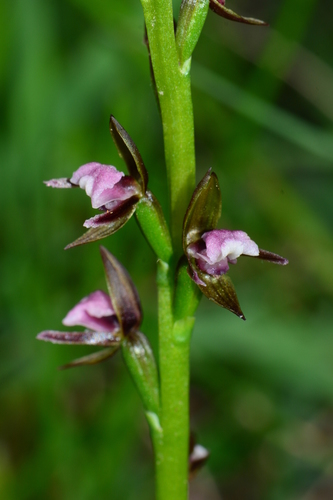
Prasophyllum brevilabre is a terrestrial, perennial, deciduous herb that grows from an underground tuber. It produces a single tube-shaped leaf up to 350 mm (10 in) long, with the free portion of the leaf measuring 20–80 mm (0.8–3 in) long. Between one and thirty well-spaced flowers grow along a flowering spike that reaches 150–500 mm (6–20 in) in height. The flowers are greenish-brown, and like other species in the Prasophyllum genus, they are inverted, meaning the labellum sits above the column instead of below it. The dorsal sepal is egg-shaped to lance-shaped, reddish-brown, and measures 7–8 mm (0.28–0.31 in) long. Lateral sepals are approximately 10 mm (0.4 in) long; they are sometimes joined to one another, but more often remain separate. The petals are linear to lance-shaped, 8–10 mm (0.3–0.4 in) long, and can be wavy or sickle-shaped. The labellum is spoon-shaped, 8–10 mm (0.3–0.4 in) long and around 3 mm (0.1 in) wide. It is folded back on itself so that its tip almost touches its base, and has wavy edges. Flowering takes place from September to January, and is most abundant after fire occurs the previous summer. Prasophyllum brevilabre is found in south-eastern Queensland, coastal New South Wales (and sometimes as far inland as Mount Kaputar), the higher rainfall areas of Victoria, and is widespread across Tasmania. It grows in a range of habitats, from coastal heath to forest, and sometimes occurs in subalpine regions.