About Pouteria valparadisaea (Molina)
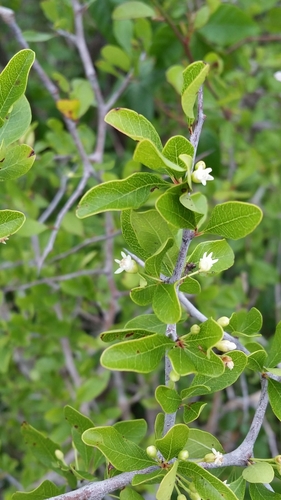
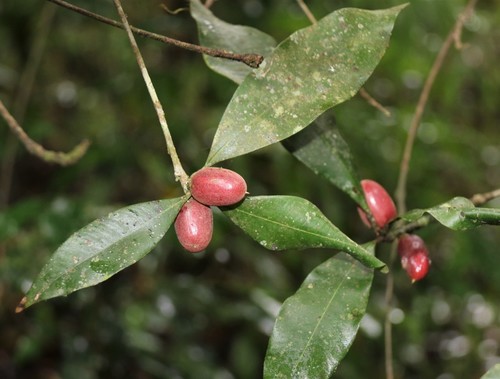
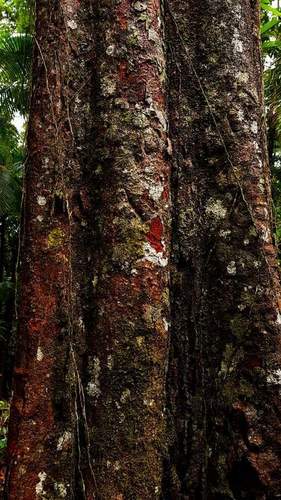
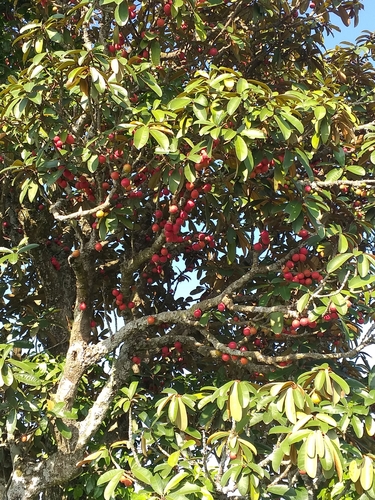
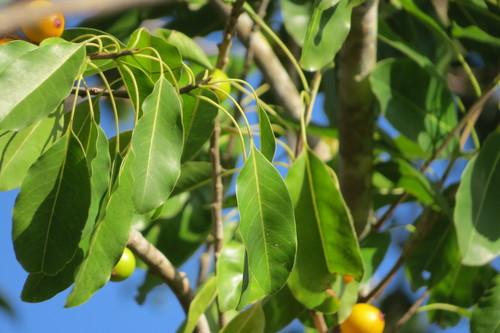
Pouteria valparadisaea (also previously described as Gayella valparadisaea) is an evergreen tree or shrub that grows up to 5 meters in height. Its leaves are sclerophyllous and oval, arranged in opposite patterns, three-leaf whorls, or alternately. Flowers grow in clusters that emerge from leaf axils. Each flower has five sepals, and the corolla most often has six lobes, though it occasionally has five. Flowers are generally pale whitish, but the corolla can sometimes have pink or yellow tones. The flask-shaped pistil is typically light green, shifting to pink toward the stigma. The fruit is a large, fleshy, single-seeded drupe that ranges in color from yellow to red, and its seed is recalcitrant. This species is a narrow endemic, with remaining populations restricted to coastal central Chile, specifically in the provinces of Choapa and San Antonio. The largest existing natural population is located near the town of Los Molles. The climate across its current range is semiarid Mediterranean, and most populations occur below 100 meters in altitude, where sea mist from the nearby ocean provides moisture. Smaller subpopulations can be found up to 400 meters in elevation. Its habitat includes heterogeneous rocky slopes, gullies, and ravines. Currently, no living mammalian frugivores or birds are large enough (with a large enough gape) to act as effective seed dispersers for this plant, and extant vertebrates show low seed-dispersal effectiveness. Researchers have hypothesized that seed dispersal was historically done by megafauna that went extinct after humans arrived in the region. Extant seed predators do exist for this species. Leaf litter has been found to increase seed survival by limiting seed predation, and it may also improve germination conditions by maintaining higher soil moisture. Pollination of this species has not been closely studied.