About Potos flavus (Schreber, 1774)
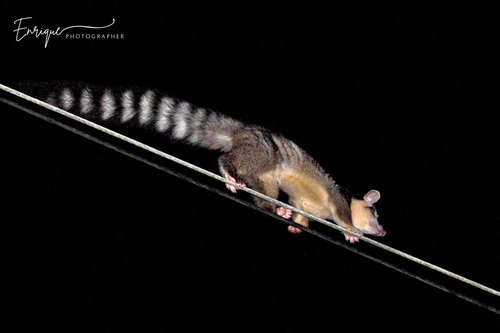
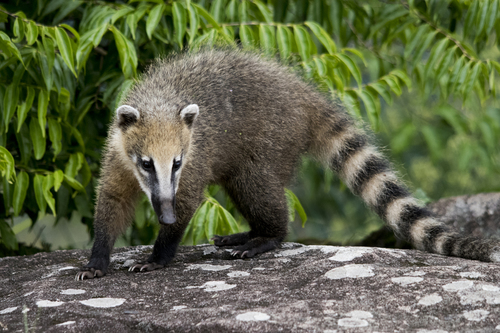
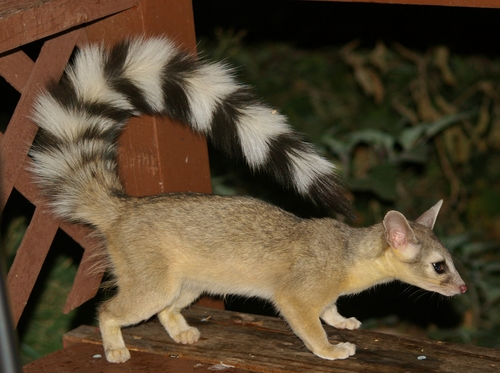
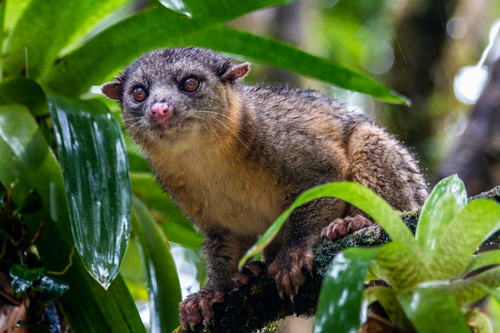
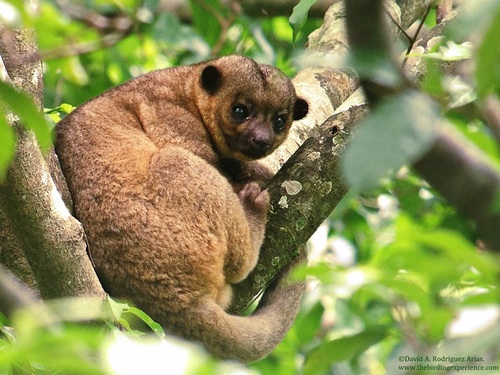
This text describes the physical characteristics, distinguishing features, range and habitat of the kinkajou, which has the scientific name Potos flavus (Schreber, 1774). Kinkajous have round heads, large eyes, a short pointed snout, short limbs, and a long prehensile tail. Total head-and-body length including the tail ranges from 82 to 133 cm (32 to 52 in), while the tail alone measures 39 to 57 cm (15 to 22 in). Mature kinkajous weigh between 1.4 and 4.6 kg (3.1 to 10.1 lb), and females are generally smaller than males. Their short rounded ears measure 3.6 to 5.4 cm (1.4 to 2.1 in). Their eyes reflect green or bright yellow when exposed to light. They have a long, thick, highly extrudable tongue. Their snout ranges from dark brown to black, and they have short, sharp claws. Coat color varies across the species' range and across different times of year. Reported shades for the upper coat and upper side of the tail include tawny olive, wood brown, and yellowish tawny; underparts and the lower side of the tail are typically buff, tawny, or brownish yellow. Some individuals have a black stripe running along the midline of the back. Coat color generally becomes lighter from south to north across the range, and no consistent seasonal color trends have been observed. The fur is short, woolly, dense, and made of two hair types: light yellowish hairs, and darker hairs with brown tips. Darker hairs reflect light more poorly than lighter hairs, which often creates the illusion of spots and dark lines on the coat. The tail is covered in thick fur all the way to its tip. Kinkajous can be distinguished from other procyonids by their small rounded ears, extensible tongue, and prehensile tail. Olingos are similar enough in appearance that many native cultures do not separate the two species; compared to olingos, kinkajous are larger, have shorter muzzles, and lack anal scent glands, in addition to the distinguishing features shared with other procyonids. The binturong, a Southeast Asian viverrid, has similar limb proportions to the kinkajou and is the only other carnivoran with a prehensile tail, though it is much larger than the kinkajou. Kinkajous resemble neotropical monkeys in having a prehensile tail and large forward-facing eyes, but differ from these monkeys in their dentition and the heavy fur covering the soles of their feet. Kinkajous range from east and south of the Sierra Madre in Mexico, throughout Central America, to Bolivia east of the Andes and the Atlantic Forest of southeastern Brazil. They live at altitudes from sea level up to 2,500 m (8,200 ft), and inhabit closed-canopy tropical forests including lowland rainforest, montane forest, dry forest, gallery forest, and secondary forest. Because of this habitat preference, deforestation is a potential threat to the species.