About Poterium sanguisorba L.
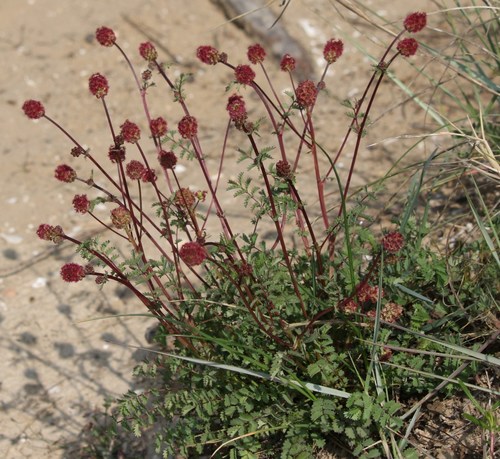
Sanguisorba minor, also known by the scientific name Poterium sanguisorba L., and common names including salad burnet, garden burnet, small burnet, simply burnet (a name also used for the whole Sanguisorba genus), pimpernelle, Toper's plant, and burnet-bloodwort, is an edible perennial herbaceous plant in the Rosaceae family. It has ferny foliage with toothed leaves. Unusual spherical clusters of crimson flowers grow well above the leaves on thin stems. It typically reaches 25 to 55 centimeters in height, though its height depends on available moisture; it can grow as short as 2 centimeters in dry areas. It has large, long taproots that sometimes reach 1 meter (3 feet) long; these taproots store water, which makes the species drought-tolerant. It is evergreen to semi-evergreen: it grows year-round in warmer climates, and stays green until heavy snow forms in cold climates. Individual plants may live over 20 years, though a lifespan of 7 to 12 years is more common. It lives longer when it is allowed to produce seed sometimes. This burnet species flowers in early summer. Recognized subspecies are Sanguisorba minor subsp. muricata, Sanguisorba minor subsp. minor, and Sanguisorba minor subsp. mongolii, the last of which originates from the Mediterranean. It is cultivated in containers, wildflower meadows, ornamental gardens, and kitchen gardens. It is usually grown in locations that are sunny or very lightly shaded, with an equator-facing or west-facing orientation. In North America, it is grown on dry rangelands. It is used for grazing, erosion control, post-fire weed control, firebreaks, and landscape rehabilitation. Because it usually stays green, it is considered fire-resistant. In the past, salad burnet was used medicinally in Europe to control bleeding. It shares the same medicinal properties as medicinal burnet, Sanguisorba officinalis. Historically, it was made into a tea to relieve diarrhea.