About Potentilla tweedyi (Rydb.) Howell
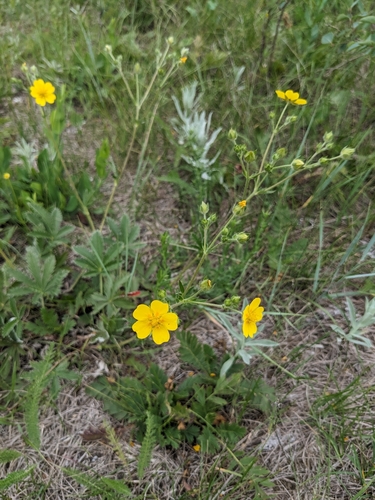
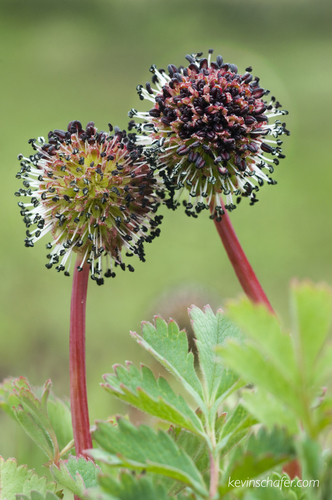
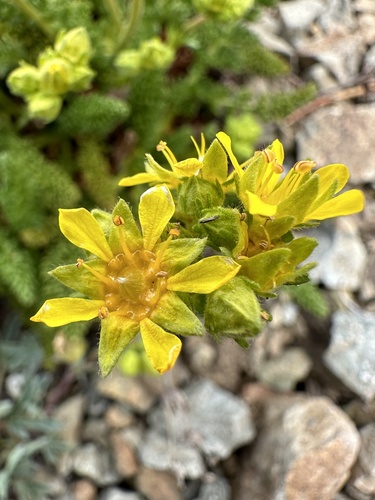
Potentilla tweedyi is a perennial herb that grows up to 20 cm (7.9 in) tall from a stout taproot. It produces finely-dissected, pinnate basal leaves, which often lie somewhat flat and appear to radiate from the central root crown. Its reddish or purplish stems are glandular, and usually finely hairy in their upper sections; each stem holds 1 to 3 small leaves and is topped with a cluster of several flowers. Each flower has five yellow petals surrounded by a shallow bowl-shaped hypanthium. Potentilla tweedyi is similar to Potentilla gordonii, and the two species cooccur in the Pacific Northwest, though Potentilla gordonii has a much wider distribution. The finely-dissected, flat-lying basal leaves of Potentilla tweedyi (also known as Tweedy's ivesia) are a useful distinguishing feature. The petals of Potentilla tweedyi are oblanceolate, spoon-shaped (spatulate), or even broadly obovate, and are wider than the petals of Potentilla gordonii, which are at most narrowly lanceolate or narrowly spatulate. The calyx (hypanthium) of Potentilla tweedyi is also much shallower than that of Potentilla gordonii, and the petals of Potentilla tweedyi are longer than its triangular green to yellow-green sepals. The "mousetail" element in its common name refers to the cylindrical arrangement of many small leaflets around the leaf rachis. Potentilla tweedyi is endemic to the Pacific Northwest region of the United States. It grows in central and northeastern Washington, northern Idaho, and far northwestern Montana (Mineral County). Its typical habitats include dry, gravelly to rocky flats, slopes, alpine ridges, and subalpine conifer woodlands, and it is notable for growing on serpentine. Tweedy's ivesia is suitable for cultivation in rock gardens. It grows best in dry sunny locations "with a good rock to cover the taproot".