About Potentilla reptans L.
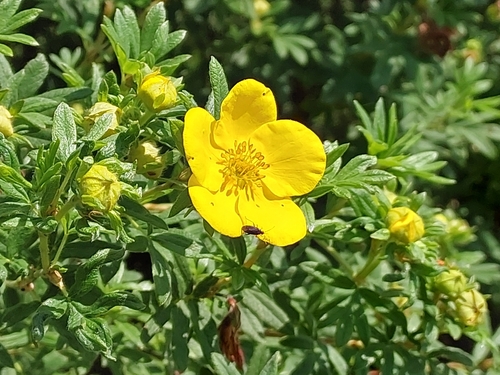
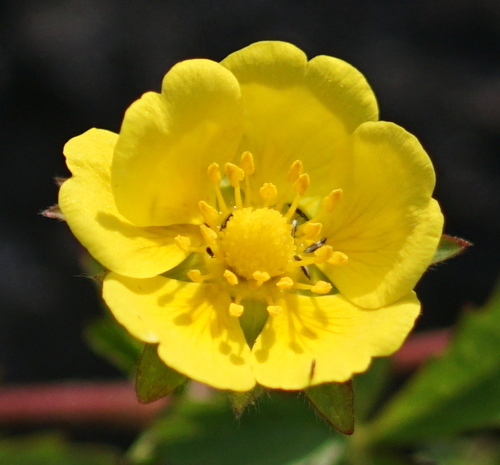
Potentilla reptans L. is a creeping perennial plant that reaches heights up to 20 cm. Its trailing stems can root at the nodes, enabling the species to reproduce through vegetative reproduction. The plant has hairless palmate leaves attached to long stalks, divided into 5 to 7 leaflets, with small green leaf-like stipules at the base. In Europe, it blooms between June and September, producing flowers 7 mm to 11 mm in diameter with heart-shaped yellow petals. These solitary yellow flowers are held on long stalks, have 5 petals and 5 sepals, and contain many stamens and carpels at their center. There are also 5 epicalyx segments, which create the appearance of 10 sepals. The native range of Potentilla reptans covers large areas across Europe, Asia, and Africa. In Europe, it is native to Albania, Austria, Belarus, Belgium, Bulgaria, Corsica, Czech Republic, Denmark, Finland, France, Germany, Great Britain, Greece, Hungary, Ireland, Italy, the Netherlands, Poland, Portugal, Romania, Slovakia, Spain, Sweden, Switzerland, Turkey and Ukraine. In Asia, its native distribution includes Afghanistan, China, Cyprus, Mongolia, Iran, Iraq, Kazakhstan, Kyrgyzstan, Lebanon, Syria, Pakistan, Israel, Palestine, Tajikistan, Turkmenistan and Uzbekistan. In Africa, it is native to Algeria, Eritrea, Ethiopia, Libya, Morocco and Tunisia. Potentilla reptans has been introduced to many countries outside its native range across the globe. It is widely distributed across North America, where it occurs in Bermuda, California, Colorado, Florida, Georgia, Illinois, Kentucky, Louisiana, Maryland, Massachusetts, Michigan, Minnesota, New Jersey, New York, Ohio, Oregon, Pennsylvania, Virginia, Washington and Wisconsin, and in the Canadian provinces of Ontario, Québec and Nova Scotia. It has also been introduced to Australia and New Zealand in Oceania. Potentilla reptans grows in neutral soils, and occupies both natural and human-made habitats including grasslands, hedgerows, roadsides, and arable land. It can also grow as an unwanted weed in grass lawns and flowerbeds. Caterpillars of the grizzled skipper butterfly (Pyrgus malvae) use Potentilla reptans as a food source. Alcoholic extracts made from the roots of Potentilla reptans have shown moderate antimicrobial activity against common wound pathogens.