About Potentilla norvegica L.
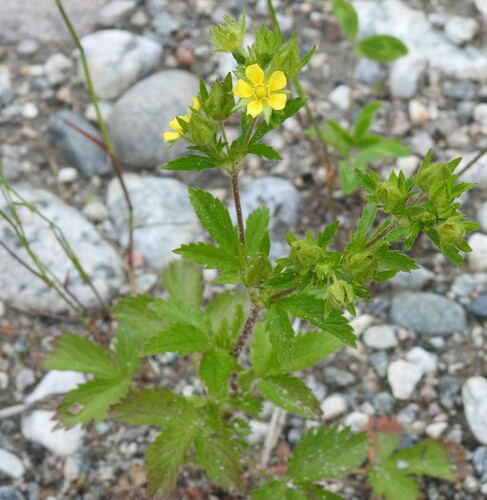
Potentilla norvegica L., commonly called Norwegian cinquefoil, is usually an annual plant, though it may also grow as a short-lived perennial. It grows a basal rosette of leaves from a taproot, then produces an erect green or red stem that reaches a maximum length of around 50 cm (20 in), and branches in its upper sections. Its leaves are stalked, and are either split into five leaflets, or have three leaflets where the terminal leaflet is split into three lobes. The basal leaves have narrow, sharp-tipped stipules, while the upper leaves have elliptical stipules that are longer than the leaf stalks. Each leaflet grows up to 5 cm (2 in) long, is broadly lance-shaped, and has toothed edges. The inflorescence is a cyme that holds several flowers. Each flower has five rounded yellow petals no longer than 4 mm (0.2 in), sitting inside a calyx made of hairy, pointed sepals with reddish tips. Each flower has twenty stamens, a separate gynoecium, and many pistils. After flowering, the calyx lengthens, and the fruit forms as a cluster of pale brown achenes. Norwegian cinquefoil is native to most of Europe, Asia, and parts of North America, and occurs as an introduced species in other regions of the world. Its natural habitats include arable fields, gardens, banks, hedgerows, wasteland, logging clearings, and loading areas, and it is occasionally found on shores, most often growing on sandy or gravelly soils.