About Potentilla indica (Andrews) Th.Wolf
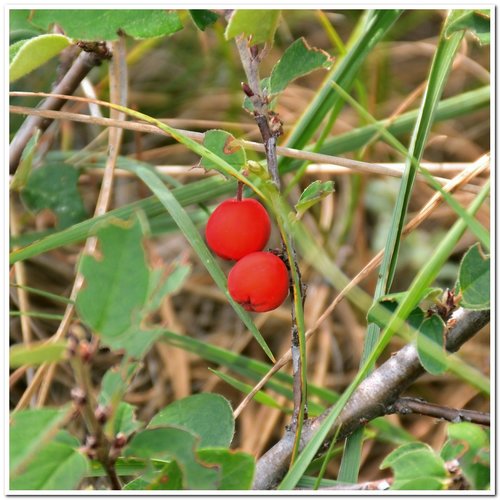
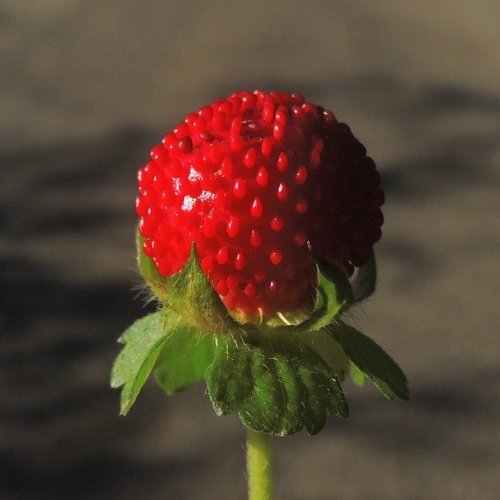
Potentilla indica (Andrews) Th.Wolf is a herbaceous plant that spreads via creeping stolons, rooting and producing new plantlets at each node. Its leaves are trifoliate, dark green, and somewhat thick. Flowers grow individually on axillary peduncles. Each yellow petal of P. indica has a nectar guide near its center that absorbs UV light more strongly than the rest of the petal, and this nectar guide is only visible in the UV spectrum. The most common variety, Potentilla indica var. indica, has red, glossy fruiting receptacles and achenes. A rare form, D. indica f. albocaput Naruh., which has white receptacles and cream achenes, has only been reported in Argentina and Japan.
Fresh berries of this plant are edible, but they are considered less palatable than true strawberries. Roots of Potentilla species, including P. indica, are chewed with betel nuts by the Khasi people of Meghalaya, northeastern India, a practice that extends from use of the widely distributed related species Potentilla fulgens, known in Khasi as lyniangbru and in English as Himalayan cinquefoil, found in Khasi Hills and Jaintia Hills. There are recorded ethnomedicinal uses of P. indica in northeastern India: it is used as an anthelmintic to eliminate parasites, and to treat lung symptoms. A 2018–2020 survey in Assam, India documented that traditional healers use Potentilla indica to treat asthma. In traditional Chinese medicine, it is used to clear heat, cool blood, reduce swelling, and detoxify.