About Potentilla hyparctica Malte
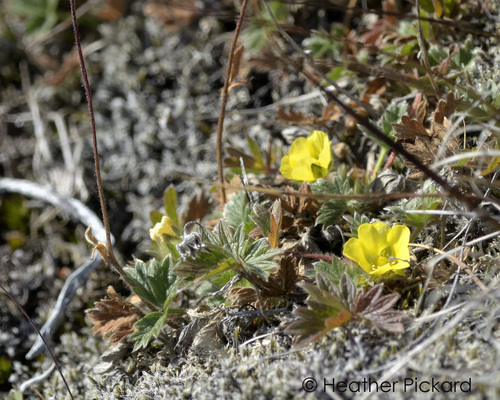
Potentilla hyparctica Malte is a low-growing, tussock-forming herb that grows from a stout caudex. Its prostrate branches are covered in reddish-brown withered leaf sheaths, and end in a rosette of alternately arranged leaves. Each leaf is long-stalked, with a blade made of three stalked, palmately arranged leaflets. Both leafstalks and the upper and lower surfaces of the leaf blade bear short, dense hairs, and the blades are covered in tiny red and yellow glands. Leaflets are oblong or obovate, with shallowly lobed margins and several coarse teeth.
Flowers are borne singly or arranged in a two- to three-flowered cyme with bracts. The flowers are symmetrical, with all floral parts arranged in groups of five. The floral cup holds narrow, oblong bractlets that are nearly as long as the sepals; both the bractlets and sepals are densely covered in short white hairs and bear numerous red glands. Petals can reach up to 9 mm (0.4 in) in length, and are yellow with an orange blotch at the base. This species has numerous stamens, and its carpels are free from one another. The fruit is a nutlet that forms 20 to 30 segments. The fruit remains held in the cup-shaped calyx, and is dispersed ballistically by wind or passing animals.
Potentilla hyparctica has a circumpolar distribution across the Northern Hemisphere, found mostly in the arctic zone. In Europe, it occurs in northern Norway including Svalbard, Finland, an isolated mountain location in northern Sweden, and northern Russia. In Asia, its range stretches from Siberia and Afghanistan to Central Asia and the Himalayas. In North America, it is found in Alaska, northern Canada, and Greenland.
This species grows in a variety of habitat types: both dry and moist heaths, hollows that collect early snowfall, vegetated slopes, damp scree slopes, riverside flats, tussocks in wetlands, and areas where bird droppings accumulate. It most often grows on sand or gravel substrates, and prefers neutral or acidic soils.