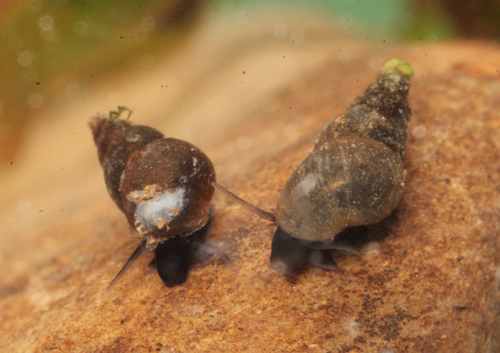
About Potamopyrgus antipodarum (J.E.Gray, 1843)
Potamopyrgus antipodarum (J.E.Gray, 1843) is commonly known as the New Zealand mudsnail. Its shell is elongated, coils dextrally, and has 7 to 8 whorls separated by deep grooves. Shell color ranges from gray to dark brown and light brown. The average shell height is around 5 mm (1/5 inch), with a maximum size of roughly 12 mm (1/2 inch). Individuals in the Great Lakes are usually 4–6 mm long, but grow to 12 mm in the species' native range. This is an operculate snail: its thin, corneous 'lid' (operculum) can seal the shell opening. The operculum has an off-centre nucleus, with paucispiral (few-coil) markings that radiate out from it. The aperture is oval, and its height is shorter than the height of the shell's spire. Some morphs, including many from the Great Lakes, have a keel on the middle of each whorl. Other morphs (not found in the Great Lakes) have periostracal ornamentation like spines, which act as an anti-predator defense. This species was originally endemic to New Zealand, where it lives in freshwater streams and lakes across New Zealand and adjacent small islands. It has since spread widely, becoming naturalized and an invasive species in many regions including Europe (first recorded in England in 1859), Australia (including Tasmania), Asia (Japan and Iraq), and North America (the United States and Canada), most likely spread by accidental human activity. It was first detected in the United States in Idaho's Snake River in 1987. Since then, it has spread to the Madison River, Firehole River, other watercourses around Yellowstone National Park, and has been found across the western United States. While the exact method of transmission is unknown, it was likely introduced in water moved with live game fish, and has spread further via ship ballast or contaminated recreational equipment like wading gear. The New Zealand mudsnail has no natural predators or parasites in the United States, so it has become a damaging invasive species. In the Madison River, densities have reached over 300,000 individuals per square meter, and it can reach concentrations greater than 500,000 per square meter. It endangers local food chains by outcompeting native snails and water insects for food, causing sharp declines in native populations. This in turn harms local fish populations, which rely on native snails and insects as their main food source. New Zealand mudsnails are very resilient. An individual can live 24 hours without water, and can survive up to 50 days on a damp surface. This gives it enough time to be carried between bodies of water on fishing gear. The snails can even survive passing through the digestive systems of fish and birds. They have spread from Idaho to most western U.S. states including Wyoming, California, Nevada, Oregon, Montana, and Colorado. Environmental officials in these states have tried to slow their spread by advising the public to watch for the snails, and to freeze or heat gear that may carry mudsnails. Some rivers have also been temporarily closed to fishing to prevent anglers from spreading the snails. In the United States, the snails grow to a smaller maximum size than they do in their native habitat. In parts of Idaho, they reach no more than 6 mm (1/4 inch), and can be much smaller, which makes them easy to miss when cleaning fishing gear. Clonal species like the New Zealand mudsnail often develop clonal lines with very different appearances, which are called morphs. Until 2005, all snails found in western U.S. states were thought to belong to a single clonal line. However, a second morph has been identified in Idaho's Snake River. It grows to a similar size but has a distinct appearance, and has been nicknamed the salt-and-pepper mudsnail because its final whorl is lighter than the rest of the shell. This morph appears to have been present in the area for several years before it was correctly identified as a distinct morph of Potamopyrgus antipodarum. It outcompetes and dominates the typical morph where the two overlap, and has a much higher proportion of males than the typical morph. In 1991, the New Zealand mudsnail was discovered in Lake Ontario, and is now found in four out of the five Great Lakes. In 2005 and 2006, it was found to be widespread across Lake Erie. By 2006 it had spread to Duluth-Superior Harbour and the freshwater estuary of the Saint Louis River. It was found living in Lake Michigan after scientists collected water samples there in early summer 2008. The snail population in the Great Lakes belongs to a different clonal line than those in western U.S. states, and was likely introduced indirectly through Europe. In 2002, the New Zealand mudsnail was discovered in the Columbia River Estuary. In 2009, the species was discovered in Capitol Lake in Olympia, Washington. The lake has been closed to all public use including boating and other recreation since 2009. A heavy cold snap in 2013, paired with a planned water level drawdown, was estimated to have killed roughly 40–60% of the lake's mudsnail population. Other known locations in Washington include the Long Beach peninsula, Kelsey Creek (King County), Thornton Creek (King County), and Lake Washington. In 2010, the Los Angeles Times reported that the New Zealand mudsnail had infested watersheds in the Santa Monica Mountains, posing serious threats to native species and complicating efforts to improve stream water quality for the endangered Southern California Distinct Population Segment of steelhead. According to the report, the snails expanded from the first confirmed sample in Medea Creek in Agoura Hills to nearly 30 other stream sites over four years. Researchers at the Santa Monica Bay Restoration Commission believe the snails' expansion was sped up when the mollusks moved between streams on the gear of contractors and volunteers. As of 21 September 2010, Boulder Creek and Dry Creek in Colorado have New Zealand mudsnail infestations. The snails have been present in Boulder Creek since 2004, and were discovered in Dry Creek in September 2010. Access to both creeks was closed to help prevent further spread. In summer 2015, a large-scale industrial wetland rehabilitation project was carried out in northeast Boulder to eliminate a local mudsnail infestation. This snail tolerates siltation, thrives in disturbed watersheds, and benefits from high nutrient flows that allow filamentous green algae to grow. It lives among macrophytes and prefers littoral zones in lakes or slow streams with silt and organic matter substrates, but can also tolerate high flow environments by burrowing into sediment. In the Great Lakes, the snail reaches densities as high as 5,600 individuals per square meter, and is found at depths between 4 and 45 m on silt and sand substrates. This species is euryhaline, and can establish populations in both fresh and brackish water. Its optimal salinity is probably near or below 5 parts per thousand, but Potamopyrgus antipodarum can feed, grow, and reproduce at salinities between 0 and 15 ppt, and can tolerate 30–35 ppt for short periods. It tolerates temperatures ranging from 0 to 34 °C. Potamopyrgus antipodarum is ovoviviparous and parthenogenic, meaning it can reproduce asexually: females are born with developing embryos already present in their reproductive system. Native populations in New Zealand consist of diploid sexual females, triploid parthenogenically cloned females, and sexually functional males, with males making up less than 5% of the total population. All introduced populations in North America are clonal, made up entirely of genetically identical females. Because this species can reproduce both sexually and asexually, it has been used as a model organism to study the costs and benefits of sexual reproduction. Asexual reproduction lets every individual in a population produce offspring, and avoids the energy cost of finding mates. However, asexual offspring are clonal, so they have no genetic variation. This makes the entire clonal population susceptible to parasites, because all individuals share the same parasite resistance mechanisms. Once a parasite strain evolves to overcome these mechanisms, it can infect any member of the population. Sexual reproduction mixes resistance genes through crossing over and random gamete assortment during meiosis, so all individuals in a sexual population have slightly different combinations of resistance genes. This variation means no single parasite strain can infect the entire population. New Zealand mudsnails are commonly infected with trematode parasites, which are especially abundant in shallow water and scarce in deeper water. As this model predicts, sexual reproduction is dominant in shallow water, due to its advantages for parasite resistance. Asexual reproduction is dominant in the deeper water of lakes, because the low number of parasites means the resistance advantages of sexual reproduction do not outweigh its costs. Each female New Zealand mudsnail can produce between 20 and 120 embryos. A single snail produces approximately 230 young per year. Reproduction takes place in spring and summer, and the species has an annual life cycle. The snail's rapid reproduction rate lets its population grow very quickly in new environments. The highest recorded concentration of New Zealand mudsnails was in Lake Zurich, Switzerland, where the species colonized the entire lake within seven years, reaching a density of 800,000 individuals per square meter.

