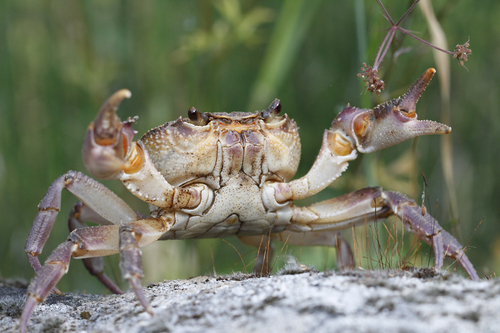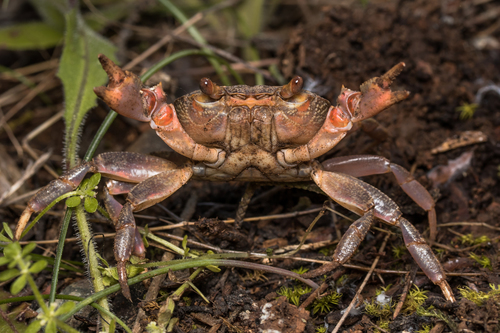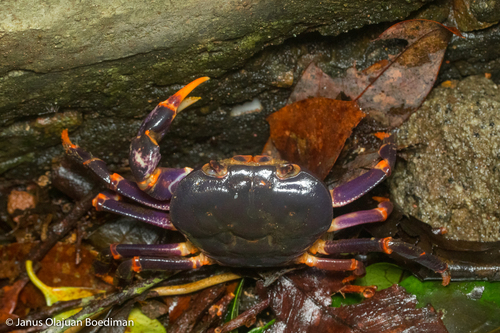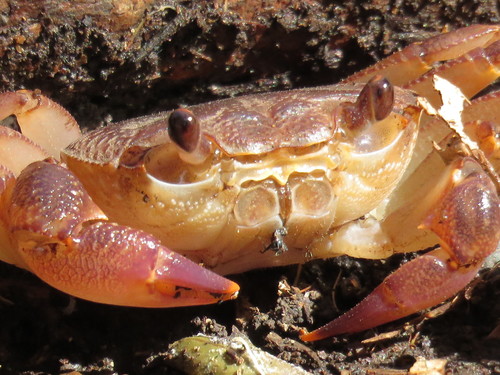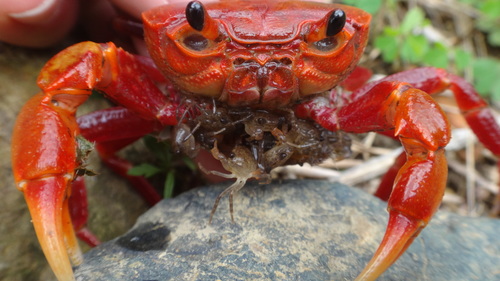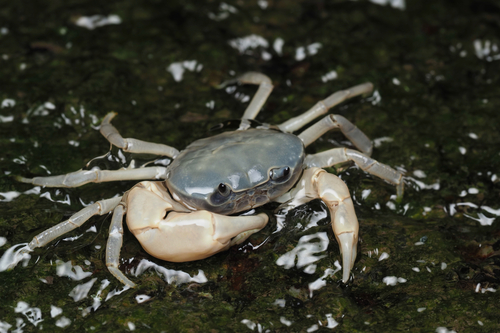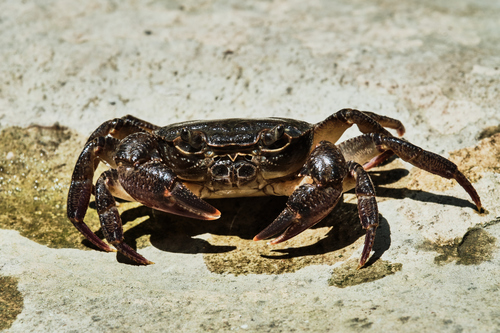
About Potamon ibericum (Marschall de Bieberstein, 1809)
Potamon ibericum can be distinguished from other species in its genus by the shape of the male’s first pleopod, the organ used to transfer spermatophores. In P. ibericum, the flexible region of this appendage is widest near its middle, rather than V-shaped (the form seen in P. fluviatile and P. rhodium) or bilobed (the form seen in P. potamios).
The natural distribution range of P. ibericum is large, but highly fragmented. In Europe, the species occurs in the Danube and its tributaries in Bulgaria, rivers in North Macedonia, north-eastern Greece east of the Axios River, Cyprus, the European part of Turkey, and along the Black Sea coast from Ukraine through to the Caucasus. Despite its specific epithet ibericum, the species does not live on the Iberian Peninsula – which has no native freshwater crabs – and the name refers instead to Caucasian Iberia. The Asian portion of the species’ natural range extends across Turkey to Iran and Turkmenistan. Some historical locations that once hosted P. ibericum populations have experienced occasional desiccation, which has reduced or completely eliminated these crab populations. The northern range limit of P. ibericum, like that of its western relative P. fluviatile, lies close to the 0 °C (32 °F) January isotherm.
P. ibericum was introduced to the Cagne River in southern France between 1975 and 1983, when the crayfish species Astacus leptodactylus was imported for aquaculture from Turkey. Today the crab occurs around 6 km (3.7 mi) downstream of the original introduction site, at the entrance to a series of gorges in a section of the river that rarely dries up. A second introduced population was found in the 1990s, 300 km (190 mi) from the Cagne River site, in the Hérault River near Saint-Guilhem-le-Désert. Neither of these introduced populations is considered invasive. A different Potamon species, P. fluviatile, has also been introduced to France near Nice.
Fossil crabs classified as the species "P. antiquum" have been found in Pliocene–Pleistocene aged sediments in northern Hungary. This species was previously thought to be the ancestor of several living Potamon species, including P. fluviatile and P. ibericum. However, the young age and geographical location of these fossils indicates that "P. antiquum" may actually be P. ibericum specimens from ancient populations that existed north of the species’ current range limit. Fossils assigned to P. ibericum from Vallesian sediments at Richardhof in the Vienna Basin suggest that these crabs preyed on an extinct snail species in the genus Melanopsis.
For long-term survival, P. ibericum generally requires a permanent body of water, though the crabs can survive short droughts by hiding under stones or retreating into deep burrows. These burrows may be located several kilometres from the nearest permanent water body. The species only breeds in moving water, and copulation takes place during the warmer months from June to October. P. ibericum is an omnivore. It feeds on detritus, filamentous algae, and plant material, as well as a range of animals including worms, amphipod crustaceans, aquatic insect larvae, molluscs, frogs and tadpoles, fish, and carrion. It forages on land at night, and will also forage during the day if air humidity is high enough. In regions where P. ibericum occurs, it is a major prey item for the European otter, Lutra lutra, alongside a range of fish species.