About Potamogeton trichoides Cham. & Schltdl.
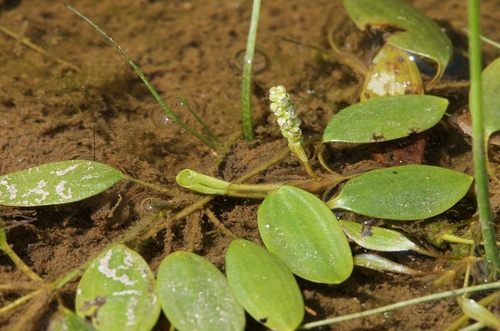
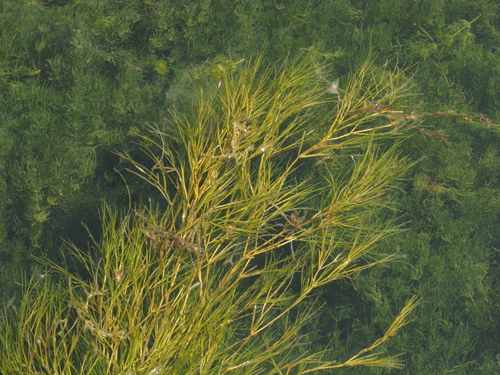
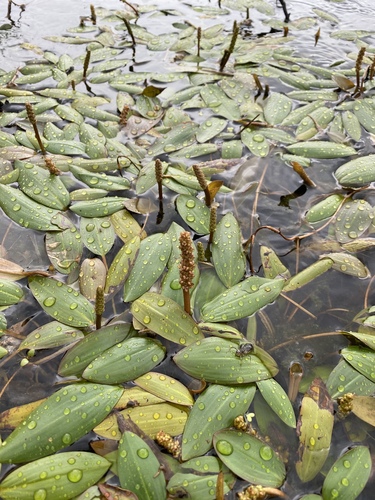
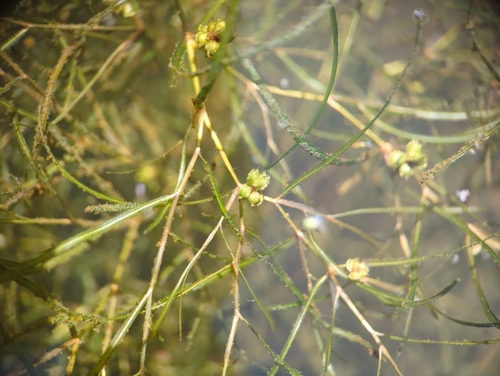
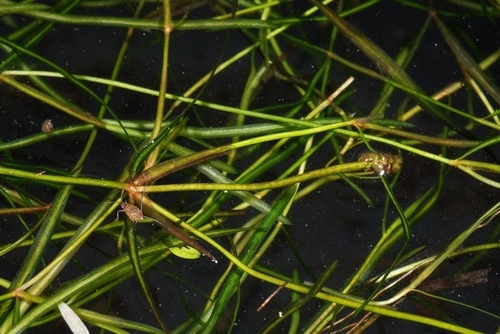
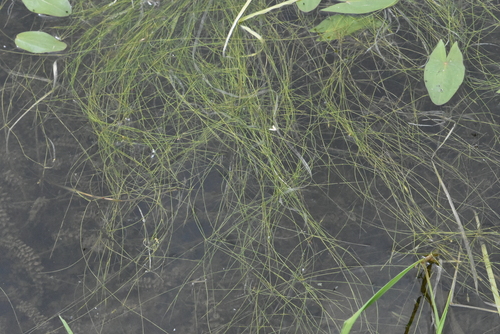
Hairlike pondweed (Potamogeton trichoides Cham. & Schltdl.) is an aquatic perennial plant. Each winter, it dies back to leave numerous asexually produced resting structures called turions, and it does not grow rhizomes. It produces slender, cylindrical or slightly compressed branching stems; these are usually less than 1 metre long, but may occasionally reach 2 metres. All its leaves are submerged; these leaves are long and very narrow, typically 16–80 mm long and 0.3–1 mm wide. Near the leaf base, the midrib can take up to 70% of the leaf's total width. The leaves are rigid and green, and darken as they age. This species does not produce floating leaves. Its inflorescence is a short spike holding 3–5 flowers, which rises above the water on a slender peduncle. This species readily hybridizes with several other Potamogeton species: hybrids include Potamogeton × franconicus G.Fisch. with P. berchtoldii, Potamogeton × grovesii Dandy & G.Taylor with P. pusillus, and Potamogeton × ripoides Baagøe with P. compressus. Hairlike pondweed is diploid, with a chromosome count of 2n=26. Among fine-leaved pondweeds, hairlike pondweed is one of the most distinctive, thanks to its characteristically stiff leaves dominated by the midrib, and its open but tightly rolled stipules. However, it is generally rarer than other fine-leaved pondweed species, and it often grows in mixed stands with other fine-leaved aquatic plants such as P. pusillus and Zannichellia palustris, so it is frequently overlooked. Potamogeton trichoides is native to the western Palaearctic and Africa. It is found in northern Europe (including Austria, Britain, Czech Republic, Denmark, France, Germany, Italy including Sicily, Norway, Spain, Sweden, Switzerland, Poland, Russia, and the Baltic States), North Africa (including Morocco, Algeria, Tunisia, Libya, and Egypt), and eastern and southern Africa (including South Africa, Tanzania, Uganda, and Zimbabwe). Outlying populations exist in the Canary Islands, the Caucasus, and the part of Russia east of the Ural Mountains. Hairlike pondweed grows mainly in still water environments: this includes ponds, lakes, ditches, canals, and slow-flowing rivers and streams. It is usually restricted to calcareous water with relatively high conductivity, and it can tolerate high nutrient levels. It is often an early succession species that colonizes newly created habitats like ditches and flooded gravel pits, but it can sometimes be abundant in low-altitude alkaline lakes. It frequently grows alongside other nutrient-tolerant aquatic macrophytes including Myriophyllum spicatum, Potamogeton crispus, P. pusillus, and Ranunculus circinatus. In Britain, hairlike pondweed populations are thought to be stable or possibly increasing. However, it is assigned to various threat categories across parts of its range: for example, it is classified as Vulnerable in the Czech Republic and Germany (it remains widespread across all major German river systems), and Critically Endangered in Switzerland. Potamogeton trichoides is not generally cultivated, and has little value for gardening.