About Potamogeton polygonifolius Pourr.
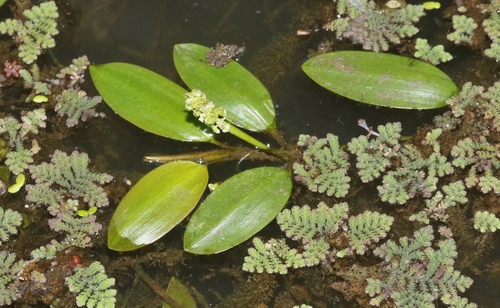
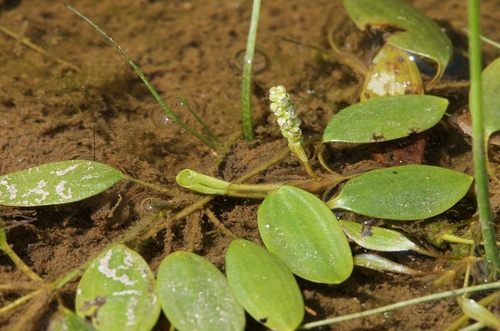
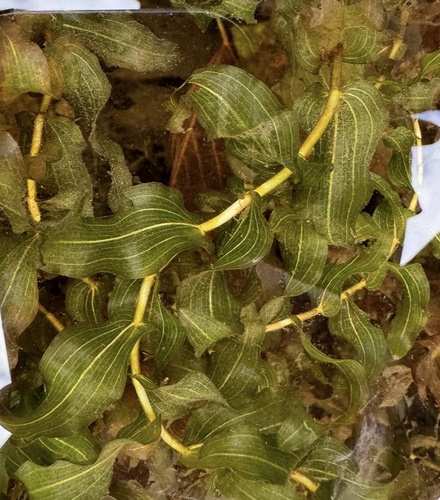
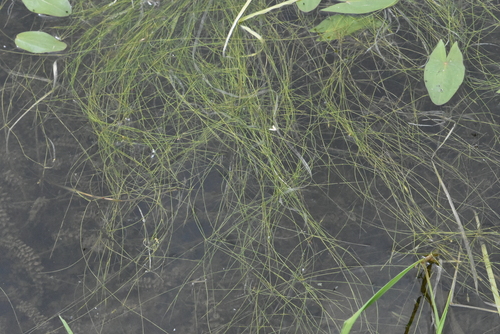
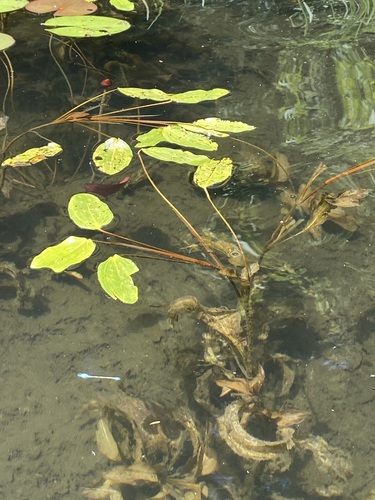
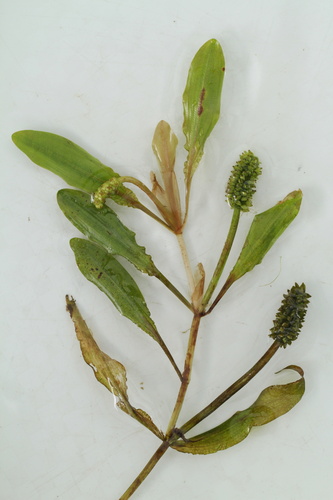
Bog pondweed, Potamogeton polygonifolius Pourr., is a perennial plant that grows from creeping rhizomes. Its stems grow up to 0.7 m long, are terete and unbranched. The plant's submerged leaves are 60–160 mm long and 2.5–24 mm wide, being relatively narrow, delicate and translucent, with petioles 14–80 mm long. These leaves tend to decay fairly early in the growing season, typically once the floating leaves develop. The floating leaves are opaque, measure 40–105 × 15–70 mm, and are usually brownish or dark green, with a pink tint when young. They have inconspicuous secondary veins. This species does not produce turions. Its inflorescences grow up to 42 mm long and bear many small greenish flowers. The fruits measure 1.9–2.6 mm × 1.4–1.9 mm: they are larger than the fruits of Potamogeton coloratus, but smaller than those of Potamogeton natans.
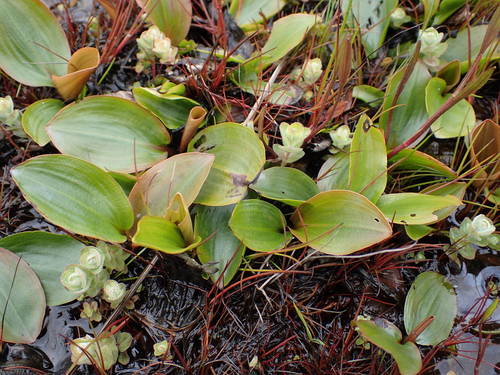
Bog pondweed is highly variable, and grows both as a terrestrial plant in seeps and wet moss, and as an aquatic form. Terrestrial forms in particular are often very difficult to identify. It is most easily confused with P. natans, which it resembles in overall growth habit. However, P. polygonifolius can usually be distinguished by the presence of fully formed submerged leaves, which are reduced to strap-like phyllodes in P. natans, and by the lack of a discoloured mark at the base of the floating leaves. The submerged leaves of Potamogeton alpinus may look similar, but those of P. alpinus are sessile.
Although bog pondweed is a common plant, it does not appear to hybridise readily with other pondweeds. That said, hybrids with P. natans (Potamogeton × gessnacensis G.Fisch.), P. gramineus, P. alpinus (Potamogeton × spathulatus Schrad. ex W.D.J.Koch & Ziz), P. berchtoldii (Potamogeton × rivularis Gillot) and P. pusillus have been recorded.
Potamogeton polygonifolius is mainly restricted to western Europe, including Britain, Ireland, France, the Netherlands, Belgium, and Denmark. It occurs more locally across the rest of its range, including Northern Iberia, Germany, mainland Italy, Sicily, southern Scandinavia, the Baltic states, the Balkans, and eastern Europe. There are outlying populations in North Africa (Morocco, Algeria), Orkney, Shetland, the Faroe Islands, and Newfoundland. Fossils of this species have been found in Russia. The taxonomic status of reported populations in the Himalayas requires confirmation, and a published record from China was based on misidentification of Potamogeton distinctus.
In Britain and Ireland, this is one of the most common pondweed species, growing in almost any wet or semi-wet oligotrophic, acidic habitat, as long as water flow is not too rapid. It can be found in lakes, slow-flowing rivers, ponds, ditches, seeps, and among bog mosses (Sphagnum). As its common name suggests, it is common in blanket bog areas, but can also grow in secondary habitats such as unshaded drainage ditches in bogs and forest plantations. In British rivers, it typically grows alongside other soft-water species such as Ranunculus flammula, Carex nigra, Carex rostrata, Scapania undulata, and Equisetum fluviatile. In lakes, it tends to grow in base-poor, oligotrophic waters alongside species such as Littorella uniflora, Sphagnum spp., Lobelia dortmanna, and Isoetes lacustris, especially on peaty substrates. Potamogeton polygonifolius is tolerant of acidic conditions, so it has not been negatively impacted by widespread acidification of upland habitats in Britain. However, in very acidified pools in the Netherlands (pH < 5), catchment liming increased the abundance of this species along with other threatened species. While it strongly prefers soft waters, bog pondweed may also occur in calcareous but low-nutrient habitats.
In lowland areas, this species is more scattered, and has declined in southern and eastern England due to nutrient enrichment. In Central Europe, Potamogeton polygonifolius is threatened, and is classified as endangered in Germany, Poland, Switzerland, the Czech Republic, and Luxembourg. Even so, remaining populations in this region are still robust and reproduce freely. Bog pondweed is also a Red List species in the Netherlands.
Bog pondweed is not generally cultivated, although it is easy to grow. Its preference for shallow water makes it very well suited for garden ponds, but it would probably be difficult to establish in high-nutrient, hard water areas.