About Potamogeton perfoliatus L.
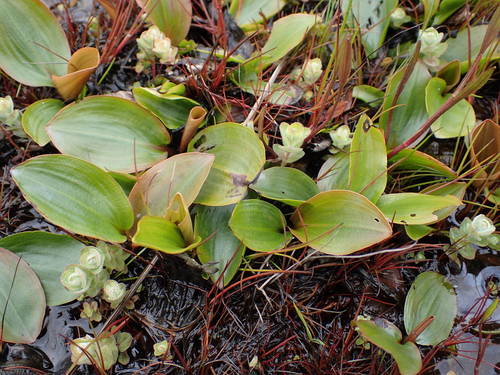
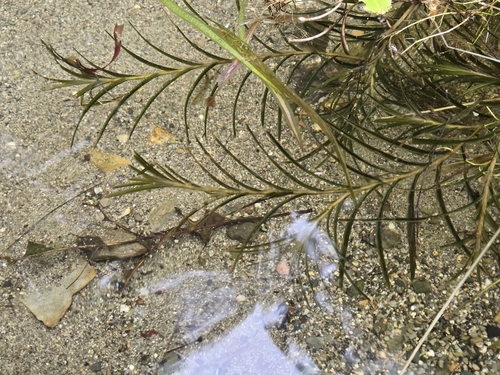
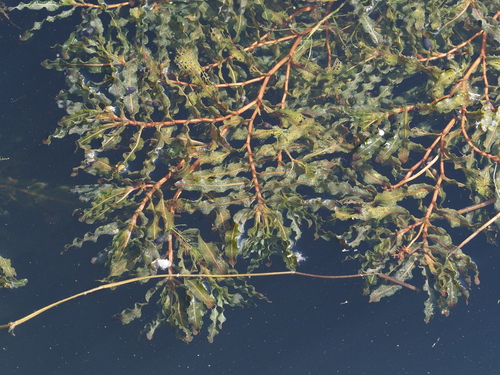
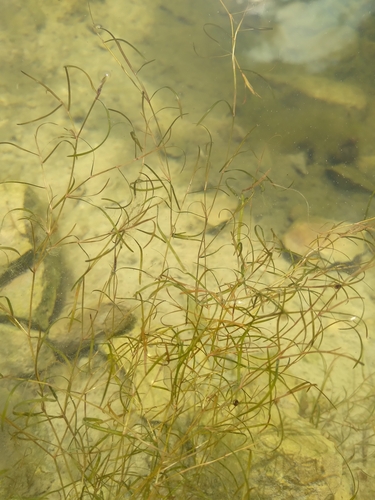
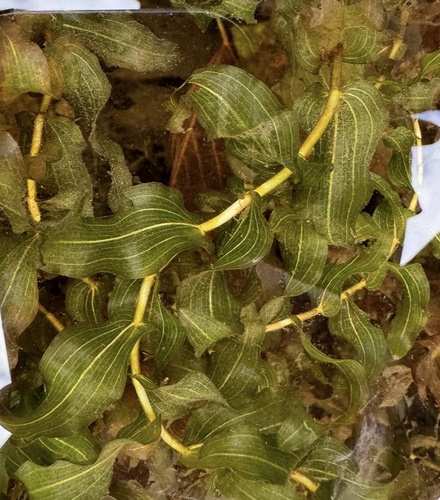
Perfoliate pondweed (Potamogeton perfoliatus L.) grows from a strong creeping perennial rhizome, and produces intermittent round stems that can reach up to 3 m in length. Its submerged leaves are oval, translucent, and stalkless, measuring 20–115 mm long and 7–42 mm wide. The leaves clasp the stem (a trait called perfoliate), have a flat apex, and bear 5–12 veins on each side of the midrib. Leaf colour varies widely, and may be bright green, dark green, yellowish, olive, or brownish. This species produces no floating leaves. Its stipules are quite delicate, and typically fall off soon after a new leaf unfurls. Inconspicuous flowers are produced between June and September. The fruits are 4 mm across and olive green in colour. Two subspecies have been formally described: subsp. perfoliatus occurs in the Old World, while populations on the eastern seaboard and Gulf States of North America are treated as subsp. bupleuroides. Because many pondweeds, including P. perfoliatus, naturally vary in response to local growing conditions, these variants may be ecotypes rather than true subspecies. The related species Potamogeton richardsonii was formerly classified as a subspecies of P. perfoliatus, but is now recognised as a separate species. Like most other broadleaved pondweeds, perfoliate pondweed is tetraploid, with a chromosome count of 2n=52. Across most of its range, perfoliate pondweed is unlikely to be confused with any other pondweed species except possibly Potamogeton praelongus. In North America it may be confused with P. richardsonii, but P. richardsonii has stipules that break down into persistent fibres even on the lower stem, while the stipules of P. perfoliatus disintegrate completely. Perfoliate pondweed regularly hybridises with other Potamogeton species, including P. crispus (forming P. × cooperi (Fryer) Fryer), P. gramineus (forming P. × nitens Weber), P. lucens (forming P. × salicifolius Wolfg.), P. alpinus (forming P. × prussicus Hagstr.), P. berchtoldii (forming P. × mysticus Morong), P. wrightii (forming P. × anguillanus Koidz.), P. maackianus (forming P. × leptocephalus Koidz.), P. alpinus (forming P. × prussicus Hagstr.), P. nodosus (forming P. × assidens Z. Kaplan, Zalewska-Gałosz et M. Ronikier), P. richardsonii (forming P. × absconditus Z. Kaplan, Fehrer & Hellq.), P. epihydrus (forming P. × versicolor Z. Kaplan, Hellq. and Fehrer) and P. praelongus (forming P. × cognatus Asch. & Graebn.). The first three of these hybrids are quite common. A triple hybrid, P. gramineus × lucens × perfoliatus (P. × torssandrii (Tiselius) Dörfler), is also known. Many of these hybrids are perennial, long-lived, and sometimes occur even when one or both parent species are not present, so extra care is needed when identifying unusual specimens. Potamogeton perfoliatus has a broad global distribution, occurring on all continents except South America and Antarctica. It has been recorded in Asia (including Afghanistan, India, Sumatra (Indonesia), Japan, Kazakhstan, Korea, Kyrgyzstan, Mongolia, Pakistan, Russia, Tajikistan, Uzbekistan), Australia, eastern and southeastern United States (North America), Europe (extending south to Spain, Central Italy and the Balkans, and including Scandinavia, Britain, Ireland and Iceland), North Africa (Algeria, Tunisia, Egypt), and the Near and Middle East. It is widespread in lakes and rivers across the British Isles and Ireland, and common across much of Eurasia and North America, but has a more scattered distribution towards the southern edge of its range. P. perfoliatus grows in a wide range of freshwater habitats including lakes, rivers, streams, large ponds, canals, and larger drains and ditches. It cannot tolerate drying out, and the healthiest, most robust plants typically grow in water more than 1 m deep. Unlike most other broad-leaved pondweeds, it is reasonably tolerant of water flow, so it can successfully grow in running waters. It is not especially sensitive to water chemistry as long as the water remains reasonably clear and not excessively base-poor, and occurs in habitats as varied as exposed Scottish lochs and lowland fenland rivers. However, at high nutrient concentrations, it is vulnerable to shading from phytoplankton, epiphytic algae, and filamentous algae. It may also grow in brackish or estuarine habitats, most notably in Chesapeake Bay, though elevated salt concentrations negatively affect both its growth and flowering. Waterbirds, fish, water beetles, and caddis larvae are all important grazers of perfoliate pondweed, which can reduce its biomass or even eliminate it from local areas. Perfoliate pondweed is less threatened than other broadleaved pondweeds, but it is listed as Vulnerable in Spain and the Netherlands and Endangered in Flanders. Ongoing efforts are underway to restore its populations in Chesapeake Bay, where it was formerly a co-dominant species. Perfoliate pondweed is the most common species of the so-called Magnopotamion group of pondweeds. This group is a characteristic floristic component of the protected European Habitats Directive habitat Type 'Natural eutrophic lakes with Magnopotamion'. Perfoliate pondweed is not widely cultivated, which is considered surprising as it has few ecological requirements and is an attractive plant. Like other pondweeds in this group, it roots poorly from stem cuttings, and is best propagated by dividing its rhizomes. It is easy to grow in a garden pond or even in a barrel, but unlike some other submerged plants, it needs to be able to root in a suitable substrate such as sand or aquatic compost. Keeping nutrient levels low helps prevent it from being smothered by algae and more invasive aquatic plants. Newly planted established plants should be weighted down initially to allow them to root, and benefit from being planted among other aquatic plants that act as a nursery. Transplants have a high survival rate once they are established. P. perfoliatus may also be established from seed, which should be sown onto a suitable substrate in shallow water. The seed should be left uncovered, or only covered with a minimal layer of substrate to hold it in place and allow root development, as seed buried more than 1 cm deep either fails to germinate or the seedlings die. Seed typically germinates within about 10 days. While it is possible to grow perfoliate pondweed in fish ponds, it is vulnerable to fish predation during early establishment, so it should be protected while it becomes established.