About Potamogeton obtusifolius Mert. & W.D.J.Koch
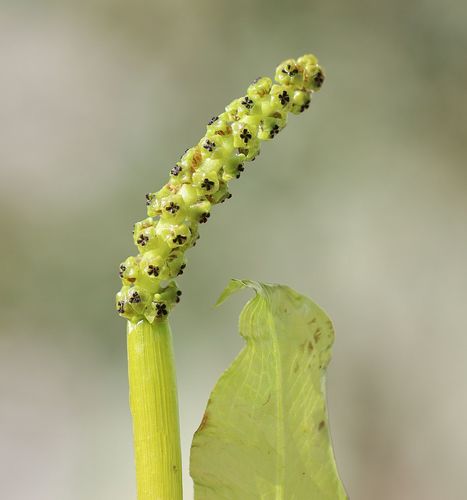
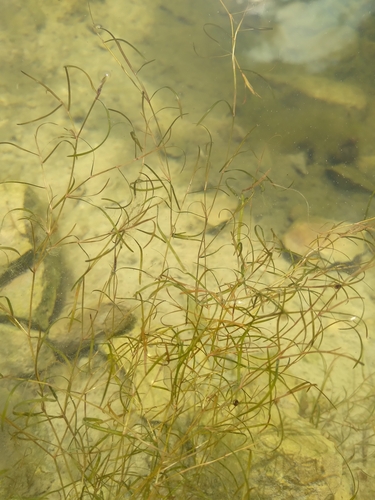
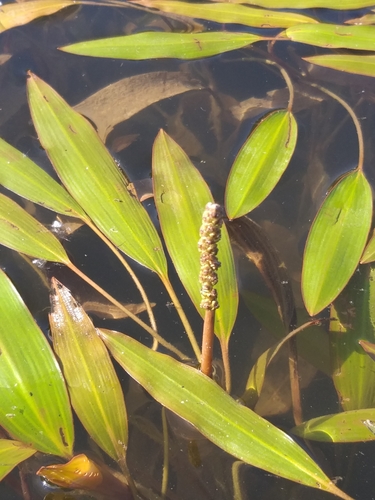
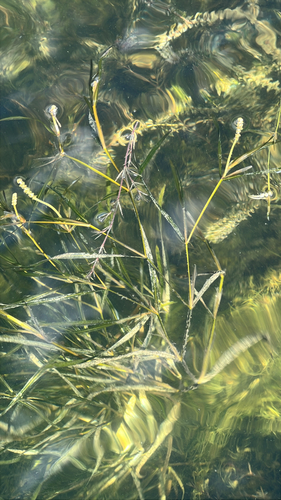
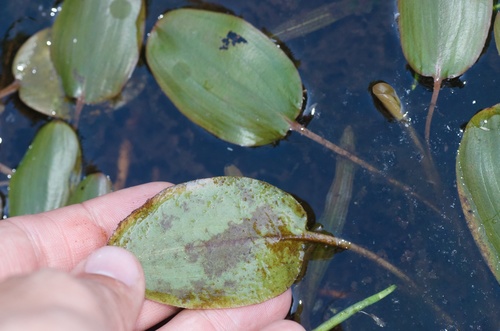
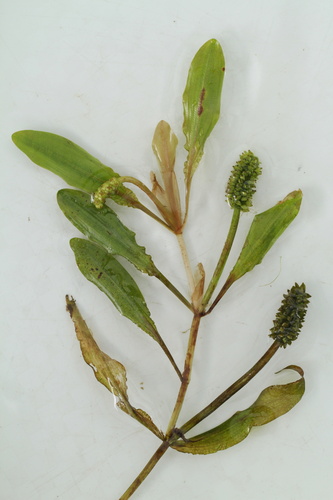
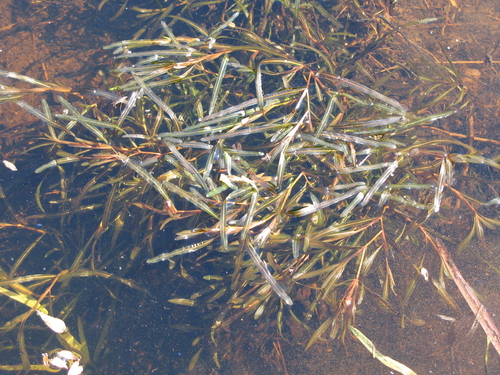
Blunt-leaved pondweed, Potamogeton obtusifolius Mert. & W.D.J.Koch, grows annually from turions and seed, producing branching plants with slender, flattened stems that bear well-developed nodal glands — these appear as two raised bumps on the stem where a leaf attaches. Its submerged leaves are long, rather grass-like, sessile, and translucent. They measure 48–85 mm long (rarely up to 100 mm) and 1.5–3.55 mm wide, and are pale green, often with a distinct reddish or brownish tinge overall, plus a pink tinge along the midrib. There are 1–2 lateral veins on either side of the midrib. As the common name suggests, leaf tips are rather blunt, though close inspection usually reveals a narrow point at the tip. Stipules are open, and the species produces no rhizomes or floating leaves. Abundant turions form along the stem, especially in autumn as the rest of the plant disintegrates. Flower spikes are short and dense, 4–9 mm long, holding 6–8 flowers each. Fruits are freely produced, measuring approximately 3 × 2 mm. Within its range, blunt-leaved pondweed can be confused with other fine-leaved pondweeds, especially Potamogeton berchtoldii and P. friesii, and potentially also P. pusillus. The combination of open stipules, rounded leaf tips, dense flower spikes, and a tendency to form a bushy mass of growth at the surface helps distinguish this species, though use of a botanical key or flora is recommended. Potamogeton obtusifolius is diploid, with a chromosome count of 2n=26. According to a key monograph on the genus Potamogeton, no hybrids of P. obtusifolius have been confirmed. However, P. × saxonicus Hagstr. has been suggested to be the hybrid between P. obtusifolius and P. pusillus. Potamogeton obtusifolius has a wide global distribution, occurring in North America (Canada, northern United States), Europe (Scandinavia, Central Europe, Northern Balkans, Great Britain, Ireland, France, Northern Spain), and Asia (Northeast China's Heilongjiang Province, Russia, Japan, Kazakhstan, Kyrgyzstan, Mongolia, Myanmar, Caucasus, Iran). In Britain, P. obtusifolius grows in a range of standing water habitats including ponds, ditches, canals, and shallow lakes, favouring circumneutral or slightly acidic waters. It is strictly a lowland plant and is rarely found in running water, except where current speeds are very slow. Though it is widely distributed, it has a patchy distribution and is not usually abundant at any individual site. Like other fine-leaved pondweeds, P. obtusifolius probably benefits from a moderate amount of disturbance to suppress competing vegetation. It tends to favour smaller water bodies and tolerates poor water quality, including turbid water, reasonably well. Despite this tolerance, blunt-leaved pondweed does not usually proliferate in eutrophic lakes. It is possible that this species is rather sensitive to wind action. In cultivation, P. obtusifolius leaves were eaten by three different species of non-biting midge (chironomid) larvae. Globally and on many national Red Lists, blunt-leaved pondweed is classified as Least Concern. However, it has suffered local declines: it is listed as Critically Endangered in Switzerland, Vulnerable in Germany, Very Rare in Luxemburg, Endangered in New Jersey and Pennsylvania, and Sensitive in Washington. It is considered to have declined in Britain, but remains widespread there, and is still listed as Least Concern in the country. Blunt-leaved pondweed is not presently in cultivation. Its wide ecological tolerance suggests it may not be difficult to grow, but it would probably require a deeper substrate than what is usual in most ornamental ponds. It can also be grown in aquaria by anchoring turions in sand or mud. It is also likely to compete poorly with other pond plants.