About Potamogeton lucens L.
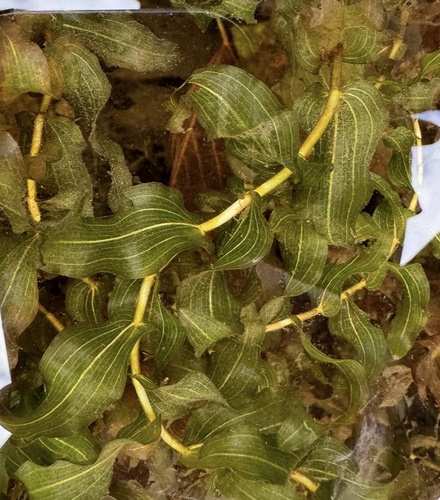
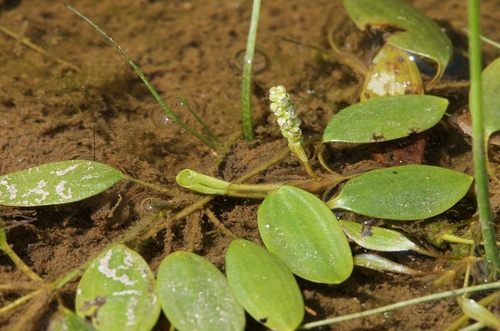
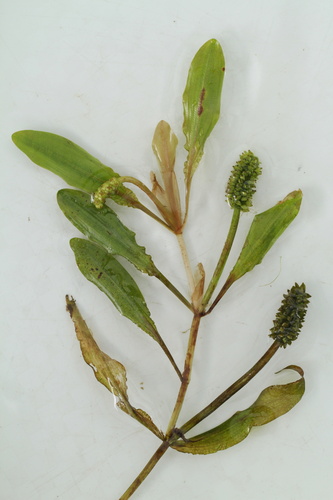
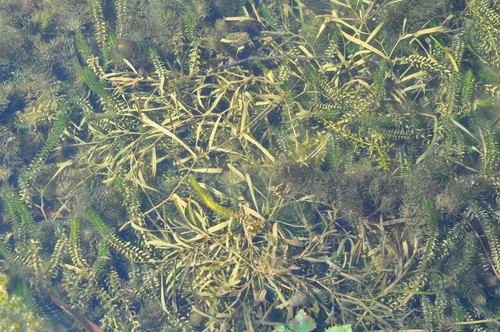
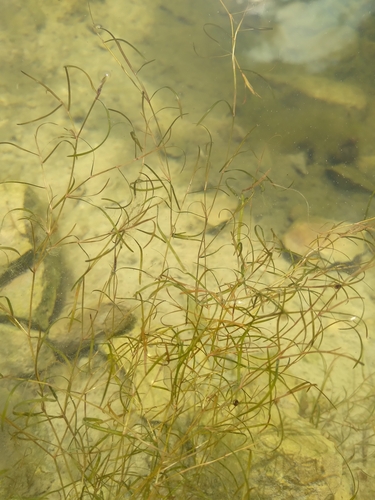
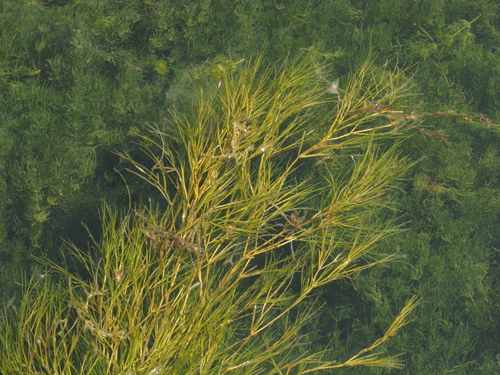
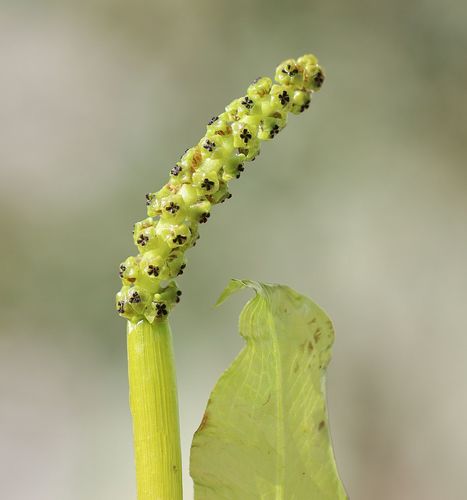
Potamogeton lucens L., commonly called shining pondweed, is a large aquatic plant with robust creeping rhizomes and long, cylindrical branching stems. Stems typically grow up to 2.5 m long, and can reach an exceptional maximum length of 6 m. Its leaves are large, ranging from 75–200 mm long (and longer in exceptional cases) and 25–65 mm wide, with a length 2–6 times their width. Like the smaller species Potamogeton gramineus, shining pondweed has smaller leaves on its branches than on its main stem. Leaves are pale green or yellowish, translucent, and shiny, with distinctive netted veining, finely toothed minutely denticulate margins, and a short petiole 1–12 mm long. Floating leaves are completely absent. Flowers bloom between June and September, and the mature fruits measure 3 mm across. Like most other broad-leaved pondweeds, Potamogeton lucens is tetraploid, with a chromosome count of 2n=52. Across most of its range, shining pondweed is unlikely to be confused with other pondweed species. However, the closely related, similar species Potamogeton schweinfurthii has recently been discovered in southern Europe. P. lucens can usually be distinguished by its relatively broader leaves (2–6 times as long as wide), with most or all leaves bearing a petiole, though some forms are very difficult to tell apart without a detailed comparison of multiple traits. Shining pondweed forms hybrids with a variety of other pondweed species: with P. gramineus it produces P. × angustifolius J.Presl., with P. perfoliatus it produces P. × salicifolius Wolfg., with P. alpinus it produces P. × nerviger Wolfg., with P. nodosus it produces P. × subrufus Hagstr., with P. sarmaticus it produces P. × pseudosarmaticus Papch., with P. crispus it produces P. × cadburyae Dandy & G.Taylor, with P. praelongus it produces P. × jutlandicus Zalewska-Gał., with P. natans it produces P. × fluitans Roth, and with P. wrightii it produces P. × inbaensis Kadono in Japan and China. Some of these hybrids are quite common, and are not always easy to distinguish from pure P. lucens. A triple hybrid, P. gramineus × lucens × perfoliatus (P. × torssandrii (Tiselius) Dörfler), is also documented. Potamogeton lucens is native to Europe (including Britain, continental Europe, and Scandinavia), Asia (including Afghanistan, India, Kazakhstan, Kyrgyzstan, Myanmar, Nepal, Pakistan, Philippines, Russia, Tajikistan, Turkmenistan, Uzbekistan), the Middle East, and North Africa. In North America, the ecologically similar species Potamogeton illinoensis replaces P. lucens. Potamogeton lucens is strictly a lowland species that grows in standing or slow-flowing calcareous water, and especially favours peatland areas supplied with calcareous water, such as the Cambridgeshire Fens. Though it prefers deep water between 0.5–2.0 m deep, it can persist in shallow areas, and may also grow in open reedbeds, which can act as a refuge in eutrophic waters. Shining pondweed is most common in older, poorly connected floodplain lakes. It is a poor colonizer, regenerates slowly after floods, and cannot tolerate water drawdown. In Britain, shining pondweed is mainly restricted to southern England, with scattered populations in Scotland and Wales, and it is more widespread across Ireland. It tolerates eutrophication to some degree; in marl lakes, it may replace Chara species as nutrient levels increase, before being displaced by fine-leaved pondweeds and eventually phytoplankton at higher nutrient concentrations. In a study of nutrient-rich river backwaters of the Tisza River in Hungary, shining pondweed tolerated very high phosphate concentrations, as long as chemical oxygen demand and chlorophyll-a concentrations in the water were not too high. In the Netherlands, the invasive species Elodea nuttallii may compete with P. lucens for habitat. Globally and on most national Red Lists, shining pondweed is not considered threatened. It has experienced a slight decline in Britain, but still remains reasonably widespread. Shining pondweed belongs to the Magnopotamion group of pondweeds, which are a characteristic floristic component of the protected European Habitats Directive habitat type 'Natural eutrophic lakes with Magnopotamion'. Shining pondweed is rarely cultivated, despite being easy to grow and visually attractive. Its distinctive, large, transparent leaves with netted veining are unlike any other commonly cultivated pond plant. Like other pondweeds in this group, it roots poorly from stem cuttings, and is best propagated by dividing its rhizomes. It grows easily in a garden pond or even in a barrel, but unlike some other submerged aquatic plants, it needs to root in a suitable substrate such as sand or aquatic compost. Newly planted specimens should be weighted down initially to let them root. Where waterfowl grazing is likely, plants will need protection, especially during the early summer growing period.