About Potamogeton friesii Rupr.
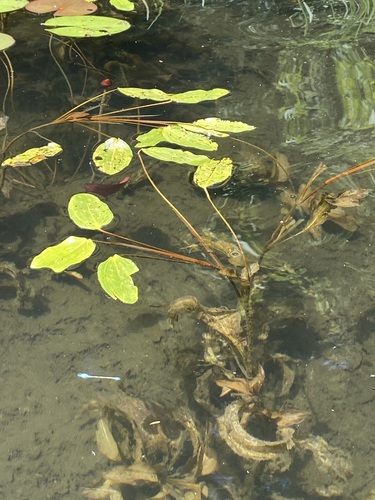
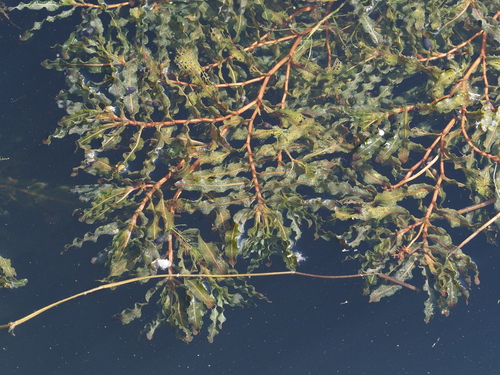
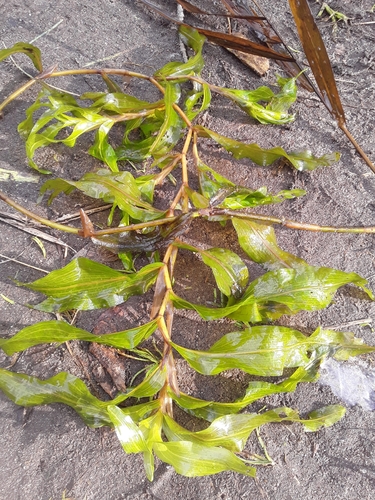
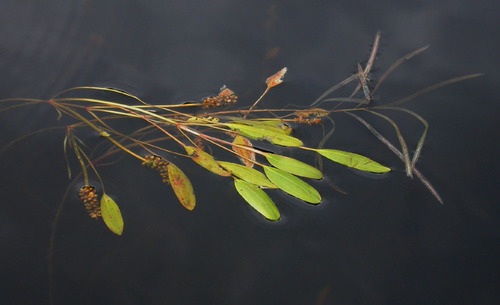
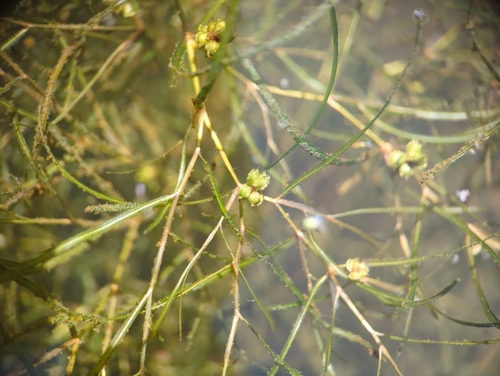
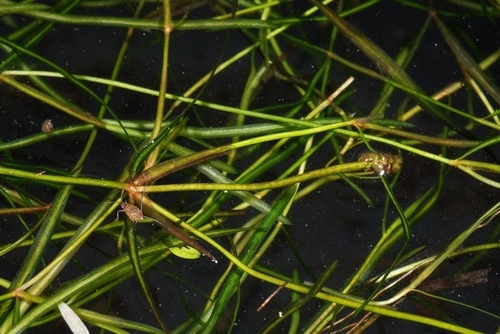
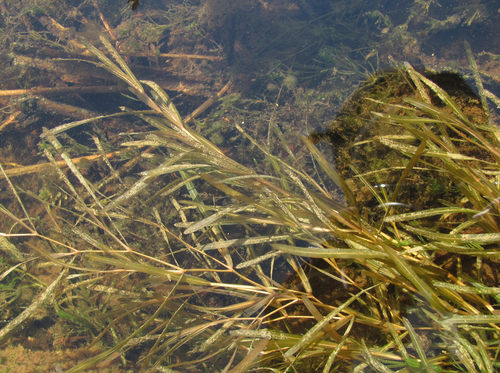
Potamogeton friesii Rupr., commonly called flat-stalked pondweed, is an annual plant that grows from turions and seed. It produces branching plants with slender, well-branched flattened stems. Its submerged leaves are long, grass-like, sessile, and translucent, with mucronate tips where the midrib extends beyond the main leaf blade, creating a distinctly pointed appearance. Abundant turions grow along the stem, especially in autumn as the rest of the plant breaks down. Within its native range, flat-stalked pondweed can be confused with other fine-leaved pondweeds, most often Potamogeton obtusifolius, and potentially also Potamogeton pusillus. It can be distinguished by a combination of open stipules, rounded leaf bases, dense flower spikes, and a tendency to form a thick bushy mat at the water surface, though use of a botanical key or flora is recommended for certain identification. Potamogeton friesii is diploid with 2n=26. Two naturally occurring hybrids of Potamogeton friesii have been described: P. × lintonii Fryer, a cross with P. crispus, and P. × pseudofriesii Dandy & G.Taylor, a cross with P. acutifolius. This species occurs predominantly in North America (Canada and the northern United States) and Europe (Scandinavia, Germany, Poland, the British Isles, northeastern and central France, Belarus, Ukraine, European Russia, the Pyrenees, and the Carpathians). Isolated populations are also found in southern Europe (Corsica, northern Italy, the Balkans) and in Asia (northern China, Russia, Japan, Kazakhstan, Tajikistan). In Britain, P. friesii grows in a range of still or slow-moving water habitats including ponds, ditches, canals, sluggish rivers, and shallow lakes, and it prefers calcareous waters. It is strictly a lowland species, and is tolerant of eutrophication, particularly in river environments. Like other fine-leaved pondweeds, P. friesii is thought to benefit from some level of disturbance to suppress competing vegetation. Flat-stalked pondweed has experienced local population declines across much of its range. It is thought to be extinct in the Czech Republic, and is listed as Endangered in Switzerland and Germany. It has undergone declines in Britain but remains widespread there; it was listed as Near Threatened in 2002, and a more recent assessment for England alone updated its status to Vulnerable, reflecting ongoing population decreases. In the Netherlands, by contrast, it is classified as Least Concern. Flat-stalked pondweed is not currently in cultivation. Its broad ecological tolerance suggests it would not be difficult to grow, but it likely requires a deeper substrate than that typically found in most ornamental ponds, and it would probably compete poorly with other common pond plants.