About Potamogeton epihydrus Raf.
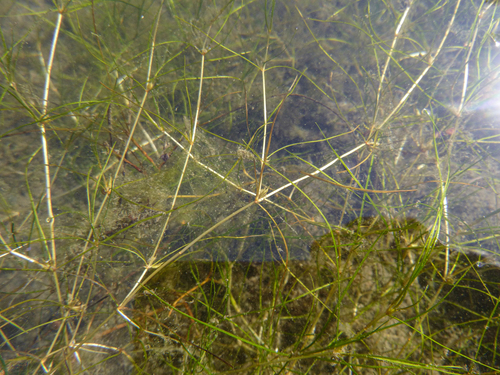
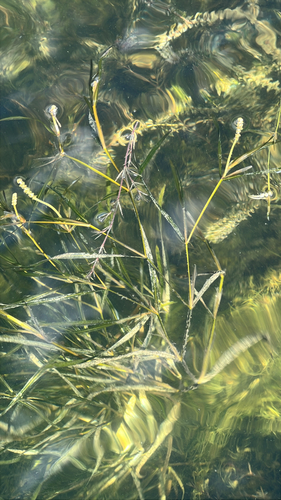
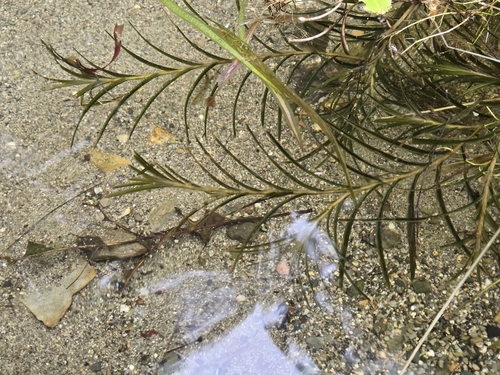
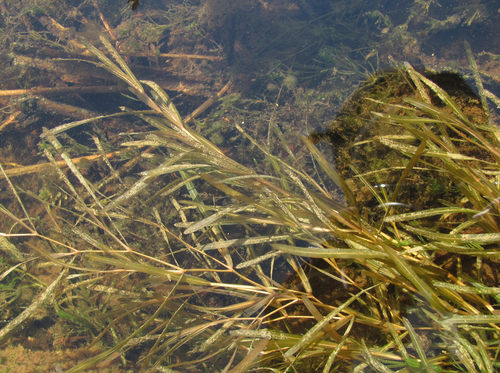
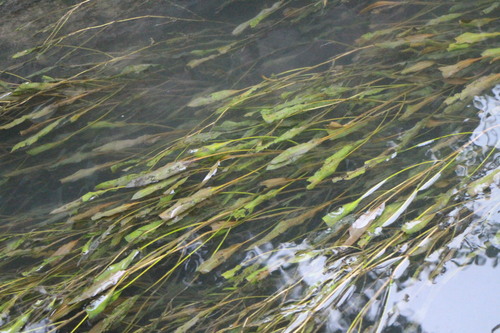
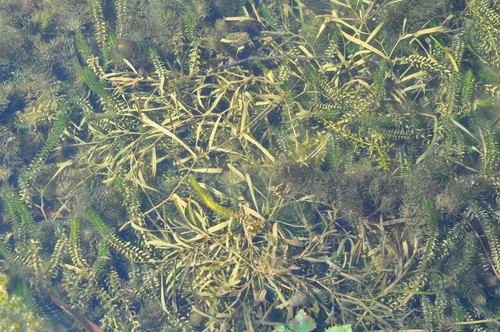
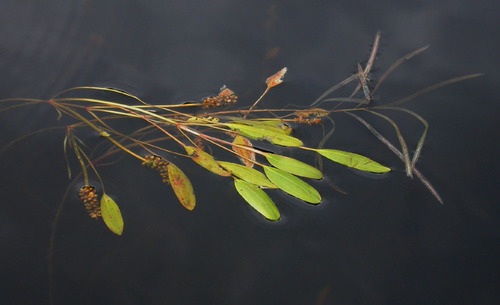
Potamogeton epihydrus Raf., commonly called ribbonleaf pondweed, is a perennial rhizomatous herb. It produces narrow, compressed, unspotted stems that reach around 1 meter in length, and are unbranched or only sparingly branched. This species produces two distinct types of leaves. Submersed leaves are sessile, 5–25 cm long and 0.1–1 cm wide; they are translucent, linear and ribbonlike, coloured red-brown to light green, with a blunt to acute tip. Floating leaves match the general form of floating leaves in other Potamogeton species; they are petiolate, opaque, and grow up to 8 cm long and 3 cm wide. The inflorescence is a small spike of flowers that emerges from the water on a peduncle 1.5–5 cm long, rarely reaching up to 16 cm. It is a diploid species with 2n = 26. Documented hybrids exist between this species and Potamogeton gramineus, P. nodosus (the hybrid is named P. × subsessilis Hagstrom), P. bicupulatus (the hybrid is named P. × aemulans Z. Kaplan, Hellq. and Fehrer), and P. perfoliatus (the hybrid is named P. × versicolor Z. Kaplan, Hellq. and Fehrer). Ribbonleaf pondweed is predominantly a North American species, widespread across boreal and temperate regions of the continent. Its main distribution centres are the northeastern United States; southeastern Canada, stretching from the Atlantic to the Great Lakes; and the Pacific seaboard from northern California to British Columbia. Scattered populations also occur in Alabama and Louisiana, Alaska, Wyoming, Montana and central Canada. There are two isolated populations in Britain, where the species was first identified as recently as 1944. One population in the Outer Hebrides is thought to be naturally occurring, while the other is an accidentally introduced population in the Rochdale and Calder & Hebble Canals. Ribbonleaf pondweed typically grows in shallow, standing to slow-flowing still or running waters, at altitudes up to 1900 m. It tolerates acidic waters as low as pH 5, and prefers oligotrophic, soft water conditions. Liming experiments indicate it is sensitive to severe acidification. Compared to many other aquatic plants found in Connecticut lakes, it is a poor disperser. It is generally common and widespread across North America, but it is listed as Endangered in Indiana and Special Concern in Tennessee. In Britain it is classified as Nationally Rare and listed as Vulnerable. British populations show no detectable genetic variation, which points to a strong founder effect. Potamogeton epihydrus is not currently in cultivation, but it is considered worth attempting to grow. Its relatively small size, ribbonlike underwater leaves and scattered floating leaves could be used effectively in garden ponds, tubs or streams. Introduced populations in Britain have not proven invasive, so there is low risk of it becoming problematic. Like other pondweeds, it must be planted with its root in contact with a suitable substrate such as aquatic compost.