About Potamogeton diversifolius Raf.
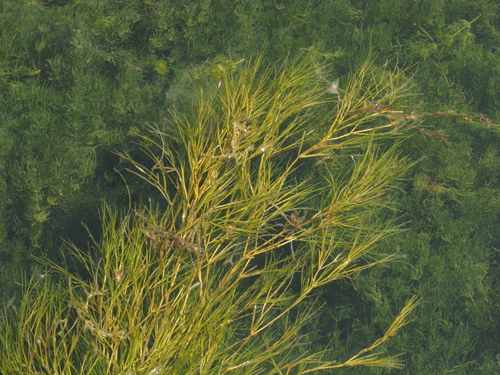
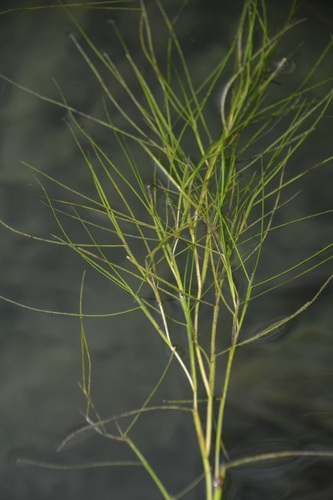
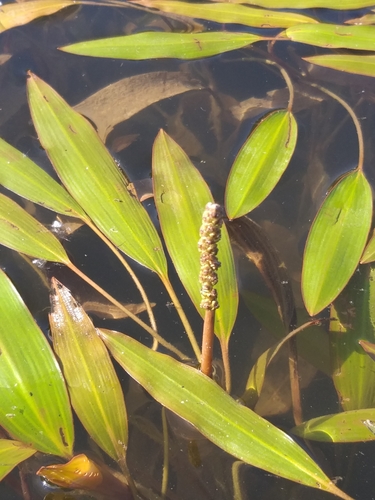
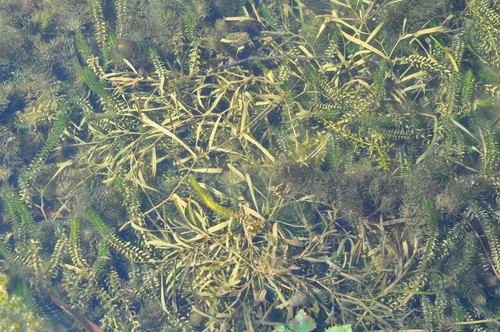
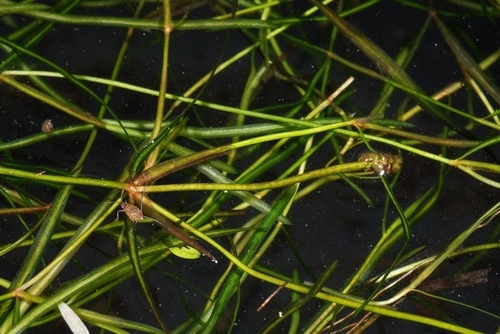
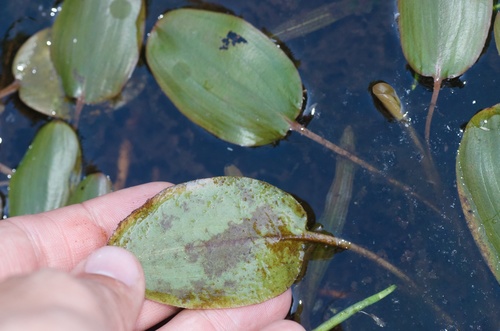
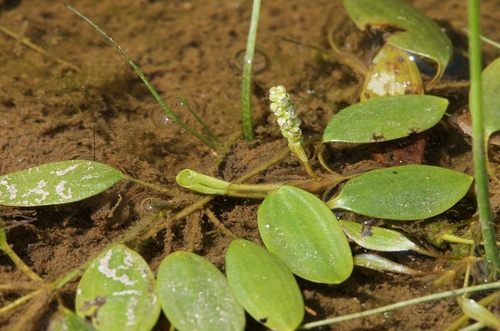
Potamogeton diversifolius Raf. is a vascular aquatic plant commonly called waterthread pondweed or diverse-leaved pondweed. Its accepted synonyms are Potamogeton capillaceus var. atripes, Potamogeton capillaceus, and Potamogeton diversifolius var. multidenticulatus. This perennial plant has dimorphic, thread-like leaves that are both floating and submerged. Floating leaves are elliptic to oval in outline, and usually have 7 to 11 distinct veins. Submerged leaves are smaller, arranged alternately, and usually only have 3 veins. Stipules located at the base of the petiole of submerged leaves form a sheath around the stem; these stipules are fused at the base of the leaf blade and measure 4 to 10 mm long. The whole plant is pale green, with an overall size range of 0.78 to 2.5 inches long and 0.02 to 0.06 inches wide. It has multi-branched stems that grow between 40 and 80 cm long. Its main stem is horizontal, thread-like, and cylindrical, with roots branching off it and rooting at the plant's nodes. Fruits are nearly disk-shaped, curve inward toward each other, usually have lateral keels, and measure 0.9 to 2.0 mm in diameter. Flowers are red, borne in dimorphic spikes, with between 1 and 15 flowers per inflorescence. Seeds form in clusters. Clusters of 1 to 15 seeds form on the stalks of submerged leaves. Cylindrical spikes on floating leaves, located in leaf axils, hold between 5 and 120 seeds. This species blooms and produces fruits from June through December. A combination of elliptical floating and submerged leaves and its distinctive vein pattern distinguishes it from other pondweed species. Potamogeton diversifolius grows in shallow freshwater bodies, including streams, ponds, shallow lake sections, still pools, and slow-moving water. It can grow in full sun or partial shade, in clay-like soil of newly excavated ditches, at elevations up to 2744 m. It is one of the most abundant and widely distributed pondweed species across North America, found across most of the United States (present in 43 US states, absent from New England states), northern Mexico, and Cuba. It is currently listed as an invasive species in Cuba. In an experiment examining fish predation, Potamogeton diversifolius was only found in fish-free enclosures. This species acts as a food source for at least approximately 124 animal species, and provides habitat for many micro- and macroinvertebrates. After the plant dies, its decomposition by bacteria and fungi creates food for invertebrates. Waterfowl eat its seeds, while fish and invertebrates eat its leaves. It also acts as a host for aquatic fungi. A study of game duck diet across 247 locations in the United States and Canada found that Potamogeton diversifolius made up 11.04% of the game ducks' total food. By region, P. diversifolius accounted for 11.73% of game duck diet on the Atlantic coast, 13.29% in the eastern US region, 6.06% in the Mississippi region, 3.99% on the US gulf coast, 16.29% in the western US region, 12.14% on the US Pacific coast, 12.73% in western Canada, and 12.47% in eastern Canada.