About Potamogeton crispus L.
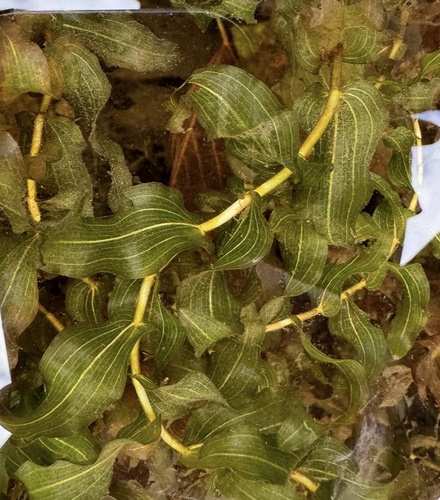
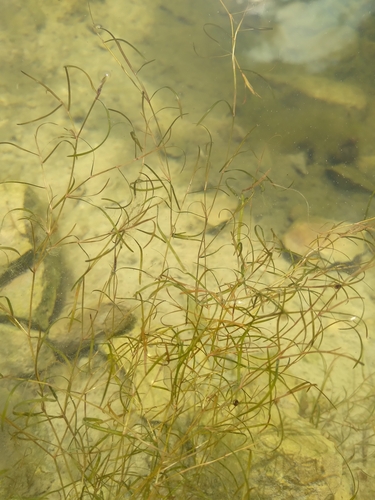
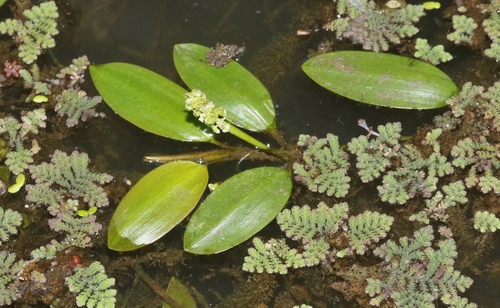
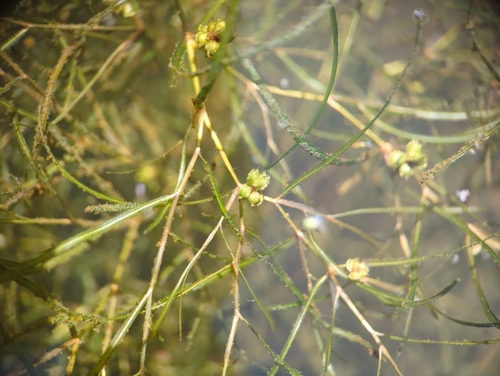
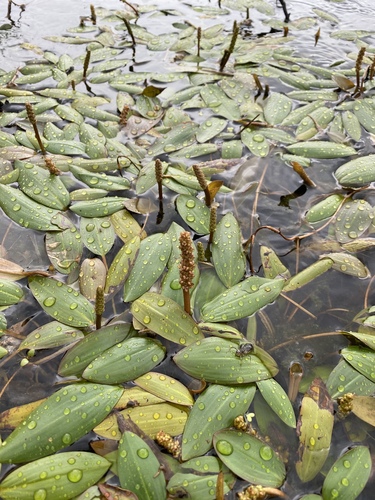
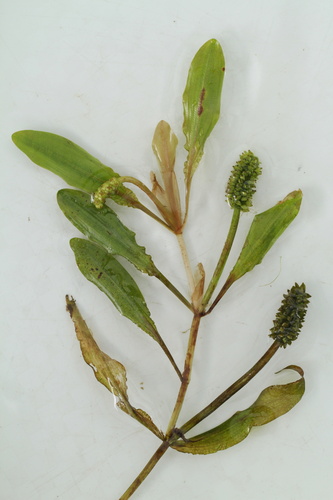
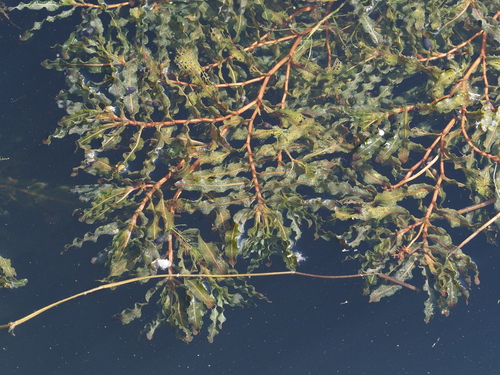
Curly-leaf pondweed (Potamogeton crispus L.) is a rhizomatous perennial herb that produces a flattened, branching stem up to 1 meter long. Its submerged leaves grow in an alternate arrangement. The leaves are sessile, shaped linear or oblong, and measure 25–95 millimeters (1–3+3⁄4 inches) long by 5–12 millimeters (3⁄16–15⁄32 inches) wide. Leaf color may be bright green or olive green; later in the growing season, leaves often become fibrous and brownish. All leaves have noticeably serrated margins, a feature that sets this species apart from other pondweeds. Leaves usually have wavy edges, though this trait is not always visible, especially on new growth. Turions form in leaf axils and at stem tips. The inflorescence is a short spike of flowers that emerges above the water surface, and flowering occurs from May to October. This plant's turions develop alongside its fruits, then germinate, and newly sprouted plants overwinter. While Potamogeton crispus is quite morphologically variable, it is usually easy to identify. Hybrids between P. crispus and various other pondweed species have been recorded, and these hybrids do not usually closely resemble the parent P. crispus. Documented hybrids include Potamogeton × bennettii Fryer (with P. trichoides), P. × cooperi (Fryer) Fryer (with P. perfoliatus), P. × olivaceus Baagøe ex G.Fisch. (with P. alpinus), P. × cadburyae Dandy & G.Taylor (with P. lucens), P. × undulatus Wolgf. (with P. praelongus), P. × jacobsii Z.Kaplan, Fehrer & Hellq. (with P. ochreatus), and P. × lintonii Fryer (with P. friesii). Potamogeton crispus is native to many countries across Asia, including Afghanistan, Bangladesh, Bhutan, China, India, Indonesia (Sumatra), Japan, Kazakhstan, Korea, Kyrgyzstan, Laos, Mongolia, Myanmar, Nepal, Pakistan, Russia, Tajikistan, Thailand, Turkmenistan, Uzbekistan, and Vietnam, as well as to Africa, the Middle East, Australia, and Europe. It has been introduced to the Americas and New Zealand. Within most of its native range, curly pondweed is widespread and common. It grows in standing and slow-flowing water such as small ponds and ditches. It is strictly a lowland plant that requires fine substrates in standing or slow-flowing calcareous water. However, it is tolerant of significant nutrient pollution, which has allowed it to persist in intensively farmed areas where more sensitive pondweed species have declined. Its ability to produce both seed and turions makes it relatively resistant to disturbance such as dredging, unlike some larger broad-leaved pondweeds. Even so, cutting the plant down to the sediment surface early in the growing season may reduce turion production. Potamogeton crispus is sometimes cultivated as a pond plant, and generally works well as a garden pond plant. Because it begins to die back rather early in the season, it is recommended to cut it back in July after it has finished flowering. Like other pondweeds in this group, it roots poorly from stem cuttings, so it is best propagated by dividing rhizomes or planting turions. Since this species has proven invasive in some regions, curly pondweed should not be grown outside of its native range.