About Potamogeton compressus L.
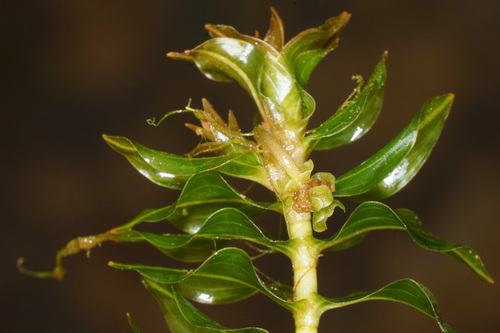
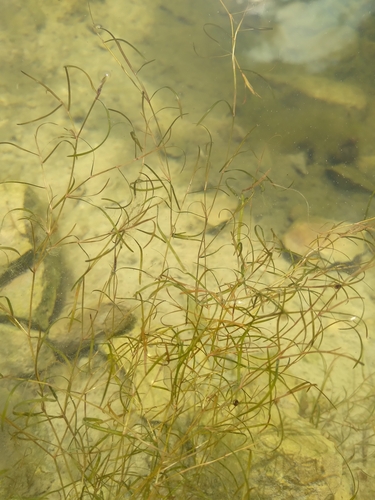
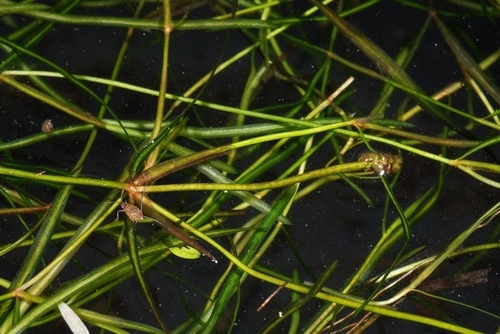
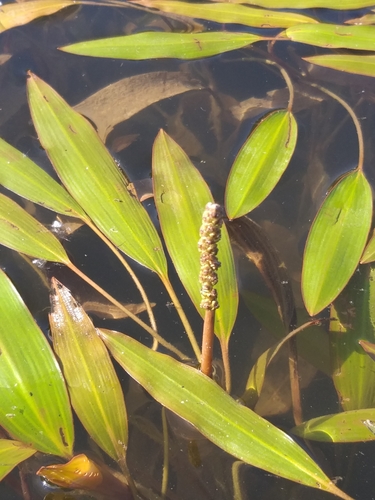
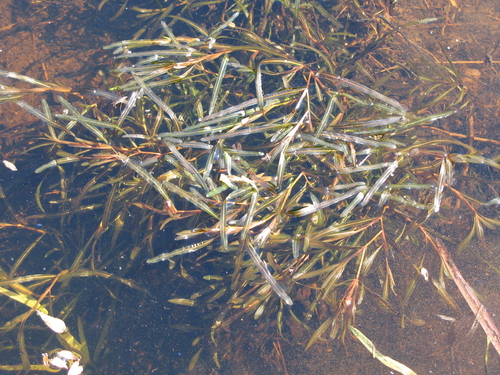
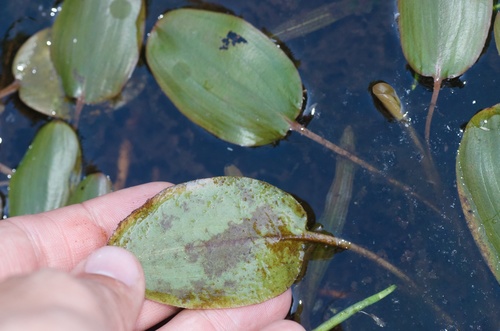
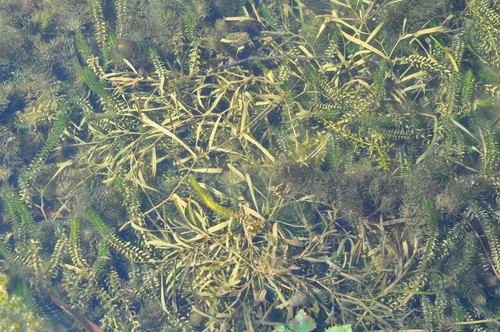
Potamogeton compressus L., commonly called grass-wrack pondweed, produces a strongly flattened, robust, branching stem reaching a maximum length of 90 cm. It grows annually from turions and seed, forming bushy plants that branch near the water surface. Its leaves are long, grass-like, 85–240 mm long and 3–6 mm wide, and colored olive-green or dark green, sometimes with a reddish tinge near the surface. Each leaf has two veins on either side of the midrib and ends in a blunt point. Unlike the transparent leaves of most pondweeds, P. compressus leaves look rather opaque, due to the presence of fibrous sclerenchymatous strands. This species has no rhizomes and no floating leaves. Its inflorescences are up to 6 mm long, bearing 4–6 flowers, on a short peduncle 5–20 mm long, which occasionally grows longer. The fruits measure 3.1–4 mm by 2.1–3 mm.
Grass-wrack pondweed is relatively easily distinguished from most other pondweeds by the combination of its strongly flattened stems and sclerenchymatous strands in the leaves. In Europe, it resembles P. acutifolius, but P. acutifolius has sharply pointed leaves, a less branched growth habit, and flower spikes with only 2–6 flowers on peduncles up to 20 mm long. In the Far East, P. mandschuriensis is a smaller plant overall, with leaves 1.5–2.3 mm wide, 8–14 sclerenchymatous strands, stems 0.8–1.5 mm wide, and fruits 2.8–3.8 mm in diameter.
P. compressus is a diploid species with 2n=28. Hybrids have been recorded with P. acutifolius (P. × bambergensis Fischer), P. oxyphyllus (P. × faurei Miki) and P. trichoides (P. × ripoides Baagøe). P. × bambergensis may be reasonably common where the two parent species coexist, but like many fine-leaved pondweed hybrids, it is difficult to identify reliably without genetic techniques.
This species is native to Europe (including Austria, Britain, Denmark, Finland, France, Germany, Ireland, Netherlands, Poland, Russia, Spain, Sweden, Switzerland, Ukraine) and Asia (including China’s Yunnan province, Japan, Kazakhstan, Mongolia, Russia). In North America, P. compressus / zosteriformis occurs in northern USA and Canada. Isolated populations are found in the Balkans, Oregon and the Rockies. There is considerable uncertainty about the exact distribution of this species in Siberia and Canada.
Grass-wrack pondweed grows in still or slow-flowing, lowland, calcareous, often nutrient-rich water bodies, such as river backwaters, ponds, and slow-moving streams. It usually grows on fine substrates including sand, silt, clay or peat, and is typically found in water less than 1.5 m deep, though Japanese populations have been recorded growing in 5 m of water. It can also colonize artificial habitats such as canals and drainage ditches, as long as these are not heavily used by boating. Grass-wrack pondweed is intolerant of turbid water and prefers some shade. Like its close relative Potamogeton acutifolius, it rarely grows in lakes; its shallow root system cannot tolerate disturbance, making it vulnerable to wind action, boat disturbance, and uprooting by fish.
P. compressus is a rather early succession species that tends to be outcompeted unless its habitat is regularly disturbed, so its populations are often transient. Most wild reproduction appears to be asexual via turions, which likely means populations have limited ability to recolonize if they are lost. Turion production is not prolific, with wild plants typically producing only 4–5 turions. Flowering and fruiting occurs more often in shallow water environments with fluctuating water levels, such as ditches.
Grass-wrack pondweed is threatened across many parts of its range, especially in Europe: it is Extinct in the Czech Republic, Critically Endangered in Flanders, Endangered in Germany and England, Vulnerable in the Carpathian region and Wales, and Near Threatened in the Netherlands. In North America it is listed as Endangered in Maryland and New Jersey, Threatened in New Hampshire, and Rare in Pennsylvania. In Britain, P. compressus is a Biodiversity Action Plan priority species and is the target of conservation action including translocation efforts.
These population declines probably reflect widespread damage to lowland riverine landscapes across Europe, particularly the loss of features like back channels, oxbow lakes and floodplain ponds when rivers are channelised and engineered for flood defence and agricultural purposes. The largest British populations grow in disused or rarely boated canals, which cannot act as the species’ primary habitat and do not provide a sustainable long-term habitat. However, in the short term, canal populations act as an important reservoir for the species. Competition with introduced Elodea canadensis (Canadian pondweed) and E. nuttallii (Nuttall's water-thyme) may also threaten populations. It is possible that the widespread reintroduction of beaver across Europe may help stop or reverse the decline of grass-wrack pondweed, as beaver ponds may provide suitable habitat for this species.
Potamogeton compressus is not currently in cultivation. It could likely be cultivated in silty ponds, as long as these are regularly cleaned out to prevent more competitive plants from excluding it. Cultivation experiments conducted for conservation purposes have successfully grown plants to maturity from turions planted in late winter, but adult plants are more difficult to establish due to their limited root system and fragile structure. High mortality was also observed in cultivation due to snail predation.