About Potamogeton cheesemanii A.Benn.
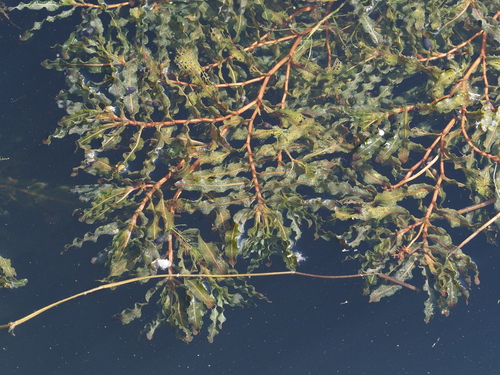
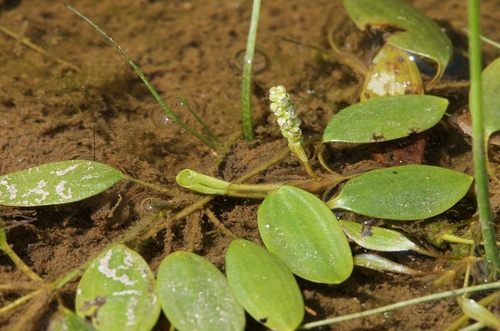
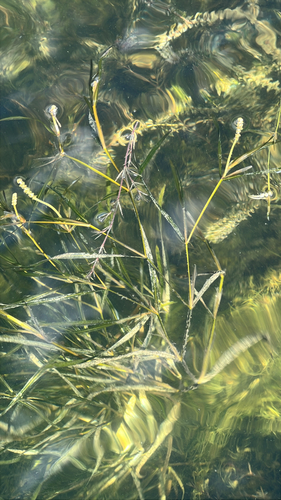
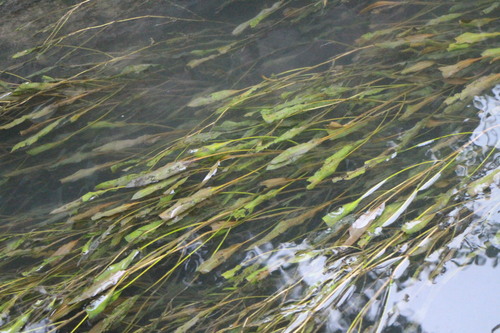
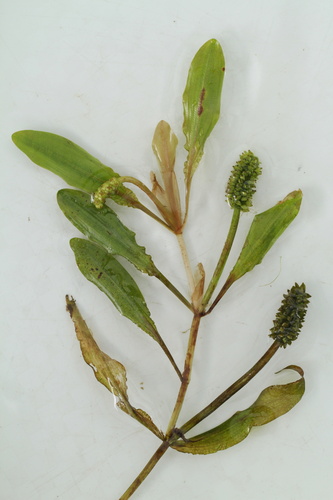
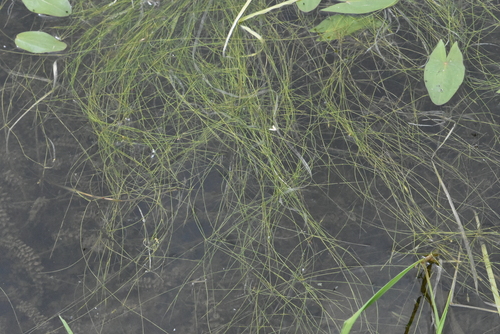
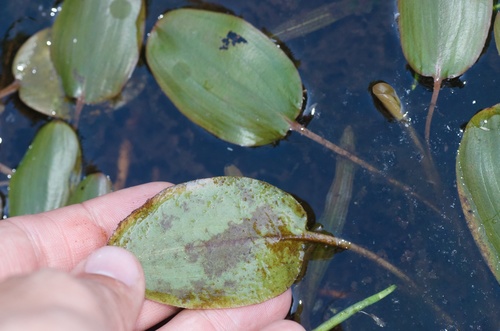
Potamogeton cheesemanii A.Benn. has rhizomes that root at nodes, producing long branches that bear few leaves. This species produces two distinct leaf forms: submerged leaves are longer and translucent, while floating leaves are oval and opaque. Its flowers are arranged in a dense spike that floats on the water surface, though the spike submerges once fruiting begins. Flowers can be cream, red, or pink. This species flowers from November to February and fruits from December to March. It can be distinguished from Potamogeton suboblongus by its two distinct leaf forms, and from Potamogeton ochreatus by its well-separated longitudinal leaf nerves. The total biomass of this plant changes with the seasons: it has less biomass in winter than in summer and spring. While it is naturally height-restricted, it is still one of the tallest species found in native hydrophyte communities. This species occurs across New Zealand, on all major islands including the Chatham Islands, and on some minor islands such as Great Barrier Island. It also grows in southern Australia and Tasmania, though at least one taxonomic authority considers the species to be endemic to New Zealand. Macrofossils of Potamogeton cheesemanii seeds dating to the Aranuian era, approximately 14,000 to 10,000 years before present, have been found in Canterbury, New Zealand. Potamogeton cheesemanii grows in slow-moving rivers, ponds, lakes, and ditches, ranging from coastal areas up to montane zones. It can grow in tarns at elevations of at least 1000 m. Ecologically, one study records that Potamogeton cheesemanii supports fewer macroinvertebrate communities than other native hydrophytes, though it is still associated with some such communities. When grass carp are introduced to control pond weeds, the carp will eat P. cheesemanii but generally prefer other plant species. Multiple dragonfly species lay their eggs on the leaves of this plant.