About Potamogeton berchtoldii Fieber
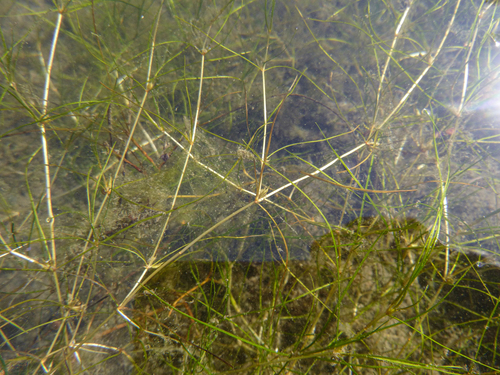
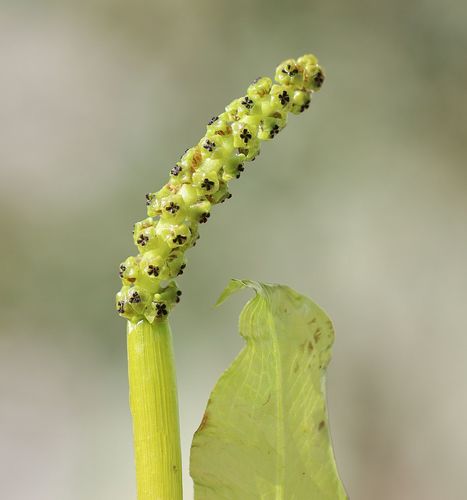
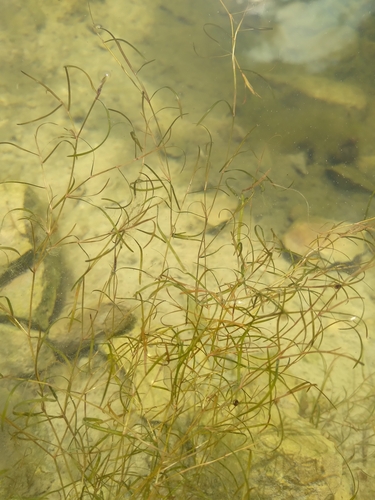
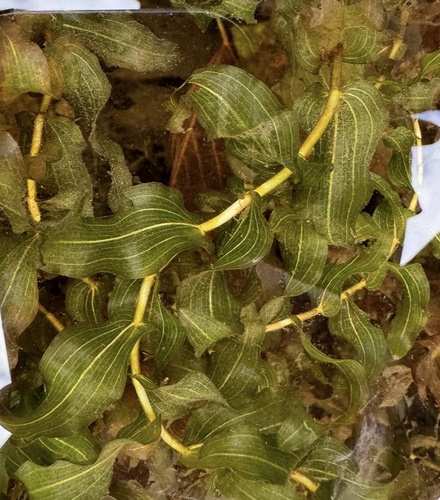
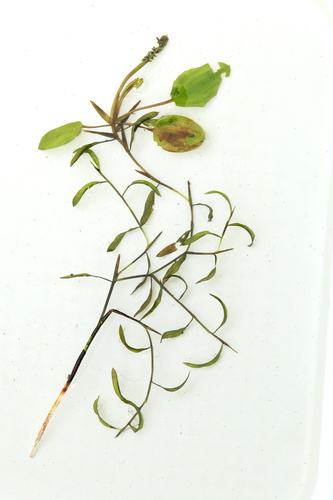
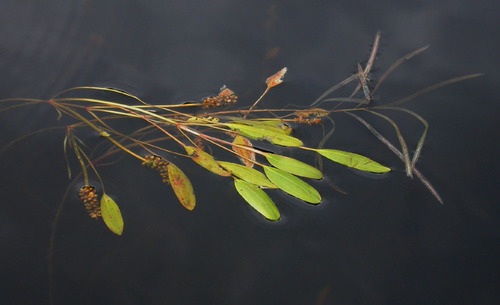
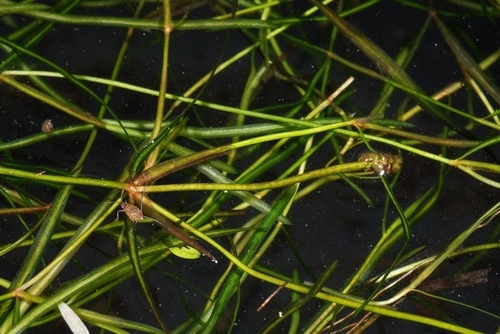
Potamogeton berchtoldii Fieber, commonly called small pondweed, is a fine-leaved pondweed that grows in a bushy habit. It does not produce a perennial rhizome; entire plants die back over winter, leaving behind numerous resting buds called turions. Its stems are very slender and typically do not grow longer than 60 cm. Its leaves are flat, usually between 25 and 50 mm long and less than 2 mm wide. Most leaves have a broad band of lacunae along each side of the midrib, and leaf color ranges from pale green, olive green to brownish green. Open stipules and shining nodal glands are key identifying features for this species. Small pondweed closely resembles many other Potamogeton species, particularly P. pusillus, so using a reliable identification key such as the one published by Preston (1995) is strongly recommended. It can also be confused with P. trichoides and P. obtusifolius. This species is native to Europe, including Britain, Ireland, continental Europe and Scandinavia, Asia Minor, the Middle East including Iraq, Iran and Turkey, North America including Canada and the United States, and Asia including Bhutan, China, Japan, Kazakhstan, Korea, Tajikistan, Turkmenistan, Russia and Uzbekistan. Potamogeton berchtoldii has broad ecological tolerance, and grows in lakes, ponds, ditches, slow-flowing streams and rivers, and temporary pools. It sometimes grows in artificial environments such as cattle troughs. It is an effective colonizer that can quickly take advantage of new habitats. Its production of large numbers of both turions and seeds is likely what allows it to rapidly exploit new or disturbed environments, though it is usually outcompeted by more robust plant species in stable environments. In Britain, small pondweed is common and widespread. It is likely under-recorded, due to its small size and frequent confusion with P. pusillus. While it does not grow in highly acidic environments, it is tolerant of a wide range of other water chemistries and can survive in eutrophic conditions. However, it is less tolerant of high nutrient levels than the closely related, very similar P. pusillus. It is the only fine-leaved pondweed in Britain that is commonly found in oligotrophic lakes, where it generally grows in deeper water alongside Isoetes and Nitella species. Small pondweed is not intentionally cultivated, though it often spontaneously colonizes new ponds, most likely spread by waterfowl. It usually does not persist long in this created environment unless competing plants are regularly removed. Its small size and noninvasive growth habit make it suitable for growing in ponds or aquariums.