About Potamogeton alpinus Balb.
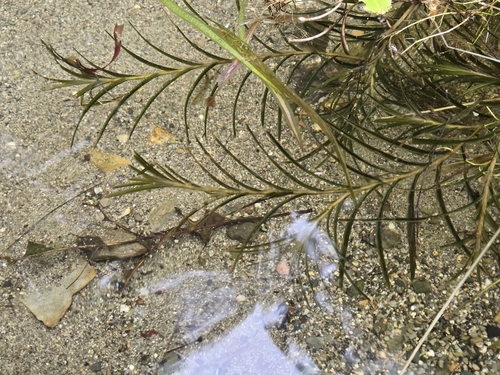
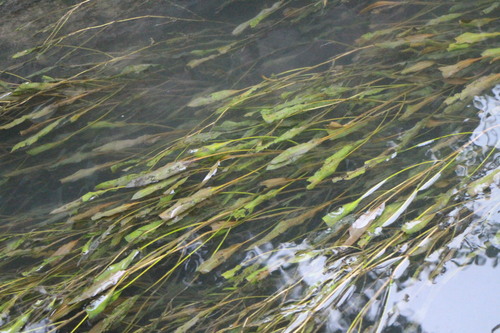
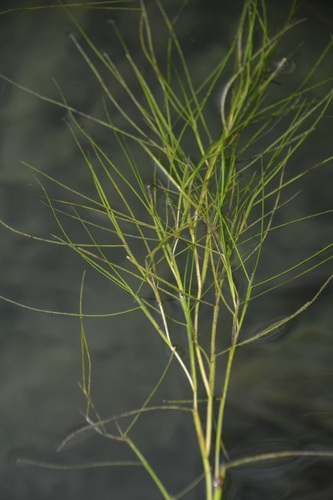
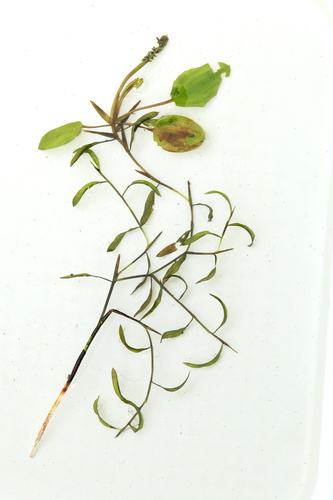
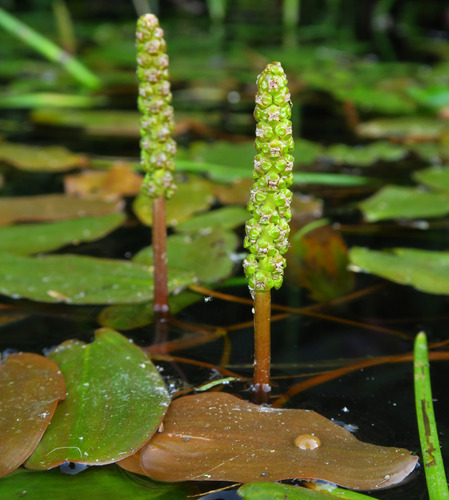
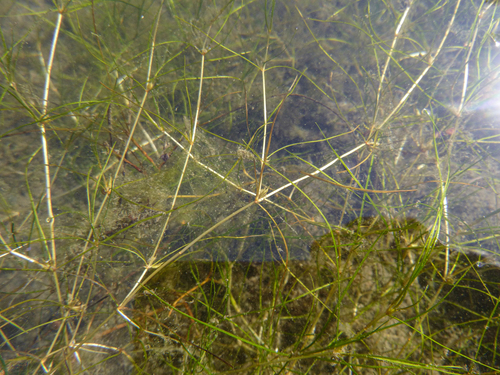
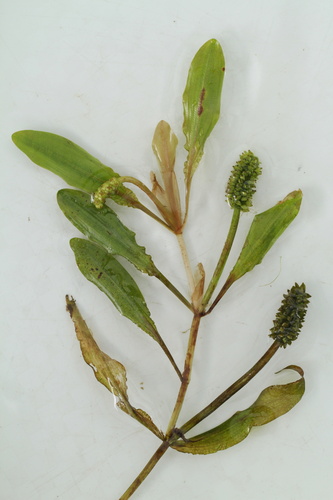
Red pondweed (Potamogeton alpinus Balb.) is a perennial herb that anchors into mud substrates via a creeping rhizome. It grows an unbranched cylindrical stem that can reach up to 2.8 meters in length. Its submerged leaves are sessile, lance-shaped, and typically measure 70–180 mm long by 10–25 mm wide. These leaves have 4–7 lateral veins on each side, untoothed margins, and a slightly hooded apex. This species may also produce floating leaves. Its inflorescence is a flower spike that rises above the water surface, reaching a few centimeters in length. True turions are absent, but each stem dies back in winter to a resting bud with a short section of root, which functions like a turion. Red pondweed is generally quite distinctive and not easily confused with other pondweeds. Early in the growing season, it may be misidentified as Potamogeton polygonifolius, but P. polygonifolius has petiolate, relatively longer submerged leaves. Potamogeton praelongus is generally greener, with noticeably white zig-zagged stems that usually branch, never produces floating leaves, and has submerged leaves that clasp the stem. Fresh red pondweed specimens often, but not always, have a reddish tint that becomes far more prominent when the plant is dried. Contrary to its name, it is not restricted to alpine regions, nor is it the only pondweed with reddish colouration. Like most other broad-leaved pondweeds, Potamogeton alpinus is tetraploid, with a chromosome count of 2n=52. Documented hybrids exist between P. alpinus and P. crispus (P. × olivaceus Baagøe ex G.Fisch.), P. gramineus (P. × nericius Hagstr.), P. natans (P. × exilis Z.Kaplan & Uotila), P. nodosus (P. × argutulus Hagstr.), P. lucens (P. × nerviger Wolfg.), P. perfoliatus (P. × prussicus Hagstr.), P. polygonifolius (P. × spathulatus Schrad. ex W.D.J.Koch & Ziz), and P. praelongus (P. × griffithii A. Benn.). All these hybrids are quite rare, but can be locally abundant and long-lived where they do occur. Red pondweed is native to most of the Northern Hemisphere. Its confirmed native distribution includes Asia (Afghanistan, China (Heilongjiang), India (Assam), Japan, Kazakhstan, Korea, Myanmar, Pakistan, Russia, Uzbekistan), Europe (Austria, Belgium, Britain, Denmark, Estonia, France including Corsica, Germany, Ireland, Iceland, Latvia, Lithuania, Netherlands, Norway, Poland, Spain (Pyrenees), Sweden, Switzerland), Greenland, Canada, and the northern United States, particularly the Rocky Mountains. Potamogeton alpinus usually grows in neutral to mildly acid water bodies that are not very base-poor, including lakes, slow rivers, streams, and ponds. It requires a deep, fine substrate such as sand, silt or peat for rooting, and tends to avoid exposed locations. It is mostly restricted to fairly nutrient-poor waters. In European rivers, it is associated with high-quality aquatic environments. A large-scale study of plant communities across 3447 British lakes found red pondweed in 169 of these, and it showed a preference for circumneutral, moderate alkalinity lakes. Unlike other broad-leaved pondweeds, red pondweed stolons die back in winter, leaving clusters of rooted resting buds in the substrate that regrow the following spring. In rivers, red pondweed can persist entirely through asexual reproduction, via rooting of stem fragments and turion-like resting bodies, though this pattern may result from weed cutting that suppresses flowering and seed set. In Britain, P. alpinus has declined sharply, especially in the southern part of the country, though it still occurs across the whole of Britain. In Wales, red pondweed was recently assessed as Critically Endangered, and it is categorized as Vulnerable in England. Declines have also been recorded across other parts of Europe and North America: it is Regionally Extinct in Luxembourg and Pennsylvania, Critically Endangered in Spain, Vulnerable in Germany and the Netherlands, Endangered in the Czech Republic, the Carpathian region, Flanders and New Jersey, and threatened in New Hampshire and New York. These declines are likely linked to a combination of eutrophication, pond infilling, and river canalization. It remains widespread in Scotland and Ireland, and is presumed widespread in other sparsely populated parts of its range such as Canada, Scandinavia and Siberia. Red pondweed is part of the so-called Magnopotamion group of pondweeds, which are a characteristic floristic component of the protected Habitats Directive habitat Type 'Natural eutrophic lakes with Magnopotamion'. Potamogeton alpinus is not widely cultivated, and appears to be rather difficult to maintain, as it competes poorly with other pond plants. This difficulty may be related to its preference for a deep fine substrate. Like other pondweeds in this group, it roots poorly from stem cuttings, and is best propagated through division of its rhizomes.